Podcast on Spotify
Follow the latest updates on E-Invoicing and Real Time Reporting on www.vatupdate.com and the LinkedIn pages on E-Invoicing/Real Time Reporting and ViDA.
HIGHLIGHTS OF WEEKS 3/2026
NEW COLLECTION – Briefing documents & Podcasts – Country Profiles on E-Invoicing, E-Reporting, E-Transport, SAF-T Mandates, and ViDA Initiatives
Chile – Implementation of Centralized Digital Signature for Electronic Receipts by SII
- Implementation of Centralized Digital Signature: The SII (Servicio de Impuestos Internos) has established a centralized digital signature system for certifying electronic receipts and exempt electronic receipts issued through its free electronic receipt issuance system, enhancing authenticity and security for taxpayers.
- Facilitation of Electronic Procedures: The centralized digital signature allows registered taxpayers to easily request electronic folios and electronically sign their tax documents, such as electronic receipts and credit notes, streamlining compliance with tax regulations.
- Consequences for Non-compliance: The SII reserves the right to exclude taxpayers who undermine or obstruct the normal operation of the electronic receipt system, with potential sanctions applicable under the Tax Code for any violations.
Germany Updates E-Invoicing FAQ: New Clarifications on Transmission and Compliance for 2025
- The Federal Ministry of Finance in early November 2025 published an updated frequently asked question (FAQ) on mandatory electronic invoicing (e-invoicing) effective January 1, 2025.
- The updated version retains core definitions and timelines but introduces key clarifications on transmission channels and compliance requirements.
Malaysia Delays Mandatory E-Invoicing for RM1m–RM5m Businesses to 2027, Expands Sector Coverage
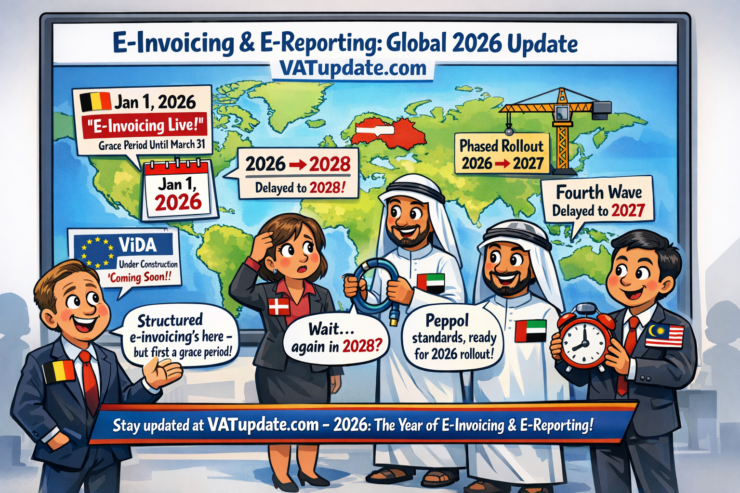
- Malaysia has postponed mandatory e-invoicing for businesses with RM1m–RM5m turnover to 1 January 2027, with an extended penalty-free transition period.
- The exemption threshold was raised to RM1 million, removing smaller businesses from the mandatory scope and cancelling the RM500k–RM1m rollout.
- Larger taxpayers remain on the original timeline, with no changes to their obligations.
- Consolidated e-invoicing will expand to include the retail and building materials sectors.
- The phased rollout continues, giving smaller and mid-sized businesses more preparation time.
North Macedonia Pilots Mandatory B2B e-Invoicing, Full Rollout Planned for October 2026
- North Macedonia is piloting a mandatory B2B e-invoicing system (e-Faktura) starting January 2026, with full implementation for all businesses in October 2026.
- All B2B invoices must be validated and coded by the tax authority’s central platform before being legally issued, replacing traditional invoice methods.
- The system follows a Continuous Transaction Control (CTC) model, giving the government real-time visibility of transactions and stronger VAT fraud prevention.
- Businesses will need to connect their accounting systems directly to the tax authority’s platform.
- The reform may require future adjustments to align with EU standards, as North Macedonia’s model differs from the EU’s preferred approach.
Philippines Extends E-Invoicing Compliance Deadline for Large Taxpayers to December 31, 2026
- The Philippines has extended the electronic invoicing compliance deadline to December 31, 2026.
- The extension applies to large taxpayers and e-commerce companies.
- These entities must update their systems to meet BIR’s technical and control standards for electronic invoicing.
Poland – Entrepreneurs will NOT be punished for not joining the KSeF in 2026
- Phased Implementation: The National e-Invoicing System (KSeF) will be launched on February 1, 2026, starting with companies whose turnover exceeded PLN 200 million in 2024. Smaller companies will be required to join by April 1, 2026, while micro-entrepreneurs with monthly sales under PLN 10,000 will have a transitional period until December 2026.
- No Penalties Initially: In 2026, entrepreneurs will not face penalties for not joining KSeF or for mistakes related to the system, as confirmed by the Deputy Minister of Finance. This approach aims to facilitate a smooth transition into the new invoicing system.
- Error Reduction and Support Measures: The e-Invoicing system is designed to minimize errors in issued documents and will include features like offline invoice generation and QR codes for confirmation. Additionally, tax offices will hold open days and extended hours to assist businesses in adapting to the new system before its implementation.
Romania Clarifies 2026 E-Invoicing Rules: Unified Deadlines and New Registration for Individuals
- From January 1, 2026, Romania changes the e-invoice submission deadline to 5 working days for RO e-Factura.
- Invoices issued up to December 31, 2025, must still be submitted within 5 calendar days, even if their deadline falls in 2026.
- The new 5 working day rule applies only to invoices issued from January 1, 2026, onward.
- There is a clear legal cut-off: 2025 invoices follow the old rule (calendar days), 2026 invoices follow the new rule (working days).
- This distinction prevents retroactive penalties and legal uncertainty for companies.
Belgium
- Belgium Grants Three-Month Tolerance Period for Mandatory E-Invoicing Starting January 2026
- Belgian Businesses Struggle With VAT Filings Due to E-Invoicing Issues, Accountants Request Extension
Cabo Verde
Chile
Croatia
France
Germany
Greece
- Data on a Greek E-Invoice vs. Data Reported to myDATA (Tax Authority) – Key Differences
- Briefing Document & Podcast – Greece E‑Invoicing, E‑Reporting, and E‑Transport: Scope, Timeline & Requirements
Kazakhstan
Kenya
Malaysia
New Zealand
North Macedonia
- Briefing Document & Podcast: E-Invoicing & E-Reporting in North Macedonia
- North Macedonia Pilots Mandatory B2B e-Invoicing, Full Rollout Planned for October 2026
Philippines
Poland
- Smallest VAT Payers Face No Grace Period for KSeF Compliance Starting January 2027
- Press Conference on Launch of National e-Invoicing System (KSeF) and Its Implementation Steps
- Finance Ministry Confirms KSeF Launch Dates; No Delays, No Penalties in 2026
- Poland KSeF 2.0 Go-Live and Key E-Invoicing Dates for Taxpayers in 2026
- Unclear KSeF Regulations: Will We Need to Invoice the Same Sale Twice from February 2026?
- KSeF 2026: Key Rules, Authorizations, Authentication, Technical Requirements for Poland’s e-Invoicing System
- Mandatory KSeF for Transactions with Local Government Units: Invoicing Rules and Ministry Clarifications
- Transaction Confirmation in KSeF: Voluntary Option and Documents for ONLINE, OFFLINE, and Emergency Modes
- Notification now required for Invoices with attachments in KSeF 2.0
- VAT Deduction Allowed from Invoices Issued Outside KSeF, If Standard Conditions Are Met
- Phantom Invoices in KSeF: Prof. Modzelewski Warns of VAT Document Confusion in 2026
- Reminder: KSeF Environment Address Changes and Migration Deadlines for Integrators in 2026
- How KSeF Will Transform Tax Audits: Benefits, Risks, and How to Prepare
- No Need to Issue Structured Invoices in KSeF for Certain Transactions from February 2026, New Regulation
- KSeF Implementation: How Prepared Are Entrepreneurs and What Concerns Do They Have?
- Mandatory KSeF for Transactions with Local Governments: Invoicing Rules and Ministry Clarifications for 2026
- Mandatory KSeF Launches February 2026: Many Small Businesses May Not Be Ready in Time
- Date in Field P_1 Is Invoice Issue Date and Tax Point, Not KSeF Creation Date
- KSeF 2.0: Key 2026-2027 Deadlines for Polish Retailers and Cash Register Invoicing
- How to Correct Structured Invoices in KSeF Issued with Incorrect Buyer NIP After February 2026
- KSeF 2026: Key Rules for E-Invoicing, Authorizations, Authentication, Technical Requirements, and Deadlines
- No Need to Issue Structured Invoices in KSeF for These Transactions from 2026 – New Regulation Announced
- Corrective Invoices in KSeF 2026: New Rules and Required Information for Issuing
- Open Days and Extended Hours for National e-Invoice System at Tax Offices in January 2026
- KSeF Implementation: New VAT Reporting, Invoice Continuity, and KKS Compliance from February 2026
- Entrepreneurs will NOT be punished for not joining the KSeF in 2026
- ePUAP, e-Delivery and the transitional period: how to effectively correspond with courts and the tax authorities in 2026
- Corrections in KSeF: Farewell to the “yellow folder” and welcome to the era of ID
Portugal
Romania
- Romania Updates RO e-Factura Rules for 2026: Expanded Scope, Easier Deadlines, Less Compliance Burden
- Romania: New 2026 RO e-Factura Deadlines—Calendar vs. Working Days Explained
- Romania Clarifies 2026 E-Invoicing Rules: Unified Deadlines and New Registration for Individuals
- Key Amendments to Romania’s Fiscal Code: RO e-Invoice and e-VAT System Updates, December 2025
Serbia
Slovakia
- Slovakia Issues Guide on VAT Act Amendments, Mandating E-Invoicing and New VAT Payment Rules
- Information on Amendments to the VAT Act Effective from 2027 and 2030 in Slovakia
- Slovakia publishes accreditation requirements for service providers
- Slovakia Issues Guidance on 2026 VAT Act Amendments Covering Group Registration, E-Invoicing, Deductions
Spain
Tunisia
- Briefing document & Podcast: E-Invoicing & E-Reporting in Tunisia
- Tunisia Expands E-Invoicing to Services; Flexible Implementation Measures Announced for 2026
- Tunisia Expands Mandatory E-Invoicing to All VAT-Service Transactions from January 2026
Turkey
Ukraine
United Arab Emirates
- How UAE E-Invoicing Will Transform VAT and Corporate Tax Compliance: Key Insights and Readiness Steps
- Everything You Need to Know About E-Invoicing in the UAE
Uruguay
Webinars / Events
World
- Advancing Global VAT Policy: Digital Transformation, E-Commerce, and Innovation at the 2026 OECD Forum
- 52 Country Profiles on E-Invoicing, E-Reporting, E-Transport, SAF-T Mandates, and ViDA Initiatives
- E–invoicing Developments Tracker
- OECD Issues Guidance on Digital VAT Transaction Reporting to Promote Global Standardisation and Compliance
- OECD Releases Guidance on Digital Transactional Reporting Systems for VAT Compliance and Administration
- OECD Releases Guidance on Digital Continuous Transactional Reporting for VAT: Policy and Design Considerations
- OECD Issues Guidance on Digital Continuous Transactional Reporting Regimes for VAT Compliance and Administration
- E-Invoicing & E-Reporting developments in the news in week 2/2026
- E-Invoicing & E-Reporting developments in the news in week 2/2026
- OECD Guidance for Effective and Interoperable VAT E-Invoicing and E-Reporting Regimes
- Belgium: Risk of Identity Fraud with Mandatory E-Invoicing via Peppol
- Burkina Faso Mandates Certified E-Invoicing for VAT Transactions from July 2026
- Gambia proposes mandatory e-invoicing in 2026 budget
- Algeria Delays Mandatory E-Invoicing to 2027 Amid Regulatory Uncertainty and Technical Challenges
- E-Invoicing & E-Reporting developments in the news in week 1/2026
- Pre-Filled VAT Returns in Europe: Current Landscape and Future Plans
- Germany Launches GEBA: New Voluntary Peppol Addressing Standard for Digital Business Transactions
- Malaysia Postpones Mandatory E-Invoicing for All Businesses to July 2026, Phased Rollout Planned
- Spain: Draft Law to Implement First Phase of EU’s VAT in the Digital Age (ViDA) Directive
- E-Invoicing & E-Reporting developments in the news in week 50 & 51/2025
-
- France Removes E-Invoicing Grace Period: Penalties Apply From 2026 Under Finance Bill 2026
- Kazakhstan extends Digital VAT pilot project until end of 2026 – VATupdate
- Malaysia Raises e-Invoicing Exemption Threshold to RM1 Million: Key Changes for 2026 Rollout
- Oman’s Fawtara: Phased Rollout of Mandatory B2B E-Invoicing Begins August 2026
- Poland: Regulation on KSeF 2.0 Exemptions Officially Published
- Serbia Postpones Preliminary VAT Return Requirement to January 2027
- UAE Introduces E-Invoicing Penalties and Tightens VAT Refund Rules Effective January 2026
- E-Invoicing & E-Reporting developments in the news in week 49/2025
- Belgium – Tolerance Period of 3 months for E-Invoicing Implementation in Belgium
- Belgium Mandates B2B Structured e-Invoicing from 2026: Key Dates, Grace Period, and Penalties
- Germany and France Synchronize E-Invoicing Standards Ahead of EU ViDA Mandates
- Spain’s Verifactu start has been postponed: New 2027 Mandate
- UAE Cabinet Decision No. 106 of 2025: Penalties for E-Invoicing Non-Compliance
- EU’s ViDA in Motion: How EU Member States Are Preparing for implementing Digital Reporting Requirements (DRR)
- E-Invoicing & E-Reporting developments in the news in week 48/2025
- United Kingdom – Mandatory B2B e-invoicing as of April 2029
- European Commission Launches Consultation to Revise and Harmonise EU eInvoicing Rules
- Hungary Seeks Feedback on New B2B e-Invoicing and Digital Reporting Model Aligned with EU ViDA
- Poland Narrows KSeF E-Invoicing Scope: Key Exemptions and Voluntary Options for 2026
- Slovakia’s 2027 Mandatory e-Invoicing: Scope, Timeline, and Key FAQs for VAT Payers
- Spain – Government approves draft bill to transpose first part of new VAT directive for digital economy
- Germany – BMF Issues Final Guidance on E-Invoice Error Categories and Validation Requirements
- E-Invoicing & E-Reporting developments in the news in week 47/2025
- Bosnia and Herzegovina to Launch E-Invoicing for Modern, Efficient, and Transparent Business Environment
- EU VAT Expert Group – Minutes of the 41th meeting – Explanatory Notes DRR discussed
- The EU Commission proposes new collaborative measures in view of ViDA
- France Proposes Two-Year Grace Period for E-Invoicing Penalties Starting September 2026
- Polish Ministry of Finance Launches KSeF 2.0 Taxpayer App Demo for Public Testing
- Turkey’s E-Invoicing System: Mandatory Digital Compliance and Real-Time Reporting by 2026
- E-Invoicing & E-Reporting developments in the news in week 45 & 46/2025
- NEW COLLECTION – Briefing documents & Podcasts – Country Profiles on E-Invoicing, E-Reporting, E-Transport, SAF-T Mandates, and ViDA Initiatives
- France – DGFiP e-invoicing guide: Overview of the French project on E-Invoicing and E-Reporting
- Germany – Federal Ministry of Finance updates e-invoicing FAQ
- Hungary is making e-invoicing mandatory for water supplies
- Ireland Sets Timeline for Mandatory eInvoicing and Real-Time B2B Digital Reporting from November 2028
- Malta’s 2025 ViDA Roadmap: Peppol e-Invoicing, Digital Reporting, and VAT Compliance Transformation
- Slovakia – Frequently Asked Questions About eInvoicing Obligations Effective from January 2027
- Tunisia Expands E-Invoicing to Services: New Mandate Proposed for January 2026 Implementation
- E-Invoicing & E-Reporting developments in the news in week 44/2025
- CEN Approves Revised EN 16931: A Milestone for ViDA Implementation (updated with Timeline)
- ViDA Public Debate: Summary of Implementation Dialogue with Commissioner Hoekstra (European Commission Website)
- France Proposes 2026 Budget Law Amendments to E-Invoicing and E-Reporting Mandate
- Greece – Digital Delivery Notes – Extension of Phase B Implementation and New Exemptions
- Malta’s Phased B2B E-Invoicing Strategy Ahead of EU ViDA Mandate
- Slovenia to Mandate E-Invoicing for B2B Transactions Starting January 2028
- Tunisia Proposes 2026 Finance Bill to Expand Mandatory E-Invoicing to All Goods and Services
- E-Invoicing & E-Reporting developments in the news in week 42 & 43/2025
- Denmark advances e-invoicing strategy and digital bookkeeping requirements
- Germany Issues Second Guidance on B2B E-Invoicing: Key Clarifications for Compliance and Operations
- Philippines Extends E-Invoicing Compliance Deadline to December 31, 2026 for Large Taxpayers
- Portugal Delays QES and SAF-T: 2026 Budget Impact on E-Invoicing and VAT Compliance
- Madagascar Moves to Implement Comprehensive E-Invoicing Mandate
- New Zealand mandates B2G e-invoicing for large suppliers from 2027
- E-Invoicing & E-Reporting developments in the news in week 41/2025
- Ireland’s ViDA Roadmap: Phased Rollout of E-Invoicing & Real-Time VAT Reporting
- Belgium – FAQ on E-Invoicing implementation in Belgium – UPDATED
- Angola Pushes E-Invoicing Rollout to New Year
- Madagascar Progresses Toward Implementing Mandatory Electronic Invoicing
- Portugal Adapts E-Invoicing System for VIDA 2030 Timeline
- Serbia Launches Updated E-Invoicing System with SEF 3.14.0
- Briefing document & Podcast: South Africa’s E-Invoicing and Real-Time Reporting Overhaul
- E-Invoicing & E-Reporting developments in the news in week 40/2025
- Australia Establishes E-Invoicing as Default in Federal Procurement
- Oman Tax Authority moves forward with e-invoicing implementation
- Saudi Arabia to Launch E-Invoicing Wave 24 by June 30, 2026
- Pakistan updates e-invoicing deadlines for corporate taxpayers and importers
- UAE specifies Implementation Timeline and Scope of e-invoicing obligation
- Peppol International (PINT) Specifications for the European Union – EU PINT Billing V1.0.0
- E-Invoicing & E-Reporting developments in the news in week 39/2025
- EU Commission Publishes ViDA Implementation Strategy for Digital VAT System Modernization
- Belgium – Look up Peppol status of your customers and suppliers
- France Opens E-Invoicing Directory for Upcoming B2B Electronic Billing Mandate
- Germany Introduces Language Flexibilities for E-Invoicing
- Taiwan becomes the most recent Peppol Authority
- E-Invoicing & E-Reporting developments in the news in week 36-38/2025
- Greece: Electronic invoicing in B2B transactions mandatory as of February 2, 2026
- Belgium: Discover the New Documentation on E-Invoicing: Mandatory in Belgium from January 2026
- Bolivia Extends E-Invoicing Deadline for Select Taxpayers to March 31, 2026
- Australia Announces Timeline for B2G E-Invoicing Adoption
- European Union – Briefing Document & Podcast: What is the EN 16931 E-Invoicing Standard?
- France launches access to directory for taxpayers ahead of the e-invoicing mandate
- France publishes information on simplifications and allowances regarding e-invoice obligations
- South Africa’s 5-Corner Peppol Integration to Modernize E-Invoicing and VAT Reporting by 2028
- E-Invoicing & E-Reporting developments in the news in week 34 & 35/2025
- Colombian E-Invoicing: DIAN Validation Required for UBL 2.1 Invoices Before Delivery
- Egypt Expands E-Receipt Requirements for B2C Transactions from September 2025
- France: Chorus Pro Confirmed as Official E-Invoicing Platform for French Public Sector Post-2026
- Greek Parliament Approves Mandatory B2B E-Invoicing Bill, Implementation Expected by 2027
- Hungary: NAV Online Invoice System – stricter validations from September underscore NAV’s commitment to data quality
- North Macedonia Mandates E-Invoicing with e-Faktura Project for Tax Compliance by 2026
- Poland Officially Moves Ahead with KSeF 2.0 After Presidential Signature
- South Africa Proposes New Regulations for E-Invoicing and E-Reporting in Draft Bill
- UAE PINT AE v1.0.1 Released as an Official E-Invoicing Standard for the Upcoming Mandate
- E-Invoicing & E-Reporting developments in the news in week 32 & 33/2025
- Denmark Releases Draft SAF-T 2.0 for Enhanced Tax Reporting and Data Exchange Feedback
- France publishes updated technical standards for 2026 e-invoicing mandate
- Germany Updates VAT Invoicing Rules: Mandatory B2B E-Invoicing and Shortened Retention Periods
- Ivory Coast: Mandatory Electronic Invoicing in Ivory Coast Begins September 1, 2025
- Kazakhstan: 2026 E-Invoicing Reform: VAT Must Be Prepaid Before Invoice Issuance
- Nigeria’s New E-Invoicing Platform Goes Live with Large Taxpayers Required to Onboard by 1 November 2025
- Norway to Mandate Digital Accounting and E-Invoicing for Businesses by 2030
- Poland’s Senate Approves KSeF Implementation and Tax Code Amendments, Awaits Final Sejm Approval
- Serbia Extends VAT Reporting Grace Period in SEF System Until End of 2025
- E-Invoicing & E-Reporting developments in the news in week 31/2025
- Polish Parliament Approves B2B E-Invoicing law starting February 1, 2026
- Singapore Enhances InvoiceNow with Advanced Ordering to Streamline Procurement Processes by 2025
- Slovakia Proposes Mandatory Electronic Invoicing for VAT Transactions Starting 2027, Seeks Public Feedback
- Cambodia Expands Mandatory E-Invoicing to Six Ministries Under Phases 1 and 2 by 2025
- France – Chorus Pro will remain the B2G e-invoicing framework in France
- E-Invoicing & E-Reporting developments in the news in week 30/2025
- Australia mandates e-invoicing for Commonwealth entities
- Botswana’s 2026 e-Invoicing Mandate: Key Insights and Business Preparation Guide
- Costa Rica Mandates Electronic Invoicing Format 4.4 Starting September 2025 for Tax Compliance
- EU VAT Committee Updates: Digital Assets, eInvoicing Rules, and 2025 Country Factsheets
- Greece – Mandatory Electronic Invoicing Provision and New Incentives Submitted to Parliament
- Malaysia’s Mandatory E-Invoicing Rollout: Updated Guidelines and FAQs
- Sweden Prepares for ViDA Directive with National E-Invoicing and Digital VAT Strategy Inquiry
- UK – HMRC reveals 5-point plan to make UK world’s most digitally advanced tax jurisdiction
- E-Invoicing & E-Reporting developments in the news in week 29/2025
- Belgium – Royal Decree on Structured Electronic Invoices
- France Designates DGFiP as Its National Peppol Authority Ahead of 2026 B2B E-Invoicing Mandate
- Greece – Draft Legislation On E-invoicing Mandate Submitted To Parliament
- Lithuania e-invoicing 2028 – eSaskaita
- Nigeria Implements Mandatory E-Invoicing for Large Taxpayers Starting August 2025
- E-Invoicing & E-Reporting developments in the news in week 28/2025
- Blog Post: The Urgent Need for Standardization in E-Invoicing and E-Reporting Across EU Member States
- SWISSHOLDING Meeting on E-Invoicing and International Tax Considerations
- Denmark Considers Replacing National E-Invoicing System with International Peppol Standard After Review
- Philippines to Implement Mandatory E-Invoicing for Select Taxpayers by March 2026
- Polish Parliament Advances Simplified E-Invoicing System, Reduces VAT Refund Time to 40 Days
- E-Invoicing & E-Reporting developments in the news in week 27/2025
- Norway Proposes Mandatory Digital Bookkeeping and E-invoicing
- Poland Releases Final KSeF 2.0 API Documentation and FA(3) Schema
- Qatar Modernizes Tax System with VAT and E-Invoicing for Economic Diversification
- Saudi Arabia Sets Criteria for 23rd Wave of E-Invoicing Integration Phase Under New National Requirements
- Sri Lanka to Implement E-Invoicing for VAT and Connect POS Systems to Tax Authority
- Sweden: Survey on Business Attitudes Toward E-Invoicing
- E-Invoicing & E-Reporting developments in the news in week 26/2025
- Burkina Faso Advances Electronic Invoicing: Developments and Future Outlook
- Danish Business Authority launches review of the future for OIOUBL
- Revision of the European E-Invoicing Standard EN16931
- Madagascar Advances Toward Mandatory Electronic Invoicing with 2025 Implementation Target
- Mauritius Expands E-Invoicing Mandate to Include Businesses with Turnover Over MUR 80 Million
- Netherlands – Letter to Parliament Regarding the Implementation of ViDA
- Pakistan – Further Extension of E-Invoicing Integration Deadline
- Tunisia Leads Africa in Digital Tax Administration with Pioneering E-Invoicing System “El Fatoura”
- E-Invoicing & E-Reporting developments in the news in week 25/2025
- France – B2B Electronic Invoicing: Transforming Business Operations with XP Z12-014
- Greece Postpones B2G E-Invoicing Mandate to 1 September 2025
- Ivory Coast’s Digital Tax Transformation: Mandatory E-Invoicing System Set for 2025 Implementation
- Tanzania’s 2025/26 Budget Proposes E-Invoicing Integration with Revenue Authority via EFDMS
- UAE Releases Key Technical Specifications for E-Invoicing: PASR and Supporting Documents Unveiled
- Zimbabwe Advances Digital Transformation Through New VAT Reforms
- E-Invoicing & E-Reporting developments in the news in week 24/2025
- Croatia’s Fiscalization 2.0: Mandatory E-Invoicing Reform Begins January 2026 for All Businesses
- Dominican Republic Mandates E-Invoicing for All Taxpayers by May 2026 Deadline
- France – AFNOR issued XP Z12-013 Standard: API for B2B and B2C E-Invoicing
- Malaysia Updates e-Invoicing Timeline – New Implementation Dates & Practical Guidance
- Uzbekistan – Timely Completion of Electronic Invoices Required for Goods and Services with Compliance and Penalties
- E-Invoicing & E-Reporting developments in the news in week 23/2025
- Estonia Mandates E-Invoicing for Registered Businesses Starting July 2025
- France – AFNOR issued XP Z12-013 Standard: API for B2B and B2C E-Invoicing
- Germany – Merge of the German federal Invoice platforms ZRE and OZG-RE in 2025
- Ghana Revenue Authority Extends E-VAT System for Real-Time VAT Invoice Issuance and Compliance
- Latvia Postpones B2B E-Invoicing Mandate to 2028, Encourages Voluntary Adoption from 2026
- Poland Unveils Draft KSeF 2.0 Framework for Upcoming Mandatory E-Invoicing Regulations
- Portugal – Launch Automatic VAT Returns in July 2025
- E-Invoicing & E-Reporting developments in the news in week 21/2025
- Brazil – Implementation of Alphanumeric CNPJ in Brazilian Electronic Fiscal Documents
- Brazil’s Technical Note 2025.002: Preparing for the 2026 VAT Implementation
- Bulgaria – NRA holds public consultations on draft order for SAF-T submission
- Denmark – OIOUBL 3.0 delay officially confirmed in Denmark
- Dominican Republic Extends E-Invoicing Deadline for Large and Medium Taxpayers to November 2025
- France Moves Forward with E-Invoicing: Updated Specs and Factur-X v1.07 Released
- Mozambique Implements New Monthly VAT Invoice Reporting Procedures Effective May 2025
- Turkey: e-Invoice and UBL-TR Guide Update from GİB
- E-Invoicing & E-Reporting developments in the news in week 20/2025
- E-Invoicing & E-Reporting developments in the news in week 19/2025
- European Union – VAT Committee: Minutes 126th meeting – March 21, 2025
- France – DGFiP and AFNOR drive progress on France’s B2B e-invoicing mandate
- Germany – Info package for ZUGFeRD 2.3.3 is now available for you to download free of charge
- Hungary’s 2025 E-Invoicing Law: Enhancements and Compliance Requirements
- Latvia Considers Postponing E-Invoicing Mandate
- Malaysia – SDK 1.0 Release
- Nigeria Launches New E-Invoicing Platform to Enhance Tax Compliance and Business Efficiency
- Oman Prepares for E-Invoicing Rollout
- Poland Releases New Draft of KSeF FA(3) Schema with Key Updates and Features
- South Africa – E-Invoicing Planned for 2028
- E-Invoicing & E-Reporting developments in the news in week 17/2025
- Germany Equates Peppol BIS Billing 3.0 and XRechnung for E-Invoicing with Public Authorities
- US and EU Join Forces to Improve e-Invoicing Compatibility
- The Hungarian Ministry of National Economy starts preparations for the implementation of ViDA
- Pakistan’s e-Invoicing Mandate: FBR Sets Integration Deadlines for Corporate and Non-Corporate Entities
- Vietnam – E-Invoicing Updates: Key Amendments and Implementation Timeline for 2025
- E-Invoicing & E-Reporting developments in the news in week 16/2025
- Poland: KSeF 2.0 is taking shape. What does the latest bill change?
- Future of E-Invoicing in Canada: Trends, Challenges, and Preparation for Businesses
- Chile’s E-Invoicing and New Tax Documentation Rules
- Israel advances timeline for allocation number requirements
- Morocco to implement Mandatory E-Invoicing in 2026
- Slovakia adopts Peppol Network for Decentralized E-Invoicing System
- Spain Extends E-Invoicing Deadline, Introduces New Exemption for Third-Party Invoicing Compliance
- Swedish Tax Agency Prevents SEK 534 Million VAT Fraud, Supports Mandatory E-Invoicing Measures
- E-Invoicing & E-Reporting developments in the news in week 15/2025
- Bulgaria Mandates SAF-T Reporting from 2026: A Complete Guide for Businesses
- France – Parliament rejects 1-year delay to Sept 2026 launch of B2B e-invoicing & B2C e-reporting
- Germany – Peppol BIS Billing 3.0 and XRechnung: Interchangeable Within Germany
- Greece’s e-Transport System: Key Deadline Changes and What Businesses Need to Know
- India – New GST E-Invoice Rule: Mandatory 30-Day Reporting for Businesses with Rs. 10 Crore Turnover
- E-Invoicing & E-Reporting developments in the news in week 13/2025
- European Union: ViDA – Council Directive with changes to the VAT Directive 2006/112/EC published
- France’s E-Invoicing Mandate Delayed Again: New Deadlines and Business Implications
- Malaysia Updates e-Invoice Guideline in Regard to MyInvois System Disruptions
- Saudi Arabia Announces Wave 22 of Phase 2 E-Invoicing for High-Revenue Taxpayers
- Denmark – The final release of OIOUBL 3 is postponed to October 2025
- E-Invoicing & E-Reporting developments in the news in week 12/2025
- Belgium: No obligation to receive structured electronic invoices for non-resident VAT taxpayers
- Angola’s E-Invoicing Mandate: A Phased Approach
- Philippines Mandates Cross-border E-Invoicing for Imports
- Singapore: Adopting the GST InvoiceNow Requirement: A Guide for Businesses in Singapore
- Spain Opens Public Consultation on B2B E-Invoicing Mandate
- E-Invoicing & E-Reporting developments in the news in week 11/2025
- European Union – European Council Adopted the VAT in the Digital Age (ViDA) package on March 11, 2025
- Costa Rica Clarifies Electronic Invoice Rules for Imports
- Estonia Approves Optional Mandatory E-Invoicing from July 2025
- Greece – Formal EU Approval for B2B E-Invoicing Mandate Published
- Philippines: Understanding the New e-Invoicing Regulation: Key Changes and Compliance Guide
- UAE releases service provider accreditation requirements
- E-Invoicing & E-Reporting developments in the news in week 10/2025
- Bolivia revises the digital tax document issuing deadline for taxpayer groups 9, 10, 11 and 12
- Croatia Proposes Mandatory Electronic Invoicing as of Jan 1, 2026 – DRAFT law in English
- Latvia – Mandatory B2B E-Invoicing and E-Reporting as of Jan 1, 2026
- Norway Explores Mandatory E-Invoicing for B2B Transactions
- Saudi Arabia announces 21st wave of Phase 2 e-invoicing integration
- Sweden Adopts Peppol for Customs Invoicing in 2025
- E-Invoicing & E-Reporting developments in the news in week 9/2025
- Belgium – Non-established entities may be exempt from the E-Invoicing obligation
- Bosnia and Herzegovina Holds Public Hearing on Draft E-Invoicing Law
- Croatia Proposes Mandatory Electronic Invoicing as of Jan 1, 2026
- Greece – Council of the EU approves implementation of Mandatory Electronic Invoicing for B2B Transactions in Greece
- Malaysia Updates e-Invoicing Timeline – New Implementation Dates & Interim Measures
- Nigeria’s FIRS Launches E-Invoicing Pilot for Large Taxpayers
- Slovenia Postpones Mandatory B2B E-Invoicing to 2027
- E-Invoicing & E-Reporting developments in the news in week 8/2025
- Malaysia’s Updated Timeline for e-Invoicing Implementation
- Norway Explores e-Invoicing for Businesses as a future Outlook
- Dominican Republic Offers Tax Credit for E-Invoicing Adoption
- Indonesia – E-Faktur Client Desktop: New Option for Tax Invoice Creation
- Costa Rica Extends Electronic Invoicing Deadline to September 2025
- E-Invoicing & E-Reporting developments in the news in week 7/2025
- EU Parliament Advances ViDA Reforms, Final Ratification Expected by March 2025
- UK Government Launches Consultation on e-Invoicing: A Step Toward Digital Efficiency
- Bolivia postpones deadline to comply with the e-invoicing obligation for taxpayer groups 10 and 11
- Botswana: E-invoicing solution set to transform tax compliance in Botswana by March 2026
- Brazil Introduces NFCom as a New Mandatory E-Invoicing Requirement
- Malaysia – New e-Invoice Guideline Version 4.1 and Specific Guideline Version 4.0
- E-Invoicing & E-Reporting developments in the news in week 6/2025
- Belgium will introduce near-real time reporting as of 2028
- Italy E-invoicing Schema Update: Key Changes Effective April 1, 2025
- Pakistan Implements New Electronic Invoicing Mandate for Taxpayers Effective Feb. 3, 2025
- Saudi- Arabia: ZATCA Determines Criteria for Selecting Taxpayers for 20th Wave of E-Invoicing Integration
- UAE e-Invoicing: A New Digital Era for Tax Compliance
- E-Invoicing & E-Reporting developments in the news in week 5/2025
- Bahrain’s Electronic Invoicing Initiative
- Bulgaria to Introduce Mandatory SAF-T Reporting for Tax by January 2026 with Grace Period
- Croatia to Introduce Mandatory Electronic Invoicing and Financial Reporting Tools by 2026
- Jordan Prepares Phase 2 of the JoFotara Electronic Invoicing System
- Latvia Mandates Structured E-Invoices for B2G (2025) and B2B (2026) transactions
- Norway’s Mandatory B2B e-Invoicing: Enhancing Financial Processes and Tax Compliance
- E-Invoicing & E-Reporting developments in the news in week (3 &) 4/2025
- Bosnia and Herzegovina: Mandatory E-invoice Law to Combat Tax Fraud and Improve Transparency
- Greece Granted EU Approval for Mandatory Electronic Invoicing Implementation by Jan. 15, 2025
- Greece is likely to mandate e-invoicing for B2B transactions in 2025
- Morocco Plans for Mandatory e-Invoicing by 2026
- Slovakia Proposes Mandatory B2B E-Invoicing by 2027
- E-Invoicing & E-Reporting developments in the news in week 2/2025
- Worldwide Upcoming E-Invoicing mandates, implementations and changes – Chronological
- Greenland to Implement E-Invoicing for Public Sector Starting 2025
- Estonia Sets 2027 Launch for Mandatory B2B E-Invoicing to Curb VAT Fraud
- Senegal to impose mandatory electronic invoicing
- Venezuela: SENIAT Introduces New Digital Invoicing Guidelines for Businesses
- What is the difference between Peppol BIS and Peppol PINT?
- E-Invoicing & E-Reporting developments in the news in week 1/2025
- Fiscalization/E-Invoicing Law (draft) in Federation of Bosnia and Herzegovina
- Cambodia Launches Voluntary B2G e-Invoicing, Pioneering Digital Tax Transformation
- European Parliament issues draft report on the Council’s draft directive amending ViDA
- Italy Delays Electronic Invoicing for Some Healthcare Providers
- ZATCA Sets Criteria for 19th E-Invoicing Wave in Saudi Arabia
- E-Invoicing & E-Reporting developments in the news in week 52/2024
- E-Invoicing & E-Reporting developments in the news in week 51/2024
- Australia/ New Zealand – November 2024 release of A-NZ Peppol v1.0.12 and PINT A-NZ Billing v1.1.0
- Bulgaria plans to introduce mandatory SAF-T requirement from 2026
- European Union – ViDA Initiative Drives Digitalization with E-Invoicing Pilot and Electronic VAT Certificates
- France – OpenPeppol to Act as Interim Peppol Authority for France’s e-Invoicing
- Ivory Coast – The electronic standardized invoice comes into force in January 2025
- Senegal’s Move Towards e-Invoicing: A Key Element of the 2025 Finance Bill
- E-Invoicing & E-Reporting developments in the news in week 50/2024
- Mandatory e-invoicing on the horizon in Bosnia and Herzegovina
- Brazil Updates E-Invoicing for New Indirect Tax Implementation
- France – E-Invoicing in France – FAQs – Unofficial translation in English – Electronic invoicing: the DGFIP updates its information sheets!
- India Lowers e-Invoicing Threshold: Key Changes and Compliance by April 2025
- Japan – Publication of Peppol Specifications for JP PINT Specifications
- Serbia’s National Assembly Passes Amendments to E-Invoicing Law
- E-Invoicing & E-Reporting developments in the news in week 49/2024
- China to Enable Nationwide Voluntary E-Invoicing Starting December 2024
- Denmark’s OIOUBL 3.0 e-Invoicing Standard: Key Dates and Business Implications
- Estonia Proposes Mandatory E-Invoicing for B2B Transactions Starting 2027
- Romania provides further insight into upcoming B2C invoicing requirements
- Uruguay Sets December Deadline for VAT Payers to Adopt E-Invoicing
- E-Invoicing & E-Reporting developments in the news in week 48/2024
- E-Invoicing & E-Reporting developments in the news in week 47/2024
- E-Invoicing & E-Reporting developments in the news in week 46/2024
- E-Invoicing & E-Reporting developments in the news in week 45/2024
- E-Invoicing & E-Reporting developments in the news in week 44/2024
- E-Invoicing & E-Reporting developments in the news in week 43/2024
- E-Invoicing & E-Reporting developments in the news in week 42/2024
- E-Invoicing & E-Reporting developments in the news in week 41/2024
- E-Invoicing & E-Reporting developments in the news in week 40/2024
- E-Invoicing & E-Reporting developments in the news in week 39/2024
- E-Invoicing & E-Reporting developments in the news in week 38/2024
- E-Invoicing & E-Reporting developments in the news in week 37/2024
- E-Invoicing & E-Reporting developments in the news in week 36/2024
- E-Invoicing & E-Reporting developments in the news in week 35/2024
Latest Posts in "World"
- Basware on YouTube – Compliance without the boring bits – Episode 5
- SAF-T vs E-Invoicing & E-Reporting: Key Differences in the Evolving Digital VAT Landscape
- Advancing Global VAT Policy: Digital Transformation, E-Commerce, and Innovation at the 2026 OECD Forum
- 52 Country Profiles on E-Invoicing, E-Reporting, E-Transport, SAF-T Mandates, and ViDA Initiatives
- Learning AI in Tax: Where to Start