Summary
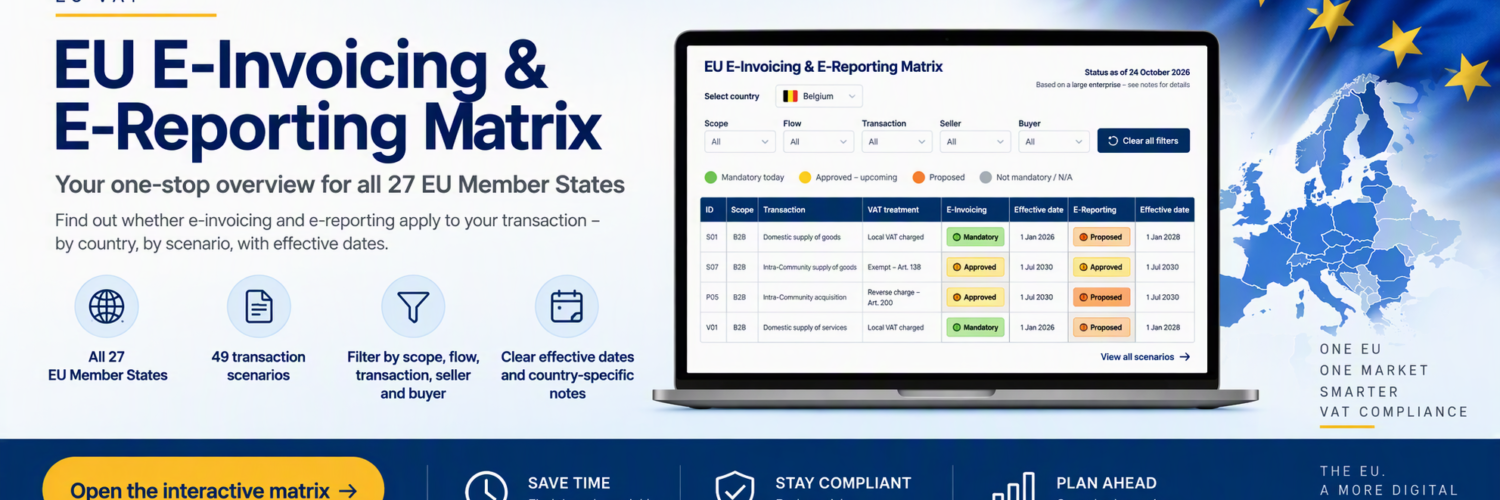
- A new free online tool, the EU E-Invoicing & E-Reporting Matrix, shows for all 27 EU Member States whether e-invoicing and e-reporting apply to 49 transaction scenarios.
- Each result is colour-coded and dated: green means mandatory today, yellow means approved and upcoming, orange means proposed. Domestic mandates and ViDA (from 1 July 2030) appear side by side.
- Users choose a country and filter by scope, flow, transaction, seller and buyer to see only the scenarios that matter to their business.
Extended article
One tool for a fragmented landscape
E-invoicing and e-reporting in the EU are now a patchwork. Some Member States have run clearance systems for years, others have just introduced domestic mandates, and several are still drafting legislation. ViDA adds a further layer from 1 July 2030 with mandatory e-invoicing and digital reporting for intra-EU B2B transactions. For businesses active in several countries, the hard question is no longer whether a country has a mandate. It is whether the mandate applies to a specific transaction.
The EU E-Invoicing & E-Reporting Matrix answers that question in a few clicks.
What the matrix covers
The matrix covers 49 scenarios for each Member State:
- Supplies and purchases of goods: domestic supplies, domestic reverse charge, exempt supplies, intra-Community supplies and acquisitions, transfers of own goods, triangulation (intermediary and final customer), call-off stock, exports and imports.
- Services: domestic services, services with a local place of supply, intra-EU services supplied and received, and services to and from non-EU businesses.
- Other documents: advance-payment invoices, credit notes, self-billing and supplies to non-taxable legal persons.
- B2C and B2G: domestic B2C sales, OSS distance sales in both directions, and supplies to public authorities by established and foreign suppliers.
- Special schemes: margin schemes, VAT and customs warehouses, platforms as deemed suppliers, VAT groups, and SME schemes (domestic and cross-border).
Each scenario also distinguishes between established and non-established parties. That distinction often decides the outcome: Belgium, for example, excludes non-established businesses without a fixed establishment from its mandate, even if they hold a Belgian VAT number.
How it works
- Select a country. A summary shows the status of domestic B2B e-invoicing, e-reporting, B2G e-invoicing and periodic reporting, with a link to the main source.
- Filter the scenarios. Narrow the list by scope (B2B, B2C, B2G), flow, transaction, seller and buyer. Each list only shows options that fit the filters above it. Selecting “Supply of goods”, for example, shows the 14 supply-of-goods scenarios.
- Read the outcome. For every scenario, the matrix shows the e-invoicing and e-reporting status with its effective date and a country-specific note.
- Reset. The “Clear all filters” button brings back the full list.
Colour coding
- Green: mandatory today
- Yellow: adopted in law, effective on the date shown
- Orange: proposed (draft law, consultation or roadmap), so it may still change
- Grey: not mandatory or not applicable
Examples
- Belgium: domestic B2B e-invoicing mandatory since 1 January 2026; near-real-time e-reporting proposed from 1 January 2028.
- France: e-invoicing and e-reporting mandatory for large and mid-sized businesses since 1 September 2026; reporting by customers liable for VAT follows on 1 September 2027.
- Germany: receipt of e-invoices mandatory since 1 January 2025; issuance follows from 1 January 2027.
- Intra-EU transactions: ViDA applies across all Member States from 1 July 2030.
Assumptions
- Status as of 24 October 2026.
- Large enterprise; phase-in dates for smaller businesses are in the notes.
- Non-established means no fixed establishment in the selected country.
- E-reporting covers transaction-level (near) real-time reporting, including clearance. Periodic filings such as SAF-T or control statements appear separately.
- Entries marked “verify” concern points where official guidance is still limited.
Try it now
👉 Open the EU E-Invoicing & E-Reporting Matrix
Feedback, corrections and suggestions for additional scenarios are welcome.
The matrix is for general information only and does not constitute tax advice. Always check the applicable rules locally before relying on an entry.
Latest Posts in "European Union"
- Recent ECJ and General Court VAT Jurisprudence and Implications for EU Compliance – October 2026
- EU E-Invoicing Mandates Accelerate Across France, Greece and Other Member States
- EU Textile EPR Roadmap: Where to Start
- European Union PPWR: What It Means for Your Business
- The race to 2027: How European nations are preparing for the ViDA revolution