
General Court Rules Denmark’s 100% VAT Group Ownership Condition Breaches EU Law
- On 15 July 2026 the General Court delivered its judgment in Case T-268/25 (Sampension Livsforsikring A/S v Skatteministeriet), holding that Article 11 of the VAT Directive precludes national rules requiring 100% ownership to form a VAT group including exempt or non-economic entities, unless justified to combat evasion or avoidance. [eur-lex.europa.eu], [vatupdate.com]
- The dispute arose when two pension funds each acquired 3% of Sampension’s wholly-owned management company, breaching Denmark’s 100% ownership requirement under Paragraph 47(4) of the VAT law. The tax authorities consequently refused re-registration of the group, prompting the Østre Landsret to seek a preliminary ruling on compatibility. [vatupdate.com]
- Crucially, the Court found Article 11 has no direct effect, so taxpayers cannot rely on it directly against a Member State where national law is incompatible and cannot be interpreted consistently. Commentators note financial integration should require no more than a majority (>50%) shareholding going forward. [vatupdate.com], [vatupdate.com]
Sources:
- The CJEU has essentially determined that financial integration for VAT grouping should not require more than a majority shareholding (>50%).
- Despite this EU law right, taxpayers may find it difficult to enforce immediately as these provisions do not have direct effect in domestic legal systems.
- The Court’s reinforcement that VAT savings are a legitimate feature of grouping regimes is particularly helpful in the UK context, given HMRC’s recent focus on revenue protection.
Source Fabian Barth
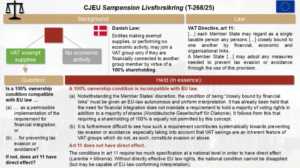
- The General Court ruled that Denmark’s requirement of a 100% interest for forming a VAT group, especially between entities with both VAT-taxable and VAT-exempt activities, is contrary to EU law.
- This ruling stems from a case where Danish tax authorities rejected Sampension Livsforsikring A/S’s application to form a VAT group with an affiliated company because it did not hold 100% of the share capital.
- An exception to this ruling applies if the 100% interest requirement is a necessary and appropriate measure to combat tax evasion or avoidance.
Source Taxlive
General Court Rules 100% Ownership Cannot Be an Automatic VAT-Group Condition (T-268/25)
- On 15 July 2026, the General Court (Second Chamber, extended composition) ruled in Case T-268/25 (Sampension Livsforsikring A/S v Skatteministeriet) that Article 11 of the VAT Directive precludes a 100% ownership requirement for VAT groups including exempt or non-economic entities — unless it is a necessary, proportionate anti-avoidance measure. [vatupdate.com], [eur-lex.europa.eu]
- The case arose when two pension funds each acquired 3% of Sampension’s wholly-owned management company, breaching Denmark’s 100% ownership rule and prompting refusal of the group’s re-registration. [vatupdate.com], [blogs.pwc.de]
- Crucially, the Court held Article 11 has no direct effect, so taxpayers cannot rely on it directly against a Member State where national law is incompatible and cannot be interpreted consistently. [vatupdate.com]
Article: The Court rejected Denmark’s generalising justification that 100% ownership prevents revenue loss and windfall effects, stressing that a mere tax advantage from grouping is not itself evasion or avoidance, and a purely theoretical risk cannot justify an absolute restriction. Commentators note financial integration should require no more than a majority (>50%) shareholding. Sources: EUR-Lex judgment, PwC Germany blog.
- Join the Linkedin Group on ECJ/CJEU/General Court VAT Cases, click HERE
- VATupdate.com – Your FREE source of information on ECJ VAT Cases
- Podcasts & briefing documents: VAT concepts explained through ECJ/CJEU cases on Spotify
—
Latest Posts in "European Union"
- Comments on C-158/25: Director Can Challenge Final Tax Assessment in Liability Proceedings
- Webinar Zampa Partners: VAT implications for holding companies (Sept 22)
- Roadtrip through ECJ Cases – Focus on ”Exemption – The ”leasing or letting of immovable property” (Art. 135(1)(l))
- Flashback on ECJ Cases C-108/99 (Cantor Fitzgerald International) – Accepting a lease assignment for payment is taxable, not exempt
- Zampa Partners: VAT Newsletter Q.2 2026