Last update: July 10, 2026
Article in the EU VAT Directive 2006/112/EC
Article 203
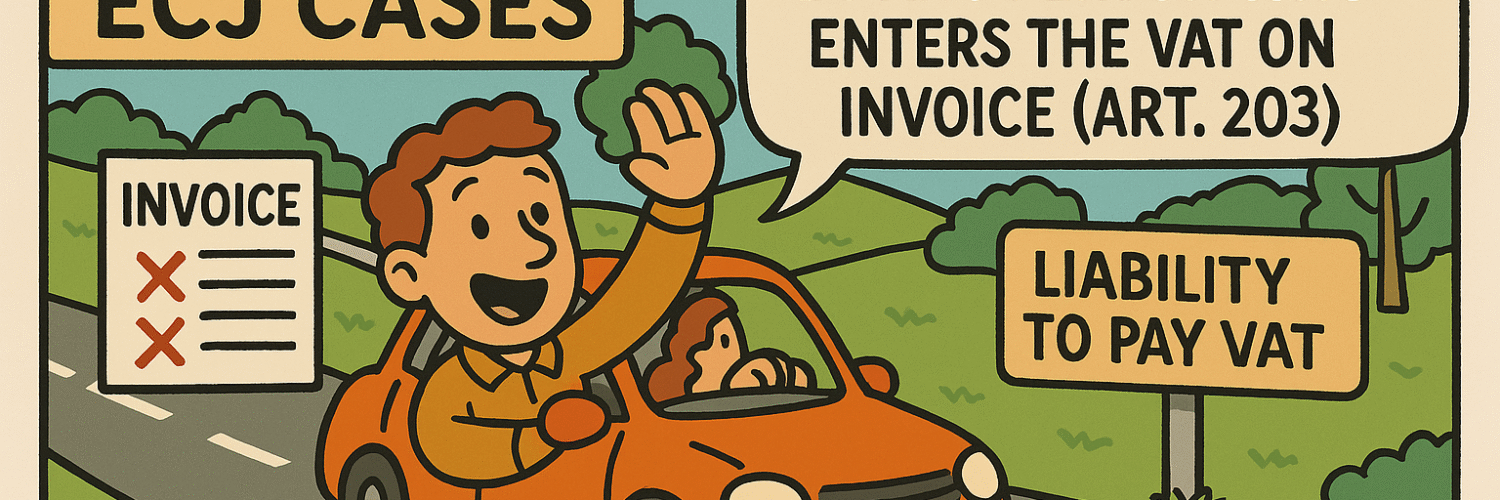
VAT shall be payable by any person who enters the VAT on an invoice.
⚖️ Importance
- Liability Based on Invoicing, Not Substance Even if a transaction is not subject to VAT, if someone issues an invoice that includes VAT, they are liable to pay that VAT to the tax authorities. This prevents fraudulent or careless invoicing from creating tax revenue losses.
- Protects Tax Revenue It ensures that VAT amounts shown on invoices are not used to claim unjustified deductions or refunds, especially by recipients who might not be entitled to deduct VAT.
- Encourages Accurate Invoicing Businesses must be diligent when issuing invoices. Incorrectly charging VAT can lead to financial liability, even if the underlying transaction was exempt or outside the scope of VAT.
- Supports VAT Neutrality By enforcing liability for incorrectly invoiced VAT, Article 203 helps maintain the neutrality of the VAT system, ensuring that only legitimate VAT flows through the system.
ECJ Cases Decided
- C-78/02, C-79/02, C-80/02 (Karageorgou & others) – VAT incorrectly paid by a non-taxable person and stated on the invoice drawn up by him
- C-566/07 (Stadeco) – Right to recover if VAT paid in error, if no danger of a loss of tax
- C-572/11 (Menidzherski biznes reshenia) – No VAT deduction if transaction did not take place
- C-642/11 (Stroy trans) – VAT mentioned on an invoice is due to the tax authorities even if transaction does not exist
- C-643/11 (LVK) – VAT is due whether or not a taxable transaction has actually been performed
- C-138/12 (Rusedespred OOD) – Neutrality principle – Refund to the supplier of tax paid where the recipient under an exempt transaction is refused a right of deduction
- C-272/13 (Equoland) – VAT exemption on imports to be subject to the condition that the imported goods are actually stored in a tax warehouse
- C-712/17 (EN.SA Srl) – Refusal of deduction of input tax and VAT zero-rate in case of fictitious actions
- C-48/20 (P) – Input VAT recovery relating to unduly invoiced VAT
- C-235/21 (RAIFFEISEN LEASING) – A written contract may exceptionally be regarded as an invoice
- C-378/21 (P GmbH) – No VAT liability in case wrongly charged VAT for B2C transactions
- C-442/22 (P Sp. z o.o.) – Employee who issued empty invoice is responsible to report them
- C-640/23 (Greentech) – VAT deductions denied if VAT is not due but taxpayers can claim refunds directly
- C-794/23 (Finanzamt Österreich) – Taxpayer not liable for incorrectly charged VAT to non-taxables
- C-101/24 ( XYRALITY) – German developer is not liable for VAT on services via an app store
- T-638/24 (D GmbH) – VAT on Intra-Community Acquisitions Not Precluded by Errors
- T-356/25 (Rapera) – Tax representatives’ direct VAT liability confirmed; joint liability requires proportionality
Pending ECJ Cases
- None
Summary of each case
C-78/02, C-79/02, C-80/02 – Karageorgou and Others (Judgment, 6 Nov 2003)
- Greek translators working for the Ministry of National Economy invoiced VAT despite not acting independently. Because their activity fell outside the scope of VAT (no employer-employee independence), the amount they entered on invoices could not legally constitute “VAT” within the meaning of the Sixth Directive.
- The Court held that where the person is not a taxable person carrying out an independent economic activity, the sum wrongly labelled as VAT is not tax “due” under Article 21(1)(c) (now Article 203). It therefore cannot be treated as genuine value added tax.
- Consequently, such incorrectly stated VAT may be adjusted and reclaimed and need not remain payable, provided the correction does not obstruct collection. This distinguished the situation from cases where a genuine taxable person wrongly invoices, protecting the neutrality principle and preventing unjust enrichment of the State.
C-566/07 – Stadeco (Judgment, 18 June 2009)
- A Dutch company invoiced VAT to a non-taxable Netherlands public body for services actually supplied abroad. The Court confirmed that VAT entered on an invoice is payable in the Member State to which that invoice relates, even where the underlying transaction was not taxable there. [vatupdate.com]
- Recovery of wrongly invoiced VAT may be made conditional on the issuer correcting the invoice, provided the risk of loss of tax revenue has been wholly and timely eliminated. This safeguards the deduction chain against unjustified input-tax claims by recipients. [vatupdate.com]
- Member States may also refuse refund where repayment would unjustly enrich the supplier. The judgment balances fiscal neutrality against revenue protection, requiring good-faith correction while ensuring the taxpayer is not penalised once no danger to the public purse remains.
C-572/11 – Menidzherski biznes reshenia (Order, 4 July 2013)
- A Bulgarian recipient sought to deduct VAT shown on invoices for supplies that the tax authority found had not actually been performed. The Court held that the right to deduct may be refused where the transactions to which the invoices relate did not genuinely take place. [juristeca.com]
- Crucially, deduction can be denied even where the invoice issuer had already paid the VAT stated, meaning the risk of revenue loss had been eliminated. The existence of an invoice alone never creates a deduction right absent a real underlying supply. [juristeca.com]
- The referring national court must assess all facts and evidence, under national evidentiary rules, to determine whether the transactions occurred. The ruling reinforces that Article 203 liability of the issuer and Article 168 deduction rights of the recipient operate independently. [juristeca.com]
C-642/11 – Stroy trans (Judgment, 31 Jan 2013)
- VAT entered on an invoice is payable by the issuer under Article 203 solely because it is shown, regardless of whether a taxable transaction actually occurred. This objective liability protects revenue against the risk of the recipient claiming an unjustified deduction. [vatupdate.com]
- However, the tax authority is not obliged to establish that the transaction did not take place before assessing that liability. The mere entry of VAT triggers the debt, subject to the issuer’s right to correct where fraud risk is removed.
- The Court also addressed legitimate expectations: a tax adjustment notice against the supplier that does not correct the declared VAT does not automatically mean the authority acknowledged the supply. Recipients cannot infer a deduction right from the issuer’s assessment position.
C-643/11 – LVK (Judgment, 31 Jan 2013)
- Companion case to Stroy trans. The Court confirmed that VAT stated on an invoice is due under Article 203 whether or not a taxable transaction was actually performed. Liability attaches to the act of invoicing itself, safeguarding against fraudulent deduction claims. [vatupdate.com]
- The recipient’s right to deduct depends on an actual supply having taken place, not merely on the invoice. Authorities may deny deduction where the transaction is fictitious, even though the issuer remains liable for the invoiced amount under Article 203.
- The principles of fiscal neutrality and legal certainty do not require the recipient’s deduction and the issuer’s liability to mirror each other. Each party’s position is assessed independently on its own facts, preventing exploitation of asymmetries in the VAT chain.
C-138/12 – Rusedespred OOD (Judgment, 11 April 2013)
- A Bulgarian supplier invoiced VAT on a supply that was in fact exempt. The recipient was refused deduction because the transaction was exempt, eliminating any risk of revenue loss to the State once that denial was final and definitive. [vatupdate.com]
- The Court held that the neutrality principle requires Member States to allow the supplier to obtain a refund of the wrongly invoiced VAT, since no danger of tax loss remained. National rules cannot make correction impossible in these circumstances. [vatupdate.com]
- A taxable person may rely directly on VAT neutrality against a national provision that conflicts with it. The judgment reinforces that Article 203 liability is not punitive: once the revenue risk is neutralised, the incorrectly charged VAT must be recoverable.
C-272/13 – Equoland (Judgment, 17 July 2014)
- An importer entered goods into a VAT warehouse only “on paper” without physical storage, then settled import VAT via reverse charge. The Court held Member States may lawfully require physical placement of goods in the warehouse as a condition for the import VAT exemption. [juristeca.com]
- However, demanding a second payment of import VAT—where the tax had already been settled under the reverse-charge mechanism through self-invoicing—breaches the principle of fiscal neutrality. The State cannot collect the same VAT twice merely because of a formal warehousing failure. [juristeca.com]
- Penalties for the formal breach must remain proportionate. The ruling illustrates the boundary between legitimate formal conditions protecting collection and disproportionate demands that would effectively tax the same transaction twice, undermining neutrality in the VAT system.
C-712/17 – EN.SA Srl (Judgment, 8 May 2019)
- Fictitious circular sales of electricity between group companies at identical prices caused no tax loss. The Court held that Article 203 requires the issuer to pay the VAT shown on invoices even for such non-existent transactions, while deduction of the corresponding input VAT is refused. [eur-lex.europa.eu]
- National law must nonetheless allow the issuer, where not acting fraudulently, to adjust the tax liability once the risk of revenue loss has been eliminated in sufficient time. The Court reaffirmed Stroy trans on this correction possibility. [cms.law]
- A penalty equal to 100% of the improperly deducted VAT was disproportionate where no loss occurred and the transactions were circular. The ruling limits punitive sanctions, requiring proportionality even where fictitious invoicing triggers Article 203 liability. [taxnotes.com]
C-48/20 – P (Judgment, 18 March 2021)
- A Polish company, acting in good faith, issued invoices wrongly showing VAT on what were actually exempt financial-intermediation (fuel-financing) services to Lithuanian firms. Article 203 formally applied, but the error stemmed from tax-authority guidance and common practice, not fraud. [vatupdate.com]
- The Court held that Article 203, read with proportionality and neutrality, precludes national law that bars a good-faith issuer from correcting wrongly invoiced VAT once a tax investigation has begun, where the recipient would have been entitled to a refund anyway. [eur-lex.europa.eu]
- Because the transactions, if correctly invoiced, would still have allowed the recipients to recover VAT, there was no risk of revenue loss. Member States must therefore provide a correction procedure for good-faith issuers, protecting fiscal neutrality. [eur-lex.europa.eu]
C-235/21 – Raiffeisen Leasing (Judgment, 29 Sept 2022)
- In a sale-and-leaseback arrangement, no invoice was issued but the written contract stated the VAT amount. The Court held that such a contract may exceptionally be treated as an invoice under Article 203 if it contains all information needed to verify the deduction conditions. [linkedin.com]
- The decisive test is substantive: the document must enable the tax authority to establish whether the material conditions for the right to deduct are satisfied. The parties’ intention to issue a formal invoice is not, by itself, determinative. [atafinance.pl]
- Consequently, the party stating VAT in the contract becomes liable to pay it under Article 203, and the counterparty may potentially deduct. The referring court must verify that the contract meets the required content, illustrating the broad, functional notion of “invoice”. [linkedin.com]
C-378/21 – P GmbH (Judgment, 8 Dec 2022)
- An Austrian indoor-playground operator charged 20% VAT instead of the correct reduced 13% rate on admissions, issuing simplified receipts. The Court held that Article 203 does not make a taxable person liable for the over-charged VAT where recipients are exclusively final consumers without any deduction right. [eur-lex.europa.eu]
- The rationale is that when customers cannot deduct input VAT, there is no risk of loss of tax revenue, which is the very purpose of Article 203. The wrongly invoiced excess therefore falls outside the provision’s scope. [ebnerstolz.de]
- It is irrelevant that the supplier was “enriched” by charging more VAT in the price; unjust enrichment cannot justify the State retaining tax that was never substantively due. The taxpayer may adjust its VAT return accordingly. [pkf.hu]
C-442/22 – P sp. z o.o. (Judgment, 30 Jan 2024)
- An employee of a Polish fuel company issued 1,679 fake VAT invoices using the employer’s identity, without its knowledge or consent, enabling recipients to claim fraudulent refunds. The core question was who is the “person who enters the VAT” liable under Article 203. [vatupdate.com]
- The Court ruled that the fraudulent employee—not the employer—is generally the person liable under Article 203, since it would be contrary to EU law to hold the good-faith apparent issuer whose identity was misappropriated liable for the tax. [eur-lex.europa.eu]
- Liability shifts back to the employer only where it failed to exercise the due diligence reasonably required to monitor the employee’s conduct. Businesses must therefore maintain adequate supervision and invoicing controls to avoid bearing VAT for staff fraud. [simmons-simmons.com]
C-640/23 – Greentech (Judgment, 13 March 2025)
- Romanian authorities reclassified an asset sale (on which VAT had been charged and deducted) as an out-of-scope transfer of a going concern, denying Greentech’s deduction. By then the limitation period had expired, making invoice correction and recovery from the supplier impossible. [pkf.hu]
- The Court held that Articles 168 and 203, with neutrality and effectiveness, do not preclude national law refusing deduction of VAT on a transaction reclassified as non-taxable, since only VAT genuinely due on taxable transactions is deductible. [eurlexsearch.com]
- Crucially, however, where recovery from the seller is impossible or excessively difficult, those principles require that the taxable person be able to apply directly to the tax authority for reimbursement. This confirms the Reemtsma direct-claim route. [eurlexsearch.com]
C-794/23 – Finanzamt Österreich / P GmbH II (Judgment, 1 Aug 2025)
- The sequel to C-378/21: the same playground operator had also served some taxable customers. The Court confirmed a taxable person is not liable under Article 203 for VAT over-charged to non-taxable persons, even where similar services were supplied to taxable customers. [eur-lex.europa.eu]
- “Final consumer with no right to deduct” means only a genuinely non-taxable person—not a taxable person who happens to use a specific supply for private (non-deductible) purposes. Liability must be assessed invoice-by-invoice, not by blanket “infection”. [vatabout.com]
- Under simplified invoicing (Article 238), where customers are unidentifiable, tax authorities may estimate which invoices carry a revenue-loss risk, provided all relevant circumstances are weighed and the taxpayer can challenge the estimate. This ensures proportionality and neutrality. [vatupdate.com]
C-101/24 – XYRALITY (Judgment, 9 Oct 2025)
- A German game developer sold in-app purchases to EU consumers via an Irish app store. Under the Article 28 commissionaire fiction, the app store is deemed to receive and supply the services, notwithstanding that post-sale order confirmations named the German developer and showed German VAT. [vatupdate.com]
- Where Article 28 applies, the place of the deemed supply from developer to app store is determined by Article 44 (B2B), i.e. the app store’s location (Ireland), not Germany. This clarifies platform VAT treatment both pre- and post-2015. [pwc.nl]
- On Article 203, the developer is not liable for German VAT despite being named on the confirmations, because the services were supplied to non-taxable persons via the app store, so no deductible VAT and no revenue-loss risk arose. [vatupdate.com]
T-638/24 – D GmbH (General Court, Judgment, 25 Feb 2026)
- D GmbH acquired goods from Austrian suppliers using its Austrian VAT number; suppliers wrongly charged Austrian VAT on what were substantively exempt intra-Community supplies. The General Court examined the interaction of the acquisition rules (Articles 40–41) and Article 203 liability. [vatupdate.com]
- The Court held that Articles 41 and 203 pursue distinct objectives and apply in parallel. Austria could tax the intra-Community acquisition (VAT number used, no proof of taxation at destination) while also maintaining the VAT liability arising solely from the incorrect invoicing. [vat-consult.be]
- This creates a striking “double” exposure in one Member State, but it respects neutrality and proportionality because invoice-based VAT (Article 203) is legally distinct from a substantive charge. Businesses face real risk when VAT-ID and invoicing formalities are mishandled in EU trade. [bakertilly.de]
T-356/25 – Rapera (General Court, Judgment, 8 July 2026)
- A customs agent acting as fiscal representative for an Italian company in Greece was held jointly liable for its VAT. The Court confirmed that Member States may designate a fiscal representative as the primary VAT debtor under Article 204, even without involvement in the underlying transactions. [vatupdate.com]
- However, automatic and unconditional joint and several liability under Article 205 is incompatible with proportionality. Before imposing it, authorities must examine the representative’s actual involvement, knowledge, good faith and the reasonable measures taken to prevent non-compliance. [vatupdate.com]
- The Court also clarified that Articles 204 and 205 cannot both apply simultaneously to the same person—one cannot be both debtor and jointly liable guarantor. This is particularly relevant for firms acting as fiscal representatives for non-established businesses across the EU. [vatupdate.com]
Briefing documents & Podcasts
C-794/23: Indoor playground operator does not owe VAT for incorrect invoices
C-101/24 (XYRALITY) – German developer is not liable for VAT on services via an app store
T-638/24 (D GmbH) – VAT on Intra-Community Acquisitions Not Precluded by Errors
- Join the Linkedin Group on ECJ/CJEU/General Court VAT Cases, click HERE
- VATupdate.com – Your FREE source of information on ECJ VAT Cases
Latest Posts in "European Union"
- Agenda of the ECJ/General Court VAT cases – 1 AG Opinion, 2 Hearings till November 13, 2026
- ECJ & General Court VAT Cases decided in 2026
- General Court – T-569/25 (X-GmbH) – Judgment – VAT Margin Scheme: Good Faith of the Taxable Dealer Must Be Examined in the Tax Assessment Procedure
- Flashback on ECJ Cases C-481/98 (Commission v France) – Different medicinal-product rates respected fiscal neutrality
- EU Parliament Proposes Single VAT Number and Expanded One Stop Shop