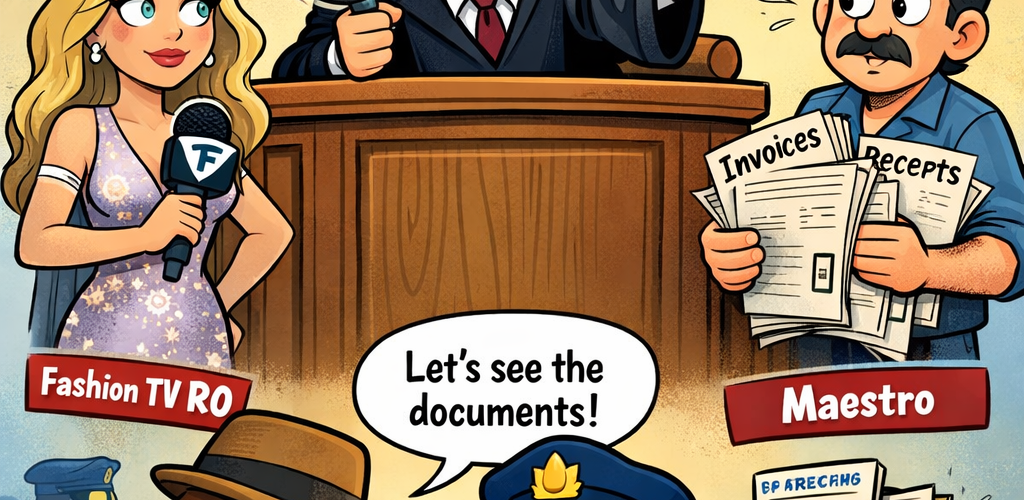
On November 12, 2025, the ECJ has released an Order in the case C-475/24 (Fashion TV RO and Maestro).
Context: The Curtea de Apel Constanța requested a preliminary ruling from the Court of Justice of the European Union (CJEU) on interpreting Articles 47 and 50 of the Charter of Fundamental Rights of the European Union. The question was whether tax proceedings against a taxable person must be discontinued if criminal proceedings for tax evasion against their legal representative were discontinued due to lack of evidence and time-barred liability.
Summary
- Facts of the Case: Fashion TV RO SRL was denied the right to deduct VAT on purchases due to alleged irregularities with the invoices. The Romanian tax authorities claimed that these invoices were linked to suppliers that were not properly registered or were inactive, leading to substantial tax liabilities.
- Questions to the Court: The Curtea de Apel Constanța sought clarification on whether the discontinuation of criminal proceedings against individuals associated with Fashion TV affects the administrative tax proceedings. Specifically, it questioned whether evidence from these criminal proceedings could be used to evaluate VAT deduction claims without violating the principles of legal certainty and the right to a fair trial.
- Court’s Decision: The Court ruled that national courts must verify compliance with the VAT Directive’s conditions for deduction. It held that such courts could examine evidence from earlier criminal proceedings against individuals distinct from the taxable entity, provided that the rights guaranteed by EU law are upheld.
- Justification of the Decision: The Court emphasized that the right to deduct VAT is fundamental, and the examination of related evidence is necessary to combat tax fraud effectively. It clarified that the principle of ne bis in idem does not apply since the criminal proceedings involved different individuals than the taxable person, allowing for the use of such evidence in tax matters.
- Implications of the Ruling: This decision reinforces the need for tax authorities to substantiate claims of VAT fraud with objective evidence while respecting the rights of the taxpayer. It ensures that courts can consider relevant evidence from criminal cases while maintaining adherence to EU principles of legal rights and fair judicial processes.
Articles in the VAT Directive
Articles 167, 168 and 178 of the EU VAT Directive 2006/112/EC
Article 167
A right of deduction shall arise at the time the deductible tax becomes chargeable.
Article 168
In so far as the goods and services are used for the purposes of the taxed transactions of a taxable person, the taxable person shall be entitled, in theMember State in which he carries out these transactions, to deduct the following from the VAT which he is liable to pay:
(a) the VAT due or paid in that Member State in respect of supplies to him of goods or services, carried out or to be carried out by another taxable person;
(b) the VAT due in respect of transactions treated as supplies of goods or services pursuant to Article 18(a) and Article 27;
(c) the VAT due in respect of intra-Community acquisitions of goods pursuant to Article 2(1)(b)(i);
(d) the VAT due on transactions treated as intra-Community acquisitions in accordance with Articles 21 and 22;
(e) the VAT due or paid in respect of the importation of goods into that Member State.
Article 178
In order to exercise the right of deduction, a taxable person must meet the following conditions:
(a) for the purposes of deductions pursuant to Article 168(a), in respect of the supply of goods or services, he must hold an invoice drawn up in accordance with Articles 220 to 236 and Articles 238, 239 and 240;
Articles 47 and 50 of the Charter of Fundamental Rights
Facts
- Tax Audit: Fashion TV RO SRL, a company involved in film, video, and television production, underwent a tax audit for 2014-2015, resulting in a notice of assessment indicating liabilities for corporation tax, dividend income tax, and additional VAT amounting to RON 584,666.
- Audit Findings: The audit report highlighted issues with invoices from 122 suppliers, including missing shipping data, cash payments, untraceable goods origins, and suppliers not recognizing transactions with Fashion TV RO SRL.
- VAT Deduction Issues: The tax inspection authority concluded that the legal conditions for VAT deduction were not met due to issues such as suppliers not being registered for VAT or being inactive at the time of transactions.
- Administrative Complaint: Fashion TV RO SRL filed an administrative complaint against the notice of assessment, which was suspended pending the outcome of criminal investigations into potential economic and financial offenses.
- Complaint Dismissal: The complaint resolution body dismissed the complaint, stating that the transactions with the 122 suppliers were fictitious.
- Court Challenge: Fashion TV RO SRL challenged this decision in court, providing an expert accounting report supporting their right to deduct VAT based on the actual existence of purchases.
- Court Decision: The Constanța Regional Court dismissed Fashion TV RO SRL’s appeal, finding that the company failed to prove the actual existence of the transactions and that the tax authority’s assessment was based on objective evidence.
- Appeal: Fashion TV RO SRL appealed this decision, arguing they had purchased goods in good faith and invoking principles of European law and VAT neutrality.
- Forensic Accounting Report: During the appeal proceedings, Fashion TV RO SRL submitted a forensic accounting report prepared for a criminal case, concluding that the purchases were genuine and VAT deductible.
- Criminal Case Dismissal: The Office of the Public Prosecutor at the Constanța Court of Appeal issued a dismissal order for the criminal case against Fashion TV RO SRL’s director and accountant, citing lack of evidence and time-barred liability.
Questions
Do Articles 47 and 50 of the Charter of Fundamental Rights of the European Union (‘the Charter’) and the general legal principle of legal certainty and the principle of the protection of legitimate expectations preclude national legislation and practice that permit a court ruling on tax matters to re-examine evidence considered by the representative of the Public Prosecutor, when that party has ordered the discontinuance of earlier criminal proceedings on the ground that there is no case to answer and because of lack of evidence, in relation to the same alleged facts relating to a failure to fulfil tax obligations examined by the court ruling on tax matters, including value added tax?
AG Opinion
None
Decision (Order)
Article 168 of Council Directive 2006/112/EC of 28 November 2006 on the common system of value added tax, read in the light of Article 47 of the Charter of Fundamental Rights of the European Union,
must be interpreted as meaning that the national court hearing a dispute relating to the exercise of the right to deduct value added tax must verify that the taxable person concerned has satisfied the substantive and formal conditions laid down in that directive and to that end may examine evidence obtained in earlier criminal proceedings against persons distinct from that taxable person, on condition that that examination respects the rights guaranteed by EU law, in particular by the Charter of Fundamental Rights, including the principle of equality of arms and the rights of the defence.
Source
- See also
- Join the Linkedin Group on Global E-Invoicing/E-Reporting/SAF-T Developments, click HERE
Latest Posts in "European Union"
- EPRS Report: Targeting VAT Fraud: How the Reverse Charge Mechanism Protects EU Revenues
- ECJ & General Court VAT Cases decided in 2026
- Comments on C-513/24 (Oblastní nemocnice Kolín) – Obligation for the presence of goods in hospital not decisive for VAT deduction
- Comments on ECJ C-515/24: ECJ Upholds Spanish VAT Deduction Ban for Entertainment Expenses at Accession
- ECJ VAT C-513/24 (Oblastní nemocnice Kolín) – Judgment – Regulatory requirement alone insufficient for pro-rata VAT deduction for hospital equipment