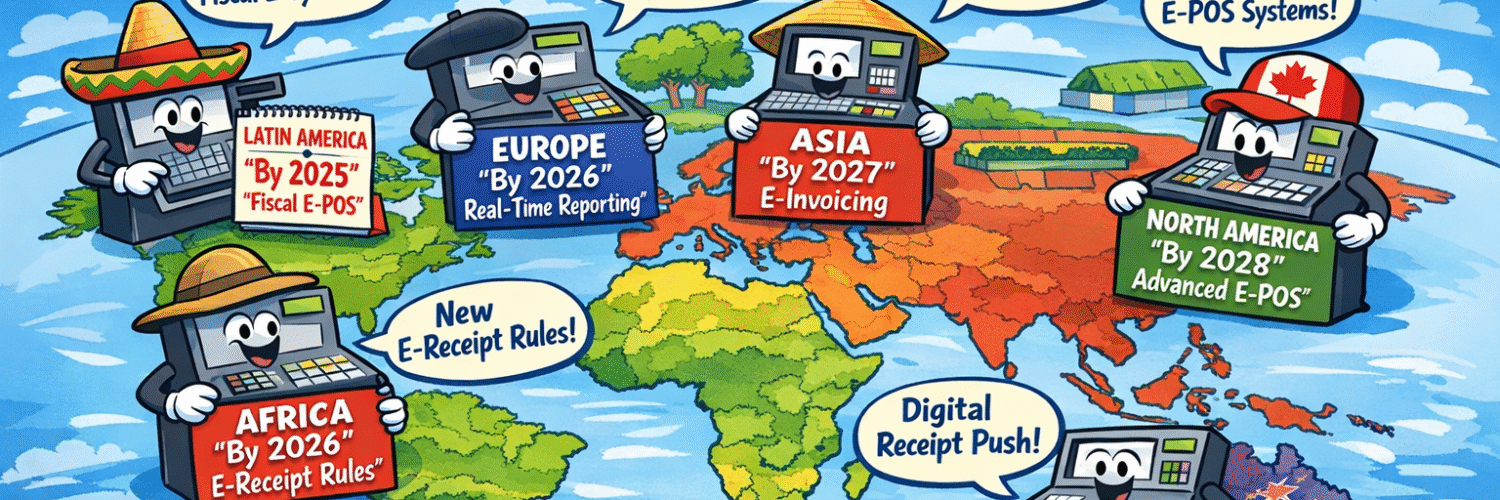
Electronic cash registers and digital receipt systems have become a focal point of VAT compliance reforms worldwide. In recent years, countries across the globe – from Europe and Africa to Asia – are mandating advanced “fiscal” cash register systems to curb tax evasion and modernize sales reporting. These initiatives include new regulations (like requiring certified or connected cash register software) and technological shifts (such as integrating cash registers with e-invoicing platforms or cloud services). Below are the key trends and recent developments shaping the use of electronic cash registers globally, followed by a timeline of major changes: [vatupdate.com]
-
Global Push for Digital Receipts and POS Reporting: Tax authorities are increasingly requiring that retail sales be recorded and transmitted electronically in real time. For example, Hungary is launching a nationwide e-cash register system with real-time receipt transmission to the tax authority, building on the success of its earlier online cash register program. Similarly, Egypt has moved to an electronic receipt system for all B2C transactions as of early 2024. These systems aim to capture every sale (especially cash sales) in a tamper-proof digital format, thereby combating VAT fraud. [vatupdate.com] [vatupdate.com]
-
New Mandates with Staged Deadlines: Many countries have set phased timelines to implement ECR reforms. Notably, Egypt required large segments of businesses to start issuing e-receipts by February 2024. Vietnam has mandated that by June 2025 a broad group of small retailers (meeting certain revenue or technology criteria) must use e-invoices generated from cash registers. In Europe, Italy’s 2025 Budget Law makes it compulsory from January 2026 for merchants to link cash registers with electronic payment devices. Hungary, after enabling voluntary adoption in 2025, plans to have e-cash registers in full use by 2026, replacing older systems. (See the detailed timeline below for additional country-specific deadlines.) [vatupdate.com] [vatupdate.com] [vatupdate.com] [vatupdate.com]
-
Electronic Receipts (E-Receipts) Become Mainstream: Printing paper receipts is no longer the only way to provide proof of sale. Poland, for instance, will allow businesses to issue electronic receipts (with customer consent) from July 2025 onward. These e-receipts are delivered through a secure central platform (the “Receipt HUB”) and are considered fiscal receipts even though they are digital. Hungary’s new system also enables consumers to access digital receipts via a mobile app instead of paper slips. Such moves modernize the customer experience and reduce paper record-keeping, while ensuring the tax authorities receive the transaction data in real time. [vatupdate.com] [vatupdate.com]
-
Integration with E-Invoicing and Payment Systems: A clear trend is the integration of cash registers with broader digital tax systems. Some countries are linking retail cash registers to national e-invoicing platforms so that even point-of-sale transactions feed into the VAT invoice system. Poland is a prime example – as it rolls out mandatory e-invoicing (KSeF) for B2B transactions in 2025–2026, it is also phasing out “cash register invoices” and will require retailers to route invoices through KSeF by 2027. Vietnam’s 2025 decree similarly connects POS systems used by small businesses to the government e-invoice system. Meanwhile, other countries focus on linking cash registers with payment data: Italy and Greece are mandating that electronic cash registers be digitally connected to card payment machines, so that every card transaction is matched with a recorded receipt. This integration helps cross-verify sales, ensuring no payment goes untaxed or unreported. [vatupdate.com] [vatupdate.com] [vatupdate.com], [vatupdate.com]
-
Stricter Compliance and Certification Requirements: Governments are tightening rules to ensure businesses use approved, secure cash register systems. For instance, Germany now not only requires tamper-proof technical security modules in each register, but as of January 2025 also mandates that every cash register be formally registered with the tax authority’s online portal. In France, the era of self-certifying cash register software is over – from 2025, French businesses must use certified POS systems (verified by accredited bodies) or face steep fines. Poland is introducing penalties for businesses that fail to decommission old unused registers by mid-2026, aiming to prevent off-the-books use of unregistered machines. These compliance measures go hand-in-hand with digital adoption, ensuring that as companies embrace new ECR technology, they do so in a controlled, government-audited manner. [vatupdate.com] [vatupdate.com] [vatupdate.com]
Below is a timeline of recent and upcoming global developments in the use of electronic cash registers, highlighting key implementation dates and requirements from 2024 onward:
Timeline of Key ECR Reforms and Mandates (2024–2028)
-
February 1, 2024 – Egypt: The Egyptian Tax Authority launches the final phases of its Electronic Receipt (e-receipt) system. From this date, businesses covered by the program must issue electronic tax receipts for all sales to consumers. This mandate (per Egypt’s Decision No. 702/2023) marks a major shift: retailers and service providers are required to transmit B2C receipt data to the government’s system, improving transaction traceability and tax oversight. [vatupdate.com]
-
February 28, 2024 – Greece: Greece’s deadline for integrating cash registers with POS terminals. After several extensions, Greek authorities set end of February 2024 as the final “tolerance period” for businesses to connect their cash registers to card payment systems. From March 2024 onward, every transaction paid by card must be automatically reported via a linked cash register. This measure, implemented by tax law and overseen by AADE (the Greek tax authority), ensures that sales paid electronically cannot bypass the fiscal reporting system. (Greek businesses had raised concerns about the cost and technical challenges, prompting the phased approach and grace period up to this date.) [vatupdate.com]
-
July 2024 – Hungary: Hungary introduces e-receipts through new e-cash registers. Starting July 1, 2024, Hungary’s tax authority (NAV) began allowing businesses to issue digital receipts via “e‑registers” (electronic cash registers). Consumers can access these receipts through a specialized app, eliminating the need for paper slips. This rollout is the first step of Hungary’s multi-year plan to modernize its cash registers. Businesses are encouraged to start adopting the new ePénztárgép system – which can be a physical device or a NAV-provided mobile application – to transmit receipts in real time to the tax authority. (Hungary’s existing online cash registers from 2014 remain valid during a transition period, but the goal is to gradually replace them with the new system by the late 2020s.) [vatupdate.com] [vatupdate.com]
-
January 1, 2025 – Germany: Mandatory registration of cash registers with German tax authorities. From the start of 2025, German companies and self-employed traders must report each electronic cash register (and similar POS systems) to the tax office. This requirement, under Germany’s Fiscal Code §146a, means any device that records sales – whether a traditional till with a certified TSE security unit, an app-based POS, or even a taximeter with a cash function – must be registered online via the ELSTER portal. Devices already in use before mid-2025 had to be reported by July 31, 2025, while new devices must be registered within one month of deployment. Businesses also have to notify authorities if a device is decommissioned or moved. This nationwide inventory of cash registers complements Germany’s earlier rule (effective 2020–2023) that all registers be equipped with tamper-evident digital security (TSE) – together, these ensure both the integrity of cash data and its visibility to tax offices. [vatupdate.com] [vatupdate.com], [vatupdate.com]
-
January 1, 2025 – France: End of self-certification for French cash register software. As of France’s 2025 Finance Act, businesses can no longer self-declare their cash register systems as compliant. Instead, any point-of-sale system used for VAT taxable sales must be certified by an accredited third party (such as Infocert or LNE) to meet anti-fraud requirements. Companies using non-certified cash register software face a €7,500 fine per device, with a 60-day grace period to comply before an additional fine can apply. This policy, an extension of measures first introduced in 2018, is intended to ensure that all sales recording software in France has robust anti-fraud features (unalterable transaction logs, etc.). French businesses in 2025 rushed to either obtain certificates for their existing POS software or switch to solutions already certified, to avoid penalties. [vatupdate.com]
-
June 1, 2025 – Vietnam: Small businesses in Vietnam must adopt e-invoices via cash registers. Under Vietnam’s Decree 70/2025 (amending earlier e-invoice regs), business households and micro-enterprises that meet certain criteria are required to issue electronic invoices generated from cash registers by this date. The mandate targets smaller businesses (e.g. retail shops, local traders) who were previously using manual receipts. Specifically, if a business’s annual revenue exceeds VND 1 billion or if they already use electronic devices (computers) for sales, they fall under this requirement. These businesses had to register with the tax authority by May 30, 2025 and adjust their tax calculation method to use continuous e-invoicing. Vietnam’s tax departments conducted outreach and provided IT support (including a four-step guide) to help thousands of small merchants connect their cash registers to the government’s e-invoice system. This reform is poised to greatly expand the share of B2C transactions captured through Vietnam’s electronic invoicing platform. [vatupdate.com], [vatupdate.com] [vatupdate.com]
-
July 1, 2025 – Hungary: Voluntary adoption of Hungary’s new ECR system begins. On this date, Hungary officially opened the certified e-cash register system for businesses to join on a voluntary basis. From July 2025, companies in applicable sectors can switch from old “online cash registers” to the new NAV-authorized e-cash registers and start issuing e-receipts ahead of the mandatory schedule. The National Tax and Customs Administration (NAV) began accepting applications from cash register manufacturers and distributors for device authorization and type-testing in the lead-up to this date. Concurrently, NAV released a free mobile cash register app (available on Google Play and Apple App Store) to encourage especially small merchants to adopt the system easily. Businesses that opt in early gain experience with the new system, benefit from features like cloud-based receipt archiving, and ensure they will be compliant well before the hard deadline. (Hungary’s tax authority is actively promoting early adoption through education and even free tools.) [vatupdate.com] [vatupdate.com], [vatupdate.com] [vatupdate.com]
-
July 2025 – Poland: Electronic receipts (“e-paragony”) introduced in Poland. From July 2025, Polish law will allow businesses to issue electronic fiscal receipts to customers as an alternative to printed receipts. Under new VAT Act amendments, a store can, with the customer’s consent, send the receipt in digital form (for example, via email or an app) from a cash register – this applies to both traditional hardware cash registers and the newer software-based POS systems. To facilitate this, Poland’s government is implementing a central “Receipt HUB” service that generates and delivers the e-receipt to the buyer without storing personal data. It’s important to note that even when an e-receipt is issued, a corresponding fiscal record is still kept – the e-receipt is essentially a dematerialized fiscal receipt, not an invoice. (In Poland, cash register receipts were historically sometimes used as simplified invoices for small B2B sales, but the new rules clarify that receipts – whether paper or electronic – are not VAT invoices. If an invoice is needed, it must be issued separately, eventually through the KSeF e-invoicing system.) The introduction of e-receipts is expected to simplify consumer transactions and reduce paper waste, while the Receipt HUB ensures authenticity and real-time tax tracking of those receipts. [vatupdate.com]
-
November 2025 – Tunisia: Fiscal cash register platform enrollment for cafes and restaurants. In late 2025, Tunisia took steps to widen the use of fiscal cash registers in specific sectors. A Ministry of Finance notice now requires that certain businesses – notably tourist restaurants, “tea rooms,” and second- and third-category cafés – register with the national fiscal cash register platform. Affected businesses must contact an accredited cash register supplier (listed on the government’s Jibaya.tn portal) to upgrade or acquire a compliant cash register and link it to the online system. The registration and setup process is done remotely in coordination with these certified suppliers. This move, backed by a ministerial decree, sets out classification criteria for which service establishments must comply and by when. Essentially, Tunisia is expanding its fiscal till system beyond large retailers to cover smaller hospitality venues, aiming to capture cash sales in sectors that historically saw under-reporting. As these cafés and restaurants register their POS systems, the tax authority will gain more immediate visibility into their daily sales. [vatupdate.com]
-
January 1, 2026 – Italy: Mandatory linking of cash registers to electronic payments. Beginning in 2026, Italy will enforce a new rule that every electronic cash register (“registratore telematico”) be digitally linked with the merchant’s electronic payment systems. In practice, Italian retailers and businesses must use a dedicated online procedure (provided in their Revenue Agency’s portal) to associate each cash register’s ID with the ID of the card reader or payment app they use. This linkage, mandated by Italy’s 2025 Budget Law, has a clear purpose: whenever a customer pays by credit/debit card or digital wallet, the payment can be cross-checked against the issuance of a fiscal receipt from the cash register. By March 2026, operational details and specific timelines will be published, including a short window for registering existing devices (likely within 45 days of the system’s launch). Notably, the law does not require a physical cable or hardware integration – the connection is achieved through cloud services (web APIs) – so POS vendors and software providers have worked to update their systems accordingly. This measure builds on Italy’s existing real-time receipt reporting system: since 2019, Italian cash registers already transmit daily receipt totals to the tax authority. Now, by also tying in the payment data, Italy seeks to eliminate any gap where a card payment might be accepted but the sale not reported (or reported for a lower amount). From 2026, failing to link a payment to a corresponding receipt could be automatically detected. [vatupdate.com] [vatupdate.com] [vatupdate.com], [vatupdate.com]
-
February–April 2026 – Poland: Poland’s e-invoicing mandate and interim relief for cash register invoices. Poland’s nationwide mandatory e-invoicing system (KSeF) for B2B transactions is set to kick in on February 1, 2026 for large taxpayers and April 1, 2026 for all other businesses. As part of this transition, the Ministry of Finance recognized that many businesses issue VAT invoices directly from cash registers (especially for small B2B sales or extended receipts) – a practice that needed adjustment under KSeF. In May 2025, the government proposed a delay in banning cash register-generated invoices until end of 2026. In other words, although e-invoicing will become mandatory in early 2026, Poland will allow the continued use of “cash register invoices” through 2026 without penalty. Likewise, until 2027 businesses won’t be forced to include a KSeF invoice reference number on receipts or payments – giving extra time to adapt point-of-sale systems to full e-invoice integration. This grace period was instituted to prevent chaos for retailers and service providers during the e-invoice rollout. It ensures that throughout 2026, a shop can still print an invoice from its cash register for a customer (if needed) while the company works on implementing a compliant KSeF solution. By January 2027, however, Poland intends to fully switch over, with cash registers no longer issuing VAT invoices – those will have to be done through KSeF, marking the final step in integrating POS transactions into the central invoicing system. [vatupdate.com]
-
April 1, 2026 – Poland: Software-based cash registers permitted for more industries. As part of Poland’s broader tax digitization, the government is expanding which businesses can use app-based cash registers (virtual tills) instead of traditional dedicated devices. Effective April 2026, several new sectors are authorized to use software cash register solutions, including car washes, automated parcel or vending machines, self-service ticket kiosks, and electronic parking systems. This follows earlier phases where only select industries (like gas stations and transport) could use software POS. By adding these sectors, Poland acknowledges that many modern sales operations are automated or unattended; allowing a certified software application (running on a tablet, PC, or cloud) to serve as the “cash register” makes compliance easier and often cheaper. Businesses in the newly included sectors must ensure their systems meet the official requirements (such as secure data logging and online connectivity) by the April 2026 date. This change is part of ongoing “fiscalization” modernization – encouraging innovation (like mobile POS and cloud solutions) while maintaining the tax authority’s access to real-time sales data. [vatupdate.com]
-
July 1, 2026 – Poland: Obligation to dispose of unused cash registers. From mid-2026, Poland is introducing stringent rules to eliminate outdated or unused fiscal cash registers that could facilitate off-record sales. Under amendments effective July 1, 2026, if a business has a cash register it no longer uses for reporting sales, it must formally return or dispose of the device via the manufacturer/service provider. Simply keeping an old cash register “in the back” becomes illegal – companies that fail to turn in unused registers may face penalties. The aim is to prevent businesses from maintaining parallel, unreported tills; by forcing returns, the authorities ensure those machines are destroyed or tracked. The new regulation encourages businesses to assess their actual need for each cash register and deregister any excess devices. It also streamlines the market by removing obsolete equipment. In practice, leading up to this date, companies had to inventory their registers and coordinate with certified service firms to write-off and physically destroy old devices. This Polish initiative highlights a rarely addressed aspect of ECR compliance – not just how to use approved devices, but also how to exit old devices from the system so they can’t be misused. [vatupdate.com]
-
September 1, 2026 – Hungary: Hungary’s e-cash registers become the norm. By fall 2026, Hungary expects virtually all businesses that issue receipts to be using its new electronic cash register system. The government’s plan sets September 2026 as the point by which e-cash registers are mandatory for all relevant taxpayers, aside from any very small exceptions. In fact, businesses that previously did not use any cash register (perhaps due to size or exemption) are required to start using one – specifically, a certified e-cash register – by Sept 2026 so that their receipt data is digitized. At this stage, Hungary’s “online cash registers” (introduced in 2014) can still technically be used, but in practice they will be gradually supplanted by the new system. (Hungarian authorities have indicated that the older devices and the new e-cash registers will run in parallel for a time, but the older systems must be fully retired by 2028.) In summary, September 2026 marks the culmination of Hungary’s transition: from that point, any retail or service sale in Hungary should be recorded on an internet-connected cash register (or approved app) that instantly sends the receipt information to NAV. The benefits touted include lower maintenance costs for businesses, no need to store paper receipts (data is archived by NAV), and improved data security and transparency. [vatupdate.com] [vatupdate.com] [vatupdate.com], [vatupdate.com]
-
End of 2026 – Poland: “Cash register invoices” fully phased out in Poland. December 31, 2026 is effectively the last day Polish businesses can use receipts from cash registers as VAT invoices. The Ministry of Finance’s timeline for mandatory e-invoicing includes ending the practice of issuing invoices via cash registers by the close of 2026. Starting in January 2027, any business transaction that requires an invoice (for tax deduction purposes) must be processed through the KSeF electronic invoicing system, even if the sale occurs at a retail cash register. This means, for example, if a customer at a store requests an invoice (instead of just a receipt), the retailer will have to generate it through the central e-invoice portal rather than the cash register printer. Additionally, Poland’s requirement to put unique KSeF invoice IDs on customer payment receipts will take full effect. The extra two-year delay (2025 to end of 2026) in implementing this was to give especially small retailers and restaurants more time to adjust their POS setups. By 2027, Poland’s retail sector will be tightly integrated with its digital invoicing infrastructure, closing one of the last gaps in data reporting between cash transactions and formal invoicing. [vatupdate.com]
-
January 1, 2027 – Spain: Spain’s revised deadline for secure POS systems (VERI*FACTU). Spain is in the process of implementing its anti-fraud law requiring certified invoicing and point-of-sale software, known as the VERIFACTU system. Initially planned for 2025–2026, the deadlines were postponed to 2027 to give businesses more time. Under the new schedule, large companies (those subject to Corporate Income Tax) must have compliant billing systems – including cash register software – in place by Jan 1, 2027. These systems must meet stringent requirements (e.g. they cannot allow deletion of records) defined by Spanish law (Law 11/2021 and RD 1007/2023). Cash registers that meet the criteria are considered part of the certified “billing systems”. The compliance entails either updating existing POS software to conform and filing a “responsible declaration” (self-declaration of compliance) or adopting software that is officially certified. (Notably, Spain permits a form of self-declaration by the software producer, but it must adhere to detailed tech specs – self-certification is unlike France’s, it’s more about registering compliant software versions.) The **Verifactu rollout** in 2027 will be a major change for many Spanish businesses, effectively requiring new POS upgrades in order to continue issuing invoices and receipts. Certain groups are exempt or on different timelines – for example, very small firms under the simplified VAT regime and businesses in Basque/Navarre that already use the TicketBAI system are exempt from this national mandate. [vatupdate.com] [vatupdate.com]
-
July 1, 2027 – Spain: Final deadline for small businesses and professionals in Spain. By mid-2027, all remaining VAT-registered businesses in Spain must comply with the secure invoicing software requirements. This includes self-employed professionals and smaller companies not using SII (Spain’s immediate supply of information system), who were given an extra six months beyond the larger companies’ deadline. In effect, from July 2027 onward, every Spanish business that issues invoices or receipts to customers needs to be using a VERI*FACTU-compliant system. Spain’s phased approach (first half of 2027 for bigger firms, second half for the rest) was designed to manage the transition and allow software providers to service clients in stages. By the end of this window, Spain aims to have a fully certified POS environment, meaning no more unchecked sales software. This is part of the broader EU trend of “Device fiscalization” – ensuring the cash register or billing software itself helps enforce tax law. Spain’s approach is similar in spirit to France’s (requiring unalterable record systems) but implemented on a delayed schedule. With these deadlines, Spain is catching up on POS fiscalization while simultaneously preparing for an e-invoicing mandate for B2B transactions in the same 2026–2027 period. [vatupdate.com] [vatupdate.com], [vatupdate.com]
-
Beyond 2027 – The Late 2020s: By the end of this decade, many countries will have fully transitioned to electronic cash register regimes:
- In Hungary, the tax authority has indicated that the old generation of online cash registers will no longer be permitted after July 1, 2028, completing the move entirely to the new e-cash register system. After that point, all cash registers in use in Hungary will be modern, connected devices or software, and paper receipts as the primary record will be history. [vatupdate.com]
- In Slovenia, which has had a real-time** fiscal cash register system** since 2016, the government is complementing it by mandating electronic invoicing for all domestic transactions by 2028. This means retail receipts (already reported in real time to the tax servers) will also feed into a comprehensive e-invoicing archive for tax control. It underscores that even countries ahead in cash register digitalization are continuing to integrate those systems with broader electronic compliance (like e-invoicing and SAF-T data reporting). [vatupdate.com]
- Other countries in the EU and beyond are expected to follow similar paths. For example, discussions are underway in some nations about requiring cloud-based POS systems or leveraging payment data directly from banks to verify retail sales. The Middle East provides a recent example: Saudi Arabia fully implemented its e-invoicing mandate by 2023, which includes QR-coded electronic receipts for B2C sales (so any cash register there must produce a compliant e-invoice for the customer). And in Latin America, many countries (like Brazil and Mexico) have long used electronic fiscal documents for retail sales, continuing to refine those systems with new technology. [vatupdate.com]
In summary, the use of electronic cash registers globally is becoming universal and highly regulated. Current developments show a clear direction: paper receipts, standalone cash boxes, and unconnected tills are rapidly being replaced by connected, software-driven systems that link to tax authorities in real time. Countries are balancing this transition with supportive measures (portals, apps, phased deadlines) and stricter enforcement (fines, mandatory certification, device registration). The result by the late 2020s will be a world where ringing up a sale on a cash register often simultaneously means reporting that sale to the government. This enhances VAT collection, reduces fraud opportunities, and integrates point-of-sale operations into the digital tax ecosystem – a cornerstone of the global move toward real-time tax reporting and compliance in the coming years.
Latest Posts in "World"
- EU PINT Billing: Electronic Address Scheme Codes and Identifiers for Credit Note Transactions
- Achieving No-Touch Tax: Evolving Infrastructure for Real-Time Compliance and Future-Proof Operations
- Maximizing ROI: What Sets Successful AI Agents Apart in Accounts Payable Automation
- Avoiding Common E-Invoicing Data Errors: Ensuring VAT Compliance Across Multiple Jurisdictions
- The Future of Tax Control: Embracing Real-Time Compliance and Interoperability in a Digital World