
Last update: July 15, 2026
Issue
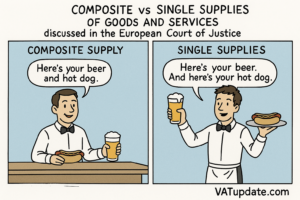
- One single supply or multiple supplies?
- A supply of goods or a supply or services?
- How to qualify the supply of goods or services?
Impact on VAT assessment
- Place of supply of goods or services
- Exempt or taxed
- Applicable VAT rate
- Invoicing
Impact on Fixed Establishment
- Impact on Fixed Establishment: When goods and services are bundled, the establishment may no longer be able to carry out the supply on an independent basis.
Guidelines found in ECJ Cases
- Check whether or not it is really possible to distinguish the various components of a supply
- A supply of services prevailing over a supply of goods, which in turn is inseparably linked to the service (or vice versa)
- Then, the whole operation is conclusively treated as a single supply
- Important:
- Perception of the customers/consumers
- External evidence as the identification of separate items in the contract or other documents associated with the transaction
- Every performance should in principle be considered to be a distinct and independent performance
- However, a performance should not be artificially split up into multiple performances
- A set of multiple performances should be considered to be one single performance when one or more elements are considered to be the principal performance, while other elements are ancillary to the principal performance
- A performance should be considered to be ancillary if it does not constitute a goal in itself for a customer, but rather should be considered to be a; way to make the principle performance more attractive/ i.e. not an aim in itself, but a means of better enjoying the principal supply
- This should be assessed from a consumer’s perspective/customer’s intention
- A set of performances should be considered to be one performance when two or more elements are so closely tied that they constitute one single performance from an economic perspective/economic reality
- Separate contracts that were not inextricably linked to one another
- Separate terms and prices/items recharged at cost
Examples
- Two different products sold in one package
- Conference/seminars
- Leasing vehicle: car + leasing
- Supply of goods with transport
- Advertising and rebates
ECJ Cases
- Extensive case law by ECJ
- However, ECJ only provides guidelines
- Still much uncertainty because facts and circumstances not always correspond
- National courts need to apply the guidelines to the facts of the case
- National court may have a different interpretation
- Leads to a fragmented approach in the EU Member States
ECJ Cases Decided
- C-73/85 (Kerrutt) – Multiple taxable transactions that cannot be combined into a single transaction must be treated separately for VAT
- C-231/94 (Faaborg-Gelting-Linien A/S): Restaurant transactions on board ship – Place of taxable transactions
- C-308/96 & C-94/97 (Madgett and Baldwin) – A service is ancillary when it is not an end in itself for the customers but a means to make the main service of the provider more attractive
- C-349/96 (Card Protection Plan) – A single transaction or multiple transactions for VAT purposes?
- C-150/99 (Stockholm Lindöpark AB) – No general VAT Exmption for a Membership of a golf club including a wide range of additional services
- C-41/04 (Levob Verzekeringen and OV Bank) – Software is a supply of services if customization is predominal
- C-111/05 (Aktiebolaget NN) – Composite supply – Supply and installation of a fibre-optic cable linking two Member States
- C-251/05 (Talacre Beach Caravan Sales Ltd) – A single supply allows levying VAT at the standard rate also on the supply ”VAT exempted” goods
- C-425/06 (Part Service) – Composite Supplies – Abuse of rights in case leasing contracts are split
- C-88/09 (Graphic Procédé) – Reprographics activities can either be classified as supply of goods or services
- C-276/09 (Everything Everywhere) – Additional fees charged when using certain methods of payment for mobile telephony services
- C-497/09 (Bog & Others) (Joined case with C-499/09, C-501/09, C-502/09) – Composite supplies – VAT treatment of foods supplied for immediate consumption
- C-572/07 (RLRE Tellmer Property) – Rental of an immovable property and the service of cleaning the common parts are separate services
- C-44/11 (Deutsche Bank) – No Exemption for transactions relating to the management of securities-based assets (portfolio management))
- C-117/11 (Purple Parking and Airparks Services) – Parking service combined with passenger transport from car park to airport is a single composite service
- C-224/11 – (BGŻ Leasing sp. z o.o) – Leasing services supplied together with insurance for the leased item
- C-395/11 (BLV Wohn- und Gewerbebau GmbH) – The term “construction work” includes not only services but also supplies of goods
- C-42/14 (Wojskowa Agencja Mieszkaniowa) – Letting of immovable property and the provision of water, electricity and heating must be regarded as constituting several distinct and independent supplies
- C-208/15 (Stock ’94) – Supply of goods and a grant of a loan constitutes a single transaction
- C-432/15 (Pavlína Baštová) – Prize money is not a Taxable Transaction for VAT purposes
- C-463/16 (Stadion Amsterdam) – Principal element determines the VAT rate for the Composite Supply of services
- C-231/19 (BlackRock Investment Management (UK) Ltd) – Judgment – VAT treatment of management services outside scope of the exemption
- C-581/19 (Frenetikexito) – Nutritional advice within the fitness center is an independent VAT service, not exempted from VAT
- C-282/22 (Dyrektor Krajowej lnformacji Skarbowej) – Electricty and services supplied at charging stations are a single/complex supply
- C-505/22 (Deco Proteste – Editores, Lda) – A gift for a subscription is not a free transfer of goods and is ”incidental service” to the main supply
- C-808/23 (Högkullen) – Parent-subsidiary services cannot always be treated as a single supply
- C-234/24 (Brose Prievidza) – VAT Refund Not Barred by Lack of Export
- C-409/24 to C-411/24 – Reduced VAT Rate Excludes Non-Accommodation Ancillary Services
Pending ECJ Cases
None
Summary of each case
C-73/85 (Kerrutt)
- A customer contracted separately with a builder for a house and with a landowner for the plot, under a “package deal” building scheme. The tax authority sought to treat the linked construction supplies of goods and services as one integrated transaction.
- The Court held that supplies made under separate contracts by different suppliers, which are legally and economically distinct, must each be assessed independently for VAT even where they pursue a common economic goal, provided they cannot genuinely be merged into one transaction.
- Takeaway: Multiple taxable transactions that cannot objectively be combined into a single supply are treated separately. Contractual and economic independence prevails; a shared purpose alone does not create a single composite supply for VAT purposes.
C-231/94 (Faaborg-Gelting-Linien A/S)
- A ferry operator served meals for on-board consumption during crossings between Denmark and Germany. The question was whether restaurant catering constituted a supply of goods (food) or a supply of services, and where the transaction should be taxed.
- The Court ruled that restaurant transactions are supplies of services, since food is only one component within a predominant bundle of service elements: preparation, table service, crockery, furniture and ambience. On ships, the place of supply is the operator’s place of business.
- Takeaway: Where service elements predominate over the mere delivery of food, catering is a service. This introduced the “overall assessment” and “predominant element” reasoning central to later composite-supply case law.
C-308/96 & C-94/97 (Madgett and Baldwin)
- Hotel operators bundled in-house accommodation with bought-in transport (coach travel) for guests, raising the question of whether the tour-operator margin scheme applied and how in-house and bought-in services should be distinguished for VAT.
- The Court held that the margin scheme applies to bought-in travel services, but not to in-house services. A service is ancillary where it is not an end in itself for customers, but a means of better enjoying the trader’s principal service.
- Takeaway: The ancillary-supply test was crystallised here: ancillary services follow the VAT treatment of the principal supply. This wording became the standard formulation echoed across virtually all later composite-supply judgments.
C-349/96 (Card Protection Plan)
- CPP offered a card-protection package combining an insurance element (indemnity against loss) with registration and administrative services. The dispute concerned whether this was a single supply or multiple supplies, and whether the insurance exemption applied.
- The Court held that a single supply exists where one or more elements constitute the principal service and others are ancillary. Each transaction is normally distinct, but artificial splitting of a single economic supply must be avoided; the essential features determine the classification.
- Takeaway: The foundational “CPP test”: ancillary means “not an end in itself, but a means of better enjoying the principal supply.” This remains the cornerstone reference for single-versus-multiple supply analysis.
C-150/99 (Stockholm Lindöpark AB)
- The case concerned whether the operation of a golf course and the granting of access to sports facilities, alongside various additional services offered to members, could benefit from a general VAT exemption under Swedish law.
- The Court held there is no general VAT exemption for such supplies. Making sports facilities available for consideration is a taxable economic activity, and Member States could not maintain a blanket exemption inconsistent with the Directive’s limited exemption categories.
- Takeaway: Bundled sporting and membership services are, in principle, taxable. Exemptions are to be construed strictly, and a broad membership package including diverse services cannot be swept into a general exemption.
C-41/04 (Levob Verzekeringen and OV Bank)
- Levob acquired standard software and paid separately for its substantial customisation and installation to meet the insurer’s specific needs. The issue was whether this was one supply or two (goods plus services), and its correct classification.
- The Court held there was a single supply of services, since the standard software and its customisation were so closely linked that they formed one indivisible economic supply which it would be artificial to split, with customisation being predominant and essential.
- Takeaway: The “Levob test” for indivisible single supplies: where elements are objectively inseparable, treat as one supply and classify by the predominant element. Customised software supplied with the base product is a service.
C-111/05 (Aktiebolaget NN)
- The case concerned the supply and installation of a fibre-optic cable running between two Member States (and international waters), involving both the goods (the cable) and substantial installation, laying and testing services.
- The Court held this was a single supply of goods, since transfer of the cable occurred only after installation and testing; the goods element predominated. Place of supply was apportioned by the geographical location of the cable in each territory.
- Takeaway: A composite supply of goods-plus-installation is a single supply of goods where the goods predominate. It complements Levob (services) by illustrating classification toward goods, and addresses cross-border apportionment.
C-251/05 (Talacre Beach Caravan Sales Ltd)
- The supply of caravans (zero-rated in the UK) was combined with their removable contents/equipment (standard-rated). The question was whether a single-supply analysis forced the whole package to be zero-rated, absorbing the taxable contents.
- The Court held that where national law deliberately applies different rates, a single supply does not prevent charging the standard rate on the distinctly-taxed items. The zero rate for the caravan did not automatically extend to its separately-rated contents.
- Takeaway: Single-supply treatment does not override a Member State’s deliberate rate distinctions preserved under standstill/derogation rules. Standard-rated components can retain their rate even within one supply—a nuance later refined by Stadion Amsterdam.
C-425/06 (Part Service)
- Leasing arrangements were deliberately split into separate contracts (financing, insurance, intermediation) among linked companies to reduce the taxable base and lower overall VAT. The authorities alleged an abusive practice.
- The Court held that artificially splitting a single transaction into multiple contracts can constitute an abuse of rights where the essential aim is to obtain a tax advantage contrary to the Directive’s purpose, even if not the sole aim.
- Takeaway: The abuse-of-rights doctrine (Halifax) applies to composite supplies. Contractual splitting engineered chiefly for tax advantage can be recharacterised as a single transaction, defeating the intended VAT saving.
C-88/09 (Graphic Procédé)
- A reprographics business reproduced documents from originals supplied by clients, controlling volume, binding and finishing. The question was whether this constituted a supply of goods (copies) or a supply of services.
- The Court held reprographics is a supply of goods where it is limited to reproducing documents and the right to dispose of copies passes to the customer; it is a service where accompanying services (advice, design) predominate over mere copying.
- Takeaway: Classification depends on the predominant element assessed from the customer’s perspective. Simple copying = goods; where tailored, value-adding services dominate = services. National courts apply the test to the facts.
C-276/09 (Everything Everywhere)
- A mobile telephone operator charged additional “separate payment handling” fees to customers paying by certain methods (e.g. card, non-direct-debit). The issue was whether these fees were a distinct exempt financial service or part of the telephony supply.
- The Court held the payment-handling charges did not constitute a distinct supply for customers; they were ancillary to the principal telecommunications supply. Customers did not seek a separate payment service as an end in itself.
- Takeaway: Charges for facilitating payment for a principal supply share that supply’s VAT treatment. Such fees cannot be carved out as separately exempt financial transactions—reinforcing the CPP ancillary test.
C-497/09 (Bog & Others, joined C-499/09, C-501/09, C-502/09)
- Various operators (snack stalls, market vans, cinema foyers, party caterers) supplied freshly prepared food for immediate consumption. The question was whether these were supplies of goods (reduced rate) or restaurant services (standard rate).
- The Court held that supplies of food from stands and mobile vans with only basic facilities are supplies of goods; catering with significant service elements (crockery, service staff, tableware) is a supply of services. The predominant element governs.
- Takeaway: The dividing line depends on the balance of service components accompanying the food. Minimal preparation and facilities = goods (reduced rate); substantial service = services. This refines Faaborg-Gelting for takeaway/catering.
C-572/07 (RLRE Tellmer Property)
- A landlord let apartments (VAT-exempt) and separately charged tenants for cleaning the building’s common parts. The issue was whether the cleaning shared the letting’s exemption or was a distinct taxable service.
- The Court held that cleaning common parts and the letting of property are, in this case, separate and independent supplies. Cleaning was invoiced separately and could be provided by third parties, so it did not form a single supply with the exempt letting.
- Takeaway: Services accompanying exempt property letting are not automatically exempt. Where separable (separate pricing, third-party provision possible), they are distinct taxable supplies—an important limit on the scope of the letting exemption.
C-44/11 (Deutsche Bank)
- Deutsche Bank provided discretionary portfolio management to clients, combining analysis/advice with the execution of buying and selling securities. The question was whether this was a single supply and whether any exemption (for securities transactions) applied.
- The Court held this was a single supply whose elements (advice and trade execution) were of equal importance and inseparable. It did not qualify for exemption; the entire portfolio-management service was standard-rated.
- Takeaway: Where two elements are equally important and indivisible, there is one composite supply. Portfolio management is fully taxable—the securities-transaction exemption does not extend to the combined advisory-plus-execution service.
C-117/11 (Purple Parking and Airparks Services)
- Off-airport “park and ride” operators offered car parking combined with transfer of passengers by shuttle bus between the car park and the airport terminal. The issue was whether these were one supply or two (parking plus transport).
- The Court held this constituted a single composite supply of parking. From the customer’s perspective, the elements were so closely linked that splitting would be artificial; parking was the predominant element, with transport ancillary.
- Takeaway: Even elements that could theoretically be supplied separately form one supply where objectively inseparable in the customer’s eyes. The transport followed the parking’s VAT treatment as the principal element.
C-224/11 (BGŻ Leasing sp. z o.o.)
- A lessor leased assets and also arranged insurance for the leased items, recharging the insurance cost to lessees. The question was whether leasing and insurance were one supply or distinct, and whether the insurance exemption applied.
- The Court held that leasing and the associated insurance are, in principle, distinct and independent supplies. Where the lessee has the choice and the insurance is separately priced, insurance is a distinct exempt supply, not ancillary to the leasing.
- Takeaway: Insurance recharged with leasing is generally separate and exempt, contrasting with cases finding single supplies. Customer choice and separate pricing are key indicators of independence—not automatic bundling.
C-395/11 (BLV Wohn- und Gewerbebau GmbH)
- The case concerned a derogation permitting reverse charge on “construction work,” and whether that term, and the reduced-rate scope, covered supplies of goods (e.g. a building erected) as well as services.
- The Court held that the term “construction work” under the relevant derogation covers not only supplies of services but also supplies of goods, giving Member States discretion to define its scope while respecting neutrality and proportionality.
- Takeaway: “Construction work” is a broad concept spanning goods and services. Member States enjoy latitude in delimiting reverse-charge and related regimes for construction, provided EU-law principles are observed.
C-42/14 (Wojskowa Agencja Mieszkaniowa)
- A landlord let immovable property and supplied utilities (water, electricity, heating, refuse collection), recharging consumption to tenants. The issue was whether utilities were part of a single letting supply or distinct supplies.
- The Court held that where tenants can decide their consumption (individual meters, separate billing), the utilities are distinct and independent supplies from the letting. Where tenants have no genuine choice, utilities may form a single supply with the letting.
- Takeaway: The decisive factor is tenant control over consumption. Metered, separately-billed utilities are independent supplies with their own rates; fixed, non-optional provision may be ancillary to exempt letting.
C-208/15 (Stock ’94)
- Under an “integration” agricultural arrangement, an integrator supplied goods (seeds, materials) to farmers and simultaneously granted them loans to finance those purchases, tied together contractually.
- The Court held the supply of goods and the granting of the loan constituted a single transaction, with the supply of goods being the principal element. The financing was ancillary, serving to enable acquisition of the goods.
- Takeaway: Interlinked financing and goods can form one composite supply where the loan merely facilitates the goods purchase. The credit did not qualify as a separately exempt financial service in this integrated context.
C-432/15 (Pavlína Baštová)
- A racehorse owner/trainer received prize money depending on her horses’ performance in races. The question was whether prize money contingent on results constituted consideration for a taxable supply of services.
- The Court held that prize money conditional on a specific result (placing) is not consideration for a taxable supply, because of the uncertainty—no direct link between service and payment. However, appearance fees paid regardless of result are taxable.
- Takeaway: Result-dependent prizes lack the direct link required for a taxable transaction. Payments made irrespective of outcome (e.g. participation fees) are taxable consideration—a key distinction for uncertain, contingent remuneration.
C-463/16 (Stadion Amsterdam)
- A stadium offered guided tours that included access to a museum. Under national rules, one element (the museum) could have qualified for a reduced rate. The issue was the rate applicable to the single composite supply.
- The Court held that a single supply must be subject to a single rate of VAT, determined by its principal element—even if a component, supplied separately, would attract a reduced rate. The principal element (the tour) set the rate for the whole.
- Takeaway: One supply, one rate. Composite supplies cannot be artificially split to apply a reduced rate to part; the predominant element’s rate governs the entire transaction. (Later nuanced for accommodation by C-409/24.)
C-231/19 (BlackRock Investment Management (UK) Ltd)
- BlackRock received a single management service (the “Aladdin” IT platform) used to manage both special investment funds (SIFs, exemptable) and other funds. The issue was whether the exemption for SIF management applied to the whole service.
- The Court held the exemption did not apply, because it was a single supply used indiscriminately across all funds and could not be split by proportion. A single supply cannot be partly exempt where the predominant use is non-qualifying.
- Takeaway: A single management service used for both exempt and non-exempt funds is taxed uniformly; apportionment is not permitted. The SIF-management exemption is narrowly applied to composite outsourced services.
C-581/19 (Frenetikexito)
- A fitness centre offered physical training combined with nutritional monitoring/advice, provided under a single price. The question was whether nutrition advice was ancillary to (and shared the treatment of) fitness, or an independent service.
- The Court held the nutrition service was an independent supply, not ancillary to fitness: each was an end in itself for customers and could be supplied separately. Nutrition advice was not exempt as medical care absent a therapeutic purpose.
- Takeaway: Independence is judged by whether each element is an end in itself. Frenetikexito consolidated the modern “general rule plus three exceptions” framework and confirmed a restrictive approach to bundling for exemption. [jdsupra.com]
C-282/22 (Dyrektor Krajowej Informacji Skarbowej)
- A Polish operator of EV charging stations supplied electricity together with access to charging equipment, technical support and IT applications (booking, transaction history, e-wallet). The question was whether this was a supply of goods or services. [vatupdate.com]
- The Court held it constituted a single complex supply of goods, since the transfer of electricity (tangible property under Article 15) is the characteristic and predominant element; access to devices, support and IT are ancillary means of better enjoying it. [danovky.sk], [tktaxlaw.com]
- Takeaway: EV recharging is a supply of goods (electricity) for VAT. Accompanying technical and IT services are ancillary and do not alter classification—important for the rate, place of supply and chain-transaction treatment of e-mobility. [eur-lex.europa.eu]
C-505/22 (Deco Proteste – Editores, Lda)
- A Portuguese publisher gave new magazine subscribers a “free” tablet or smartphone (value under €50). The issue was whether the gift was a separate free supply (deemed supply under Article 16) or part of the subscription. [vatupdate.com]
- The Court held the gift was not a free transfer of goods, but an ancillary/incidental supply to the principal supply of subscriptions, forming a single supply for consideration. VAT is due only on the subscription consideration. [meijburg.com], [eur-lex.europa.eu]
- Takeaway: Promotional gifts inducing subscriptions follow the principal supply’s VAT treatment (including its reduced rate) and do not trigger a separate deemed supply. This benefits businesses using gifts to promote sales. [meijburg.com]
C-808/23 (Högkullen)
- A Swedish holding company actively managing subsidiaries supplied management, financial, real-estate, IT and HR services, invoiced via cost-plus. The tax authority treated them as a single unique supply with no market comparator, requiring open-market-value revaluation on all costs. [kpmg.com]
- The Court held that Articles 72 and 80 preclude tax authorities from treating such parent-to-subsidiary services as a single supply in all situations. The open-market value can still be determined using the comparison method for the individual services. [eur-lex.europa.eu]
- Takeaway: Intra-group management services cannot be automatically bundled into one unique supply to force cost-based revaluation. Each service is, in principle, individually assessable—highly relevant for shared-services and management-recharge structures. [kpmg.com]
C-234/24 (Brose Prievidza)
- A Slovak company sought a Bulgarian VAT refund on “tooling” (a special tool) purchased in Bulgaria that remained on the manufacturer’s premises to produce components later supplied intra-Community. Bulgaria refused, treating the tool as ancillary to the exempt intra-Community supply. [vatupdate.com]
- The Court held that the mere fact goods did not leave the Member State cannot, in itself, justify refusing a refund. Refusal is justified only where the tool supply forms part of a single transaction or is ancillary to the intra-Community supply. [eurotax.fr], [news.bloom…ergtax.com]
- Takeaway: Tooling supplies are a facts-based exercise; absent artificial splitting, the tool is a taxable domestic supply and the buyer keeps a refund right. Physical movement alone does not defeat VAT recovery—reinforcing neutrality. [news.bloom…ergtax.com]
C-409/24 to C-411/24 (J-GmbH and Others)
- Three German hotel/guesthouse operators bundled short-term accommodation (reduced 7% rate) with breakfast, parking, Wi-Fi and wellness. The question was whether German law could exclude such ancillary services from the reduced rate, taxing them at 19%. [vatupdate.com]
- The Court held that Article 98 does not preclude national rules excluding non-accommodation ancillary services from the reduced rate, provided fiscal neutrality is respected. Member States may selectively apply reduced rates to accommodation alone. [vatabout.com], [vatupdate.com]
- Takeaway: A notable refinement of Stadion Amsterdam’s “one supply, one rate”: for accommodation, Member States may lawfully split off ancillary services (breakfast, parking, Wi-Fi) and tax them at the standard rate, even within a single package price. [vatupdate.com]
Podcasts
C-808/23 (Högkullen) – Parent-subsidiary services cannot always be treated as a single supply
C-234/24 (Brose Prievidza) – Judgment – VAT Refund Not Barred by Lack of Export – VATupdate
Thesis
Articles
- Join the Linkedin Group on ECJ VAT Cases, click HERE
- For an overview of ECJ cases per article of the EU VAT Directive, click HERE
Latest Posts in "European Union"
- Flashback on ECJ Cases C-409/98 (Mirror Group) – Tenant inducements are not exempt property letting
- Roadtrip through ECJ Cases – Focus on Place of Supply of Intra-Community Acquisitions – ”Triangulation” (Art. 42)
- Roadtrip through ECJ cases: Focus on Promotional activities/Discounts (Art. 79, 87, 90(1))
- EU and China Agree Trade Understandings on Tariffs, Hybrid Vehicles and Market Access
- United States Seeks Comments on EU CBAM’s Impact on Trade