1. Executive Summary
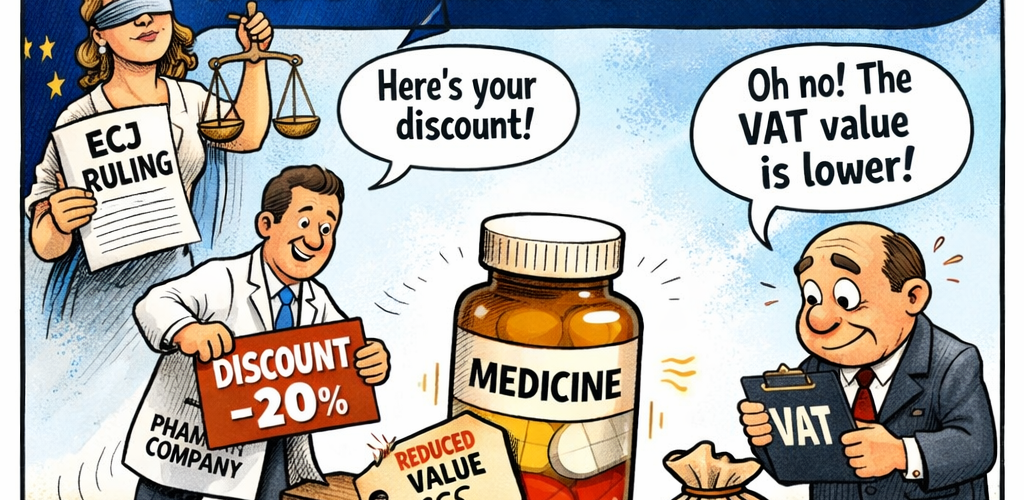
This ECJ judgment, delivered on 20 December 2017, clarifies the interpretation of Article 90(1) of Council Directive 2006/112/EC (the VAT Directive), specifically regarding the reduction of the VAT taxable amount when pharmaceutical companies are legally required to grant discounts to private health insurance companies. The Court ruled that such mandatory discounts do result in a reduction of the taxable amount for the pharmaceutical company, aligning the treatment with discounts granted to public health insurance schemes and upholding the fundamental principles of VAT neutrality and equal treatment.
2. Case Background and Dispute
The case originated from a preliminary ruling request by the Bundesfinanzhof (Federal Finance Court, Germany) concerning Boehringer Ingelheim Pharma GmbH & Co. KG (Boehringer), a pharmaceutical company.
- Supply Chain: Boehringer manufactures medicinal products and supplies them to pharmacies via wholesalers. Pharmacies then supply these products to individual consumers.
- Public vs. Private Insurance:Statutory (Public) Health Insurance: For medicines supplied to persons covered by public health insurance, pharmacies grant a discount to the health insurance funds. Boehringer is then required to reimburse these discounts to the pharmacies or wholesalers. The German tax authority treats this discount as a reduction in remuneration for VAT purposes.
- Private Health Insurance: For medicines supplied to persons with private health insurance, the private health insurance company reimburses the insured person for the costs incurred. Boehringer is then statutorily required to grant a discount directly to the private health insurance company. Crucially, the German tax authority did not treat this discount as a reduction in remuneration for VAT purposes, arguing that private insurers are not part of the direct supply chain from Boehringer to the final consumer.
- Boehringer’s Challenge: Boehringer sought to reduce its taxable amount for VAT in its 2011 declaration by deducting the reimbursements made to private health insurance companies. The tax authority rejected this.
- Referring Court’s Dilemma: The Bundesfinanzhof observed that previous ECJ case law (e.g., Elida Gibbs) allowed for taxable amount reductions even when a manufacturer had no direct contractual link with the final consumer, provided a “chain of transactions” existed. However, it questioned whether private health insurers fit into this “supply chain” given they only reimburse insured individuals, rather than purchasing the medicines themselves. The referring court also raised concerns about unequal treatment under EU law, as similar discounts were treated differently based on the type of insurer, despite the pharmaceutical company being financially encumbered in the same way.
3. Key Legal Principles and Provisions
The ECJ’s decision hinged on the interpretation and application of several core EU VAT principles:
- VAT Directive 2006/112/EC:Article 73: Defines the taxable amount as “everything which constitutes consideration obtained or to be obtained by the supplier… from the customer or a third party.”
- Article 90(1): Stipulates that “where the price is reduced after the supply takes place, the taxable amount shall be reduced accordingly.” This provision aims to ensure that “the tax authorities may not collect an amount of VAT exceeding the tax which the taxable person received.” (Para 32)
- Principle of VAT Neutrality: This is a fundamental principle, meaning that “within each country similar goods should bear the same tax burden whatever the length of the production and distribution chain.” (Para 33, quoting Elida Gibbs). It also implies that the taxable person should only pay VAT on the actual consideration received.
- Elida Gibbs Case (C-317/94): This landmark case established that when a manufacturer grants a price reduction to the final consumer, even without a direct contractual relationship, the taxable amount for VAT must be reduced to reflect the actual amount finally received by the manufacturer.
- Principle of Equal Treatment (Article 20 Charter of Fundamental Rights of the European Union): The referring court highlighted this principle, questioning the objective justification for treating discounts to private insurers differently from those to public insurers when the underlying economic effect on the pharmaceutical company is the same.
4. Court’s Reasoning and Analysis
The ECJ’s reasoning focused on the core principle that the taxable amount for VAT should reflect the actual consideration received by the taxable person.
- Actual Consideration Received: The Court emphasized that Boehringer ultimately receives a sum “corresponding to the price of the sale of those products to pharmacies, reduced by that discount.” (Para 35) It would contradict the VAT Directive for the taxable amount to exceed this finally received sum.
- Principle of Neutrality Applied: The Court explicitly stated that if the taxable amount were not reduced, “the principle of neutrality of VAT vis-à-vis taxable persons… would not be complied with.” (Para 35)
- Elida Gibbs Precedent: The Court confirmed that the principles from Elida Gibbs are applicable. Although Article 90(1) usually refers to direct contractual modifications, its application must not undermine the principle of neutrality (Para 38). The Court clarified that Article 90(1) does not necessarily presuppose a subsequent contractual modification, as long as “part or all of the consideration has not been received by the taxable person.” (Para 39)
- Indirect Link Sufficient: The Court found that the fact that the private health insurance company directly reimburses insured persons (not purchasing the product itself) does not “break the direct link between the supply of services made and the consideration received.” (Para 40) It considered the private health insurance companies as “being the final consumer of a supply made by a pharmaceutical company” in the sense that they bear the ultimate cost and benefit from the discount. (Para 41)
- Mandatory Discount: The Court noted the crucial fact that the discount was fixed by law and mandatory. Since Boehringer was legally obliged to grant the discount, it “was not able freely to dispose of the full amount of the price received on the sale of its products.” (Para 43) This aligns with previous case law (e.g., International Bingo Technology) where statutorily mandated payments reduce the “consideration received.” (Para 44)
5. Conclusion and Ruling
The ECJ concluded that, in light of the principles established in Elida Gibbs, the principle of equal treatment, and the fundamental principle of VAT neutrality, Article 90(1) of the VAT Directive must be interpreted to allow for a reduction of the taxable amount.
The Court ruled:
“In the light of the principles defined by the Court in the judgment of 24 October 1996, Elida Gibbs (C-317/94, EU:C:1996:400, paragraphs 28 and 31), regarding the determination of the taxable amount for value added tax and having regard to the principle of equal treatment under EU law, Article 90(1) of Council Directive 2006/112/EC of 28 November 2006 on the common system of value added tax must be interpreted as meaning that the discount granted, under national law, by a pharmaceutical company to a private health insurance company results, for the purposes of that article, in a reduction of the taxable amount in favour of that pharmaceutical company, where it supplies medicinal products via wholesalers to pharmacies which make supplies to persons covered by private health insurance that reimburses the purchase price of the medicinal products to persons it insures.” (Para 46 and Formal Ruling)
This judgment ensures that pharmaceutical companies only pay VAT on the net amount they effectively receive, regardless of whether the discount is channelled through public or private health insurance schemes, thereby upholding fiscal neutrality and equal treatment.
See also
- ECJ C-462/16 – Boehringer Ingelheim Pharma GmbH & Co. KG – Judgment – Discounts reduce the VAT value of pharmaceutical supplies – VATupdate
- Roadtrip through ECJ cases: Focus on Promotional activities/Discounts (Art. 79, 87, 90(1)) – VATupdate
- Join the Linkedin Group on ECJ/CJEU/General Court VAT Cases, click HERE
- VATupdate.com – Your FREE source of information on ECJ VAT Cases
- Podcasts & briefing documents: VAT concepts explained through ECJ/CJEU cases on Spotify
Latest Posts in "European Union"
- Comments on ECJ Case C-639/24: Limits on Denying VAT Exemption for Intra-Community Supplies
- European Parliament Analysis: The Role of the Reverse Charge Mechanism in Tackling VAT Fraud
- Mathez Formation: VAT news: the CJEU puts economic reality back at the centre of the game (Feb 6)
- Blog: Navigating Indirect Rebates: A Call for Clarity in VAT Regulations Under ViDA
- European Parliamentary Research Service briefing: Evaluating the Reverse Charge to Fight Fraud