Click HERE to explore more Episodes om ”VAT concepts explained through ECJ/CJEU cases”
SUMMARY
Executive Summary:
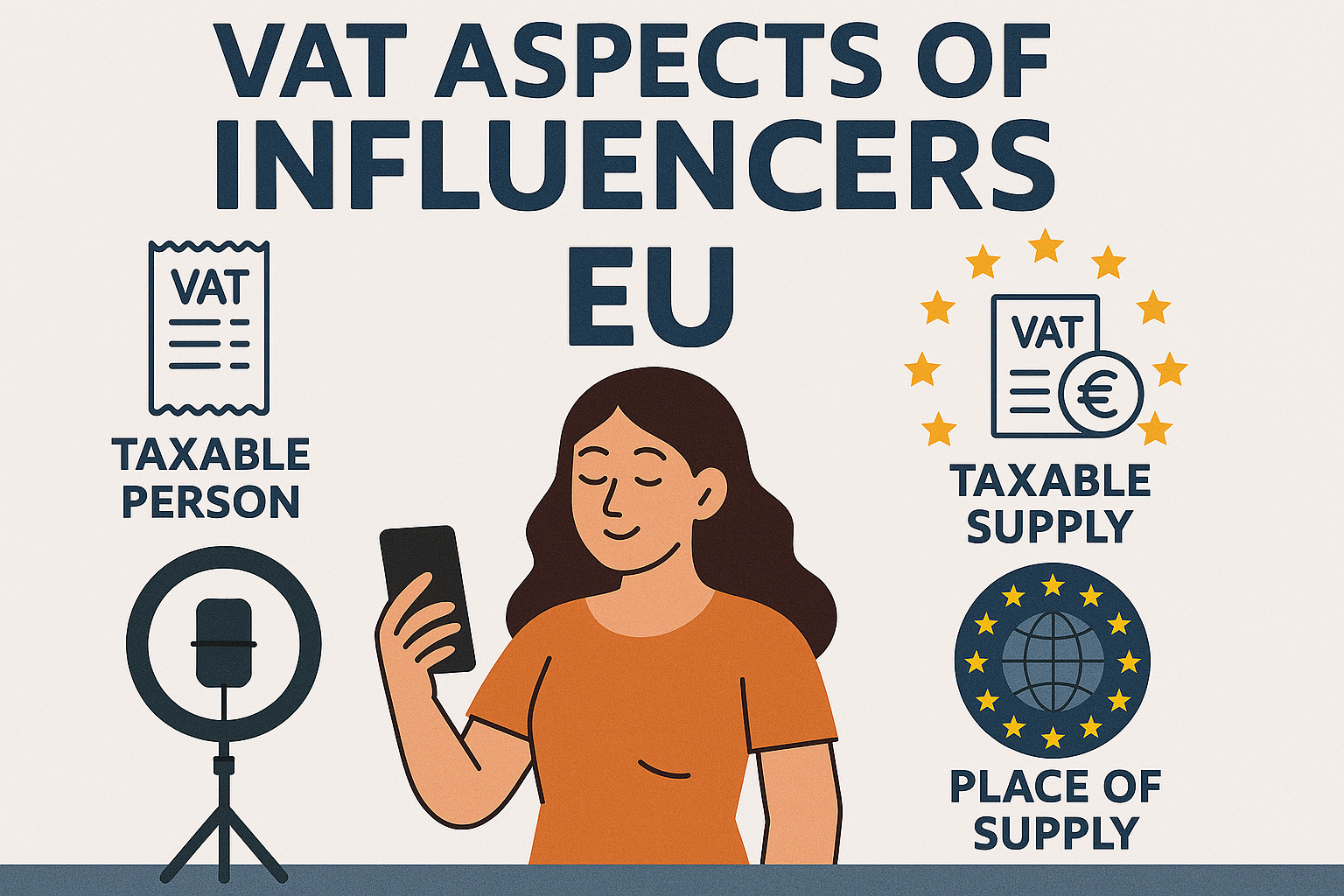
This document outlines the Value Added Tax (VAT) obligations of social media influencers operating within the European Union (EU). The core principle is that influencers are treated as businesses for VAT purposes. There is no “influencer tax” but standard VAT rules apply to the services they provide and the goods they sell. They must register for VAT, charge VAT on their income, and remit it to the tax authorities, subject to certain thresholds and simplified schemes like the One-Stop Shop (OSS) for cross-border transactions. The article details different income streams, cross-border considerations, and offers practical guidance for compliance, including a discussion of EU case law that has shaped the VAT landscape for the digital economy.
Key Themes and Ideas:
Standard VAT Rules Apply:
- The EU VAT Directive governs the VAT treatment of influencers. “Social media influencers in the EU are subject to the same VAT rules as any other business.”
- There is “no special “influencer tax” or exemption.”
- Influencers must register and charge VAT like other businesses once their revenue exceeds the national threshold. These thresholds vary considerably across member states.
Definition of Economic Activity:
- The article emphasizes that anyone conducting an “economic activity” is a taxable person under the EU VAT Directive. “In the context of influencers, if you are earning or seeking to earn income by creating content, promoting products, or leveraging your audience for remuneration, you are engaging in economic activity.”
- The distinction between a hobby and a business hinges on “intention and continuity rather than profit level.”
Taxable Income Streams:
- “Any form of compensation for an influencer’s work is considered payment for a supply.”
- This includes cash payments for sponsored content, affiliate commissions, barter arrangements (free products, trips), and other forms of remuneration. Only “genuine unsolicited gifts or tips (with no strings attached)” fall outside VAT.
- Sponsored Posts/Brand Collaborations: These are treated as B2B service. VAT is charged at the standard rate. Cross-border B2B is subject to the reverse charge mechanism.
- Affiliate Marketing: Commission income is also a taxable service, handled similarly to sponsored posts.
- Platform Revenue (Ad Sharing, Subscriptions, Tips):Revenue sharing from platforms like YouTube and TikTok is generally treated as a B2B service provided to the platform.
- For paid subscriptions (e.g., Patreon, OnlyFans), the platform typically handles VAT collection from end-users, as confirmed by the ECJ “Fenix” case. The influencer provides a service to the platform which is often subject to reverse charge or is outside the scope of EU VAT if the platform is based outside of the EU.
- “True donations” (gifts) are outside the scope of VAT if there is no obligation or specific benefit in return.
- Merchandise and Product Sales: Physical goods are a supply of goods, and digital goods (downloads) are treated as electronic services. The place of taxation is determined by distance selling rules and the OSS.
- Barter Deals: These are taxable. “In a barter arrangement, there are essentially two supplies“. Influencers must charge VAT on the service value (based on the market price of the product/trip received).
- Appearances and Events: Appearances and performances are services. Admission to events for consumers is taxed where the event takes place.
Cross-Border VAT Rules:
- B2B Services: The “reverse-charge mechanism” applies, where the client in another EU country accounts for VAT. “The invoice carries no VAT; instead, it states something like “Reverse charge – VAT exempt under Article 44”.”
- B2C Sales (Goods & Digital Services): The One-Stop Shop (OSS) simplifies VAT collection for cross-border sales to consumers within the EU. “Since mid-2021, the EU’s One Stop Shop (OSS) system allows a single registration to cover all cross-border B2C sales of goods and electronic services within the EU.”
- There is an EU-wide threshold of €10,000 per year for total cross-border consumer sales (all EU countries combined). Above that threshold, VAT must be collected based on each customer’s country, necessitating OSS registration.
- Non-EU Influencers: Must register for and charge VAT from the first sale to EU consumers.
VAT Registration and Compliance:
- Influencers must apply for VAT registration once they exceed the threshold (or if there is no threshold in their country).
- Upon registration, they must charge VAT, issue VAT invoices, keep records, and file periodic VAT returns.
- Failure to comply can lead to penalties and backdated tax bills.
Member State Differences:
- While the EU VAT Directive provides the framework, “each country administers VAT independently, which leads to differences in thresholds, in specific administrative rules, and in how actively they enforce certain provisions.”
- Registration thresholds vary widely, from €0 in Spain to around €85,000 in Italy.
- Some countries have special regimes for small entrepreneurs.
Platform Responsibilities:
- The 2023 ECJ “Fenix” case (OnlyFans) emphatically confirmed that OnlyFans must charge VAT on all payments from fans (at the fans’ location’s rate) and cannot just treat itself as taking a commission.
Importance of Documentation:
- It’s crucial to maintain proper invoices and records for all income and expenses.
- For barter deals, documentation should ideally state market values.
- Platforms use self-billing where they issue a statement showing e.g. “Service provided: €1000, VAT: €0 RC, Total: €1000”.
Enforcement & DAC7:
- Starting 2023, a significant EU measure (DAC7 directive) requires digital platforms to report income generated by sellers/users to tax authorities annually. This makes it much easier to detect VAT non-compliance.
Relevant ECJ Case Law:
The article highlights several key ECJ cases:
- Tolsma (1994): Established the principle of a “direct link” between payment and service for VAT to apply. This is the basis for why unsolicited gifts aren’t taxed.
- Fenix/OnlyFans (2023): Confirmed that platforms are often the principal supplier of electronic services to consumers, responsible for VAT collection.
- Rompelman (1985), INZO (1996): Defined what constitutes engaging in business for VAT, emphasizing intent and economic activity even if small or ultimately unsuccessful.
Conclusion:
EU-based influencers must understand and comply with VAT laws. By registering when required, charging VAT correctly, utilizing OSS and reverse charge mechanisms, maintaining proper records, and staying updated on regulations, influencers can manage their VAT obligations effectively and focus on their core business
INDEPTH ANALYSIS
Social media influencers in the EU are subject to the same VAT rules as any other business. There is no special “influencer tax” or exemption – when an influencer engages in economic activity (providing promotional services, selling goods, etc. for income), EU VAT law treats them as a taxable person. Below is a detailed overview of how VAT applies to influencers, covering registration obligations, different income types (sponsored content, affiliate earnings, free products, events, etc.), cross-border rules, and relevant court rulings. Key points upfront:
- Standard VAT Rules Apply: Influencers must register and charge VAT just like other businesses once their revenue exceeds the national threshold (which ranges from €0 in some countries to around €20–50k, and up to €85k in a few cases). No EU country has a blanket VAT exemption specifically for influencer work.
- All Income is Taxable: Any form of compensation for an influencer’s work is considered payment for a supply. Cash payments for sponsored posts, affiliate commissions, and even barter arrangements (free products, trips, or services given in exchange for publicity) are subject to VAT. Only genuine unsolicited gifts or tips (with no strings attached) fall outside VAT.
- Cross-Border Services: Influencers often reach audiences and clients across the EU. For business clients in other countries (B2B), VAT is typically handled by the reverse-charge mechanism (the client’s country accounts for VAT, so the influencer’s invoice shows no VAT). For consumer audiences (B2C), selling digital services or goods into other EU countries may require the influencer to charge the customer’s local VAT – this is simplified by the One Stop Shop (OSS) system once annual cross-border B2C sales exceed €10,000.
- Platforms and VAT: Many influencers use platforms (YouTube, Instagram, Twitch, Patreon, OnlyFans, etc.) to monetize content. Major platforms generally handle VAT on sales to end-users, meaning the platform charges VAT to viewers/fans where required. The influencer then provides a service to the platform (usually B2B). A recent ECJ case in 2023 (the “OnlyFans” case) confirmed that platforms facilitating paid content are responsible for VAT on those fan payments, not the individual influencers.
- Member State Differences: All EU countries follow the common VAT Directive principles, but practical details differ. VAT registration thresholds vary; some countries require registration from the first euro of revenue, others have generous small-business exemptions. Some tax authorities (e.g. Ireland) have issued specific guidance for influencers, but they all reiterate that influencers must comply with normal VAT laws – including invoicing, record-keeping, and paying VAT due.
- Agencies and Businesses: Whether an influencer operates as a sole trader, through their own company, or via an agency, the VAT treatment remains consistent. Each taxable supply in the chain (influencer → agency, agency → brand, etc.) is subject to VAT rules. An agency paying an influencer is not a loophole to avoid VAT; it simply means the influencer’s client is the agency (and that transaction must have VAT applied or accounted for appropriately).
VAT Registration: When and Where Influencers Must Register
- Some countries have no threshold at all for domestic businesses – meaning any amount of business income requires VAT registration. Spain is a prime example: an influencer in Spain must register for VAT from the first euro earned from brand deals or other taxable supplies. (Spain’s law doesn’t offer a general small business exemption, so virtually all business activities fall under VAT.) Similarly, Sweden and Finland effectively require registration at very low turnover (in Finland’s case the threshold is only €15,000, in Sweden SEK 0 for those with tax liable turnover).
- Many countries set moderate thresholds on the order of €10,000–€50,000 per year. For instance, Germany’s small business threshold is €22,000 in the previous year (and not above €50,000 in the current year) – roughly meaning if a German influencer made more than €22k last year, or will clearly exceed €50k this year, they must register. Ireland has a €37,500 annual threshold for services (like promotional work) and €75,000 for goods – an Irish content creator who only does sponsored services would register once they top €37.5k in a year. Poland is about PLN 200,000 (≈ €45k). Denmark ~DKK 50,000 (≈ €6,700).
- A few countries have opted for the maximum allowable thresholds under EU law (around €85,000). For example, Italy effectively has an €85,000 threshold through its special “flat-rate” (forfettario) regime for small businesses: Italian influencers under that revenue can choose this regime, under which they do register for VAT but do not charge VAT on sales (and cannot reclaim input VAT either). France historically had €34,400 for services, but is in the process of raising thresholds (toward €85k) in line with EU simplification options; by 2025-2026 France’s threshold for services will likely be higher (exact figures evolving). Czech Republic recently raised its threshold to CZK 2 million (around €80k).
- Charge VAT on their taxable supplies at the appropriate rate. Influencer services (promotion, advertising) are almost always taxed at the standard VAT rate (since they are not a specifically exempt or reduced category). Standard rates vary by country (e.g. ~20% in France/UK, 21% in Belgium, 23% in Ireland, 27% in Hungary, etc.).
- Issue VAT invoices for sales to other businesses or upon request by customers. A proper invoice includes the influencer’s VAT number, the client’s VAT number if it’s a B2B EU sale, date, description of service, amount, VAT amount or rate, and any special mentions (like “Reverse charge” if applicable).
- Keep records of all income and expenses. This includes documenting freebies received as barter (with their estimated value) and any VAT charged or paid.
- File periodic VAT returns (monthly or quarterly in most cases, depending on country and turnover) and pay any VAT due to the tax authority. The VAT due is the VAT charged on sales minus the VAT paid on business purchases (input VAT credit) – see the section on VAT deductions.
- Within the EU (OSS scheme): Traditionally, if you sold goods or digital services to consumers in other EU countries, you had to register in each country once you exceeded certain thresholds. Since mid-2021, the EU’s One Stop Shop (OSS) system allows a single registration to cover all cross-border B2C sales of goods and electronic services within the EU. There is an EU-wide threshold of €10,000 per year for total cross-border consumer sales (all EU countries combined). If your total sales of goods/services to consumers in other EU countries stay under €10k/year, you can simply charge your home country’s VAT and report it domestically (treating those as local sales). Once you go above €10k, you are required to collect VAT based on each customer’s country. OSS is a huge simplification: the influencer can keep one VAT number (home country) and file a quarterly OSS return listing how much was sold to customers in each Member State and paying the VAT for each – the tax authorities distribute it accordingly. Without OSS, the influencer would have to register for VAT in every country where consumers buy their content or merchandise, which is burdensome. In practice, most growing influencers who sell across borders will opt into OSS as soon as they approach the threshold.
- Non-EU influencers: If an influencer is based outside the EU but making sales to EU consumers (for example, a US influencer selling digital coaching sessions to people in Germany, or merchandise shipped to France), EU law requires them to register for and charge VAT from the first sale in each country – there is no small business threshold for non-established businesses. However, they can simplify by registering for the “non-Union OSS” for digital services (e-services) and the IOSS (Import One Stop Shop) for low-value goods imports, or by using an EU intermediary. Essentially, the EU doesn’t let non-EU sellers skip VAT; the system is designed to level the playing field so that foreign suppliers charge the same VAT to EU customers as local suppliers would. For instance, a Canadian YouTuber selling downloadable content to EU fans would register in one EU state for OSS and use it to remit VAT for all EU sales, rather than needing 27 registrations.
- Multiple roles (e.g., separate businesses): If an influencer has more than one business activity (say they also have a consulting company), depending on national rules, those might be under one VAT number if they operate as one legal person. But generally, an individual or single entity has one VAT registration covering all its economic activities.
VAT Treatment of Different Influencer Income Streams
1. Sponsored Posts, Brand Collaborations, Advertising Services
- VAT on Domestic Sponsorships: If the brand (client) is in the same country as the influencer, the influencer must charge VAT at the standard rate on the fee. For instance, if an influencer in France charges €5,000 for a campaign to a French company, they add 20% French VAT (€1,000) for a total of €6,000. The brand can typically reclaim that €1,000 as input VAT in its VAT return (since it’s a business expense), so the VAT is neutral to the brand but the tax gets recorded. The influencer will declare €5,000 as taxable turnover and €1,000 as VAT collected in their return and pay that €1,000 to the tax authorities.
- Cross-Border B2B (EU): If the client is a business in another EU Member State, the “place of supply” shifts to the client’s country under the general B2B rule (Article 44 of the VAT Directive). The practical effect is the invoice carries no VAT; instead, it states something like “Reverse charge – VAT exempt under Article 44”. The client on their end must self-account for VAT (charge themselves the local VAT and simultaneously deduct it, if entitled, so no actual cost). This is known as the reverse-charge mechanism. It simplifies life for the influencer because they don’t have to register or pay VAT in the client’s country. Example: A German cosmetics brand pays a Polish influencer €2,000 for posts. The Polish influencer (if VAT-registered in Poland) invoices €2,000, VAT 0, with a note that it’s reverse-charged. The German brand will include €2,000 as a purchase under reverse charge in its German VAT filing (meaning they’ll compute 19% of 2,000 as output tax and claim it back as input tax in the same return). Important: The influencer should obtain the client’s VAT number to apply this treatment and include it on the invoice. Without a valid VAT ID for the client, a cross-border service might have to be treated as B2C (see below).
- Services to Non-EU Businesses: Similar to the above, if an influencer in the EU provides services to a client outside the EU (say a US or UK company), the service is “outside scope” of EU VAT (since under the general rule it’s taxed where the client is, and that’s outside the EU VAT area). The invoice would be without VAT. Often an annotation like “Export of service – not subject to EU VAT” is used. The influencer doesn’t charge EU VAT, and the non-EU client will handle any VAT obligations on their side (e.g., some countries have reverse charge for imported services).
- B2C Sponsored Work: It’s relatively uncommon for an influencer to be directly paid by an individual consumer for a sponsorship-type service (usually it’s companies paying). If it does happen, the place of supply for B2C services is where the supplier (influencer) is located, by default. That means the influencer would charge their own country’s VAT to the customer. For instance, a French micro-influencer got paid €500 by an individual in France to promote that person’s indie music on their Instagram; they’d charge French VAT on €500. If the individual was in another EU country, it might fall under “electronically supplied services” rules if delivered online, but generally personal one-off arrangements are rare. In practice, almost all “sponsored content” deals will be B2B (the brand or an agency acting for the brand is the customer, not a private person).
- Roles of Agencies/Talent Managers: Frequently, influencers work with agencies or managers who line up deals. An agency might contract with the brand to deliver a campaign involving the influencer. In such cases, the agency is essentially buying the influencer’s services and reselling to the brand. Each leg is a transaction: the influencer provides a service to the agency, and the agency provides a service to the end client. From a VAT perspective:
- Influencer invoices agency for the agreed amount (plus VAT if domestic, or reverse-charged if agency is abroad).
- Agency invoices the brand (plus VAT if domestic, or reverse-charge if brand is in another EU country).
- The presence of an agency does not remove the influencer’s VAT obligation; it just means the influencer’s customer is the agency instead of the brand. So, for example, if an Italian agency arranges a UK influencer to promote a product for a French brand, the UK influencer would invoice the Italian agency with 0% VAT (UK to Italy B2B falls under reverse charge). The Italian agency would invoice the French brand with 0% VAT (Italy to France B2B reverse charge). The French brand accounts for French VAT. Each party handles their part.
- In-House Employees vs Independent Influencers: If a brand simply gifts something to a person with no contractual obligation (like a random fan), no service is provided. But if a brand uses its own employees or hires an advertising company, that’s not an “influencer scenario” per se. We mention this only to clarify that the influencer cases we’re discussing involve independent content creators acting as vendors, not salaried employees of the brand.
2. Affiliate Marketing and Commission Income
- If the retailer/business paying the affiliate commission is in the influencer’s home country, the commission is just another service payment. The influencer must charge VAT on that commission. Often the arrangement is that the retailer will issue a self-billing invoice or a statement showing commission earned. For example, a UK influencer earned £1,000 in affiliate commissions from a UK-based online store; the store might self-bill £1,000 + £200 VAT (20%) = £1,200, paying £1,200 and then the influencer pays £200 to HMRC (the store deducts £200 as input).
- If the affiliate program is run by a company in another EU country, then as a B2B service, no VAT is charged by the influencer – it’s reverse-charged to the company paying the commission. For example, a German influencer in the Amazon EU Associates program gets commission from Amazon Luxembourg (which is common in Europe). The German influencer doesn’t charge German VAT on that income; Amazon Luxemburg self-accounts for Luxembourg VAT (and since Amazon’s business is largely VAT-exempt or out of scope in that context, it might not actually pay anything, but that’s on Amazon).
- If the paying company is outside the EU (say a US-based affiliate network), the service is an export of services – no EU VAT adds, and the influencer just needs to report it as an out-of-scope sale.
3. Platform Revenue: Ad Sharing, Subscriptions, and Tips
- Advertising Revenue Sharing (YouTube, TikTok, etc.): Platforms like YouTube (Google AdSense) share a portion of advertising revenue with content creators. Contractually, the creator typically is providing a service to the platform (the right to place ads on their content, content creation services, etc.) for which the platform pays them. Here, the platform is the business client. For example, Google Ireland pays a Polish YouTuber for ad views by Polish and EU viewers. In this B2B service scenario, the YouTuber’s service is “advertising intermediary service” provided to Google. According to the general VAT rule, the place of supply is Ireland (Google’s location), so the Polish YouTuber’s invoice (often self-billed by Google) is without Polish VAT – Google applies Irish reverse charge (Google both the supplier and recipient in self-billing, effectively). If the influencer is below threshold and unregistered, technically they should have registered because that income is taxable (though practically, if that was the only income and all under reverse-charge, the Polish tax might not push them until threshold if that’s allowed – in Poland, local turnover threshold counts even those services? Actually, in some countries foreign-supplied B2B services might not count toward domestic threshold, but that’s detail).
- Self-Billing: As noted, YouTube/Google uses self-billing where they issue you a statement each month showing e.g. “Service provided: €1000, VAT: €0 RC, Total: €1000”. The influencer then just accounts for €1000 as an output (zero-rated export) in their records. Similar programs include TikTok’s Creator Fund, Facebook/Instagram’s ad or bonus programs, etc. Most are structured such that the platform has a local entity in the EU (Ireland or another) and handles VAT internally via reverse charge.
- Paid Subscriptions and Memberships: Influencers may earn through fans paying for exclusive content – e.g. via Patreon, OnlyFans, Twitch Subscriptions, YouTube Channel Memberships, or similar. The VAT handling here depends on who is considered the supplier of the service to the final consumer:
- On platforms like OnlyFans or Patreon, the platform typically acts as an agent or reseller of the content. In the EU, a specific rule (VAT Implementing Regulation Article 9a) says if a platform facilitates a supply of electronic services for payment, the platform is deemed to be the supplier to the consumer (unless the platform is explicitly acting as an intermediary and the actual supplier is clearly indicated). Practically, platforms have generally taken on the VAT burden for consumer sales. The 2023 ECJ “Fenix” case (OnlyFans) emphatically confirmed that OnlyFans must charge VAT on all payments from fans (at the fans’ location’s rate) and cannot just treat itself as taking a commission. This means that an influencer using OnlyFans does not personally charge their subscribers VAT – OnlyFans does it within the subscription price. Instead, the influencer is providing a service to OnlyFans (the platform gets, say, 20% commission, but legally it’s as if OnlyFans bought the content from the influencer and sold it to fans). The influencer’s service to OnlyFans is B2B. Since OnlyFans (Fenix Intl) is a UK company, an EU influencer’s sale to it is an export (no EU VAT). Platforms like Patreon (US-based), or Twitch (US-based for the bits system) similarly handle VAT on the consumer side: Patreon, for example, adds VAT for EU patrons and remits it via OSS; it then pays creators their share. Thus, the influencer just receives their net payout and generally does not have to charge VAT on it (because their customer is Patreon, not the end patron).
- YouTube Channel Memberships and Twitch Subs: In these cases, Google and Amazon (Twitch) also handle VAT for the membership or sub fees (they’re essentially like OnlyFans in that regard). The influencer gets a share after VAT. The influencer’s share is again a B2B payment from the platform (often under a service agreement).
- Direct Subscriptions: If an influencer bypasses major platforms and sells content access directly (say through their own website with Stripe payments), then the influencer is the one supplying the digital service to consumers and must handle the VAT. In that scenario, the influencer would likely need to register for OSS to charge each subscriber’s local VAT once over €10k EU-wide. Many avoid this hassle by using existing platforms that do it for them.
- Bottom line: For most mainstream platforms, the platform collects VAT from fans and the influencer deals with the platform under B2B terms. Influencers should be aware of this and ensure they aren’t also charging VAT on the same funds. For example, pre-2023 some OnlyFans creators in the EU were unsure and might have (erroneously) charged VAT on their subscriber earnings; the court case clarified they shouldn’t – OnlyFans did. If an influencer uses a smaller platform or custom setup where they are responsible for customer billing, then they must apply the B2C VAT rules themselves.
- Donations and Tips: Some fans send money without expecting a specific product – e.g., a viewer donates €5 during a live stream just to support the creator. True donations (gifts) are outside the scope of VAT because there’s no “supply” in return. However, this area can be gray: if the influencer gives any benefit (even a shout-out or their name on a screen) in return, tax authorities might argue there is a supply of service (entertainment, acknowledgement) for that payment. Generally, small voluntary tips are considered gratuitous. But if, say, an influencer sets up a system “Donate €50 and I’ll send you a personalized thank-you video,” that’s clearly a service for payment and is taxable. The guiding principle from case law (like Tolsma, where a street musician’s voluntary donations were not taxed) is that payments which are freely given with no obligation and no specific benefit in return are not “consideration” for VAT. Many influencers treat sporadic tips as outside VAT (or as a price-included scenario on platforms that anyway handle it). If tips become a significant revenue source, it’s safer to consult tax guidance on whether those should be treated as taxable. Often platforms like Twitch treat bits (tips) similarly to subs – as part of their service – so again the platform may handle VAT when the bits are purchased.
4. Merchandise and Product Sales
- Domestic Sales: Sales to customers in the influencer’s own country are straightforward – charge local VAT on each sale (once registered). For example, a Dutch influencer selling a €30 t-shirt to a Dutch fan would charge 21% VAT (approximately €6.30) and the consumer pays €36.30 gross. The influencer later remits the €6.30 to the tax authority (minus any credits).
- Distance Selling within the EU: If an influencer ships goods to consumers in other EU countries, the place of taxation is determined by the distance selling rules. As of 2021, an EU-wide threshold of €10,000 for cross-border B2C (for all EU countries combined) applies to goods (and electronically supplied services together). Below this threshold, an influencer can choose to just treat foreign sales as domestic (charging their home VAT). Once above, by law the sales should be taxed in the destination country (where the customer is located). The influencer then has two choices: register in each such country or use the OSS (One Stop Shop). OSS, as mentioned, allows them to report all these sales in one return.
- In OSS, the influencer needs to charge the correct VAT rate of the buyer’s country at the point of sale. This means adjusting prices or at least knowing which rate to apply based on shipping address. Software or e-commerce platforms often handle this calculation. For example, an Austrian influencer selling posters to consumers across the EU, upon crossing €10k in EU sales, will start charging German customers 19% VAT, French customers 20%, Sweden 25%, etc., instead of Austrians 20%. All that gets summed in the OSS report.
- If not using OSS, the influencer would legally need a VAT number in each country where they surpass that country’s own threshold (which since 2021 is generally zero as the harmonized threshold is EU-wide). This is unworkable for small businesses, hence the push to use OSS.
- Selling Outside the EU: If an EU influencer sells goods to customers in non-EU countries (like Switzerland, USA, etc.), those goods are exports. Exports are zero-rated for EU VAT – meaning the influencer does not charge VAT on them. However, the customer may have to pay import VAT or customs duties when the item arrives in their country, depending on that country’s laws and the item’s value. Some influencers clearly inform international fans that they are responsible for any import fees. The EU has the IOSS system for goods under €150, but that’s more relevant to non-EU sellers importing into EU. For an EU seller exporting goods, zero-rate is fine, but they should keep proof of shipment out of EU in case of audit.
5. Barter Deals and Gifts (Non-Monetary Compensation)
- The influencer supplies a service (promotion, endorsement, content creation) to the brand.
- The brand supplies a good or service (the free product or benefit) to the influencer.
- The influencer must charge VAT on the service value (the value of what they provided). Since no money is paid, the value is based on the consideration received. Usually that means the market price of the product/trip they got (or the fee they would have normally charged for similar work, if that’s known). In practice, tax authorities often use the fair market value of the item received as the value for the service. For example, an influencer gets a smartphone worth €1000 in exchange for reviewing it. If the influencer is VAT-registered, they should issue an invoice to the phone company for “marketing services” worth €1000 and add VAT (say 20% = €200) – even though they aren’t paid €1000, they got a phone of equal value. They would declare €1000 as output and owe €200 in VAT. If the phone company is domestic, they might actually physically pay that VAT to the tax authority (and the phone company could take the invoice from influencer to claim €200 input VAT, offsetting the VAT they’ll owe on giving away the phone). If cross-border, the influencer might mark it reverse-charged (if the brand is in another country).
- The brand must account for VAT on the item given to the influencer. When a business gives away goods from its inventory, that can be considered a taxable supply unless it qualifies as a low-value gift or sample. Typically, the brand would treat the item’s cost or price as a taxable amount and owe output VAT on it. However, if the brand receives the influencer’s invoice (with VAT), the brand might offset the two VAT amounts. Alternatively, the brand might also issue a self-billed invoice on behalf of the influencer to formalize things.
- The influencer supplies a £500 service to the hotel – output VAT £100.
- The hotel supplies a £500 service (hotel room) to the influencer – output VAT £100. They could swap invoices: influencer invoices hotel £500+£100 VAT; hotel invoices influencer £500+£100 VAT. Each then claims the other’s VAT, netting out to zero if fully deductible (the hotel’s expense on marketing is business use, reclaim £100; the influencer’s hotel stay – if it’s considered a business expense, possibly reclaim, but if it’s personal enjoyment, the influencer company might not be allowed to reclaim that input VAT, so they’d end up bearing the cost). In any case, HMRC sees £100 due and £100 claimed on each side. If the influencer can’t claim (because maybe the stay isn’t strictly for business use?), the influencer ends up effectively paying the VAT out of pocket, which is a cost.
- Unsolicited PR Gifts: Suppose a brand sends a product with no formal agreement – “we hope you like it, feel free to share if you wish”. The influencer is not obliged to post. In that case, from the influencer’s perspective, no supply has been made. They didn’t promise anything in return, so the item is a true gift. Therefore, the influencer does not owe any VAT just for receiving an unsolicited gift, because they haven’t supplied a service for it. (For the brand’s VAT: the brand might still have to treat it as a taxable gift depending on value, but that doesn’t involve the influencer). Many brands and influencers operate this way with “PR mailers” – the brand takes the VAT hit on giving away some inventory as advertising, and the influencer, if they like, may post something but isn’t under contract. Tax-wise, that’s simpler for the influencer. However, if this becomes systematic (“we’ll keep sending you our monthly box and we know you always post an unboxing”), it could be seen as an implicit agreement. Generally though, if there’s no obligation, the tax authority can’t assert a sale occurred. (This principle goes back to Tolsma: voluntary payments/gifts = no direct link, no taxable supply).
- Explicit Barter Deals: If there was a clear arrangement – even an email exchange like “We’ll gift you X if you post Y” – then it’s a barter. Most serious campaigns with high-value items involve explicit terms, thus clearly barter.
- De Minimis and Samples: The VAT Directive allows exceptions for gifts of “small value” and “samples” given by businesses. E.g., a company can give small promotional items or sample products without charging itself VAT. Each country sets its definition of small value (commonly €50 or so per recipient per year). If an influencer only receives such minor items, the brand might classify them as exempt business gifts, and the influencer’s work might be seen as incidental goodwill. But high-value exchanges won’t qualify.
6. Appearances, Events, and Offline Services
- Paid Appearances/Performances: If a cosmetics company pays a beauty influencer €2,000 to appear at a store opening in Milan, or a conference pays a tech YouTuber a fee to speak, those fees are taxable services. The nature of service might be categorized as “entertainment services” or “promotional services” but either way, no special exemption applies (VAT isn’t waived just because it’s a personal appearance). The influencer will handle VAT similar to sponsored content: charge VAT if the client is domestic, or reverse-charge if the client is a business in another country.
- Events for Consumers: If an influencer hosts their own ticketed event for fans (like a meet-and-greet or a live performance), they are now supplying admission to an event to consumers. VAT rules have a special tweak: admission to events (concerts, conferences, etc.) to private individuals is taxed where the event takes place (Article 53 VAT Directive), not where the supplier is. So if a German influencer organizes a paid workshop in Italy for attendees, Italian VAT would be due on the ticket sales, meaning the influencer might need an Italian VAT registration just for that, or use a local partner. This is an edge case; many influencers avoid the hassle by not directly selling international event tickets themselves (they might partner with a local organizer).
- Services vs Goods at events: If an influencer sells merchandise at an event, that’s goods (VAT based on where the sale happens – e.g. selling shirts at a convention in UK means UK VAT on those spot sales). If they charge for autographs or photos, that’s a service (could be seen as part of admission or a separate service).
- Cross-Border Considerations: Usually these appearance deals are B2B (brand or event company hires influencer). As noted, B2B cross-border means the influencer might not charge VAT (if client has VAT ID in another EU country). One thing to consider: some countries have a concept of “use and enjoyment” for services. E.g., if an influencer’s service is actually used in a country different from the one dictated by general rules, some states tax it locally to avoid loopholes. A classic example: if a service is supplied to a non-EU client but effectively used in an EU country, that EU country might demand VAT. For instance, Denmark has a rule like this – if a foreign entity hires a Danish company to do advertising targeting Denmark, Denmark wants VAT on it even if normally export of service. For influencers, this is rarely enforced except in very specific cases (and would be the client’s problem via reverse charge typically).
- Reimbursements of Expenses: If travel or accommodation costs are reimbursed by the client separately, sometimes those can be passed through without VAT (disbursements) or with VAT depending on how invoiced. If the contract says “we’ll pay your travel,” some clients handle booking directly (then it’s out of scope for influencer). If the influencer invoices “travel expenses €300”, that usually forms part of their supply (so VAT is added to that expense reimbursement, unless it qualifies as a disbursement under specific rules).
Differences Across EU Member States and Practical Guidance
- Registration Thresholds Recap: As discussed, whether an influencer needs to register depends on local thresholds: from none (Spain) to high (up to ~€85k). This is a major difference: an influencer earning €15k a year in Spain is obliged to be VAT registered and charge VAT, whereas the same earnings in Germany would be under the threshold and not require VAT. Influencers who move or operate in multiple countries must be aware of this. Also, some countries differentiate between goods and services thresholds (Ireland, France).
- Small Business Regimes: Some countries have special regimes for small entrepreneurs that alter VAT obligations. Italy’s regime forfettario (flat tax regime) is one: eligible businesses under €85k turnover pay a percentage income tax but do not charge VAT (they’re exempt from VAT but still count as taxable persons in a way). This regime is popular among Italian influencers just starting out. Spain, conversely, has no simplified VAT regime (everyone charges VAT, but small self-employed can pay income tax via modules – separate from VAT though).
- Invoicing and Record Requirements: All countries require basically similar info on invoices (as per the Directive and local laws). But details like whether you must issue an invoice for B2C sales vary – e.g., in some countries you must give an invoice if a customer asks or if it’s a distance sale; in others, receipts or simplified invoices are enough for small sales. Influencers selling online often use e-receipts; if they sell via platforms, those platforms often issue invoices to buyers. As long as records are kept, that’s fine.
- Guidance from Tax Authorities: A number of tax authorities have released guidance or rulings targeting the influencer economy:
- Ireland (Revenue Commissioners) in mid-2025 released detailed guidelines for influencers, covering VAT and income tax. They explicitly outlined scenarios of monetary and non-monetary income, reaffirming that standard VAT rules apply and giving examples (e.g., how to value a free car given to an influencer for promotion, how affiliate income is taxable, etc.). This sort of guidance is meant to educate and warn influencers to comply.
- Germany hasn’t issued a specific “influencer VAT” notice, but the Ministry of Finance has commented on things like the OnlyFans case, confirming Germany’s alignment with the ECJ decision. Also, German court rulings have addressed whether certain Youtubers were engaged in commercial activity (affirming they were).
- Spain has issued binding rulings (consultas) confirming that YouTube or Twitch income is subject to VAT (with no threshold exemption). Spain’s tax agency also deploys data tools to identify undeclared online earnings (e.g., checking bank deposits from platforms).
- UK (no longer EU, but relevant historically) had an eye on influencer income too and published guidelines; the principle was the same: treat it as any other supply of services.
- Other countries: Many have not done special rules simply because it’s clear existing rules cover it. But they may feature influencer scenarios in audits or Q&As. For instance, France has general guidance on barter and online sales, which would equally apply to influencers. The Netherlands have clarified that product sponsorships count as consideration.
- Enforcement and DAC7: Starting 2023, a significant EU measure (DAC7 directive) requires digital platforms to report income generated by sellers/users to tax authorities annually. This includes platforms like YouTube, Facebook (for marketplace maybe or bonuses), Etsy, Patreon, etc. So, tax authorities will get data on influencer earnings from platforms. This will make it much easier for authorities to detect influencers who should be VAT-registered but are not. For example, if an influencer in Country X earned €50k via Patreon in 2024 and didn’t register, the tax authority could be alerted and pursue them. Tax audits for influencers often look at social media content (if someone is showing many freebies or luxurious life but no business registration, questions arise). Also, governments are publicizing the obligation: e.g., in Italy there were high-profile cases of influencers caught evading taxes, sending a message to others.
- No Special VAT Rates or Exemptions: Influencer activities don’t benefit from any reduced VAT rates (those are usually for things like books, basic food, etc.) nor exemptions (exemptions are for categories like education, healthcare, etc. – influencing doesn’t fit these). So everywhere in the EU, the standard rate of VAT applies to their services in general. A minor exception might be if an influencer writes a book and sells it – books might be at a reduced rate or zero in some countries, but that’s because it’s a book, not because an influencer wrote it.
- Cross-Border Simplicity: The OSS system is EU-wide, so once an influencer tackles that, it’s uniform. Some smaller countries might not have many influencers making cross-border sales, but the rules are there.
- Income Tax vs VAT: Worth noting though outside the scope: Member States might have differing income tax treatments (some allow hobby income under a threshold before tax, etc.), but for VAT, the coordination is much tighter via EU rules.
Relevant ECJ Case Law Shaping VAT for Influencers
- Direct Link and Consideration (Tolsma, 1994): In the Tolsma case, a street musician played music and received voluntary donations from the public. The court held that since listeners were not obligated to pay, and payments were completely voluntary, there was no direct link between the service (music) and the payments – thus no “consideration” and no taxable supply. This case is fundamental in VAT: it established that a payment must be tied to a specific service/good to be taxable. For influencers, this underpins why true unsolicited gifts or voluntary fan donations aren’t taxed, whereas any agreed exchange is. The principle of “reciprocal performance” (each side does something for the other) is what triggers VAT. So if a company says “we’ll give you this if you do that,” it’s taxable; if they give something with no strings, it’s not (for the recipient).
- Barter Transactions (Various cases): The EU courts have consistently treated barter like any sale. Cases like Naturally Yours Cosmetics (1988) and Empire Stores (1994) dealt with non-monetary consideration (services in exchange for discounts, or customers getting free goods for referrals). They confirmed that as long as you can assign a monetary value to the exchange, it should be taxed on that value. More recent cases like Serebryannay vek (2014) and A Oy (2018) dealt with complex barter scenarios (services exchanged for rights to use property, demolition services in exchange for salvage material) and again confirmed the two-sided supply approach. These cases collectively mean that influencers and brands must value what they exchange. If a high-end bag is given for a post, both sides should treat that bag’s retail price as the taxable amount.
- Platform as Deemed Supplier (Fenix/OnlyFans, 2023): This is very relevant for digital content monetization. The Fenix case addressed the platform OnlyFans, which had argued it was just an intermediary and should only owe VAT on its 20% commission. The ECJ ruled that EU law (the Implementing Regulation’s Article 9a) validly makes the platform the principal supplier of the electronic service to consumers. In effect, when a fan pays $10 to an OnlyFans creator, OnlyFans is deemed to charge the fan $10 + VAT (if applicable, depending on location), and then pays the creator $8 (80%) as “their share” – but for VAT, that $8 is considered the fee for the creator’s service to OnlyFans, not to the fan. This ruling ensures VAT is collected on all such transactions and simplifies things for tax authorities (dealing with one platform rather than thousands of creators). For influencers, Fenix means if you use a platform that falls under these rules, you generally do not charge VAT to your fans – the platform does it – but you may need to account for VAT on what you earn from the platform (usually under reverse charge or outside scope if platform is foreign). After Fenix, many EU countries updated guidance to clarify that people on platforms like OnlyFans, Patreon, etc., wouldn’t individually charge VAT to end customers; instead, they treat their income as B2B from the platform.
- Economic Activity (Rompelman 1985, INZO 1996): These cases dealt with what constitutes engaging in business for VAT. Rompelman allowed a person to register for VAT and deduct VAT on building property even before any rental income started – because they clearly intended an economic activity. INZO said even if a project ultimately fails, the initial intent to do economic activity made the VAT on startup costs deductible. For influencers, this highlights two things: (1) Starting to monetize a social account, even if small, makes it an economic activity (no need to be profitable yet); (2) If you invest in equipment anticipating future income, you may be able to recover VAT on those costs once you’re in business. Conversely, if someone claims “oh it’s just a hobby” but they regularly get income, tax authorities will point to these principles to say it’s business.
- Use & Enjoyment (various cases): A minor mention – certain cases (e.g. about telecom services) have led to rules to ensure taxation where services are actually used. Not directly about influencers, but for instance if an influencer’s service is technically “exported” but used in the EU, some countries might still tax it. These are exotic scenarios (the average influencer won’t run into this unless deliberately structuring around VAT).
- Samples and Gifts (EMI Group, 2010): This case clarified what counts as a sample (generally, small specimen for trying out). It matters for brands giving items to influencers – if something is a sample, the brand doesn’t have to charge itself VAT. But if an influencer gets a full-sized product as a gift, it might not qualify as a “sample” under those rules. The case law helps companies decide how to treat their marketing distributions. Influencers indirectly benefit when a brand can call something a sample (the brand eats the VAT and the influencer isn’t involved).
- Influencers are not outside the tax net – the same concepts of taxable supply apply to them.
- Non-monetary payments are definitely taxable (the courts have taken that question up many times and always concluded yes, tax them).
- The new digital economy adjustments (like deeming platforms as suppliers) have been upheld by the courts, integrating platform-facilitated influencer income into the VAT system.
Conclusion and Essential Takeaways
- Register when required: Know your country’s threshold and track your earnings. Register for VAT on time to avoid penalties. Once registered, put systems in place to charge and collect VAT on your sales. Don’t forget that big ticket barter deals count towards your turnover.
- Charge VAT (or ensure it’s accounted) on all forms of income: Whether you’re paid in euros or given a fancy gadget or free resort stay, if it’s in return for your services you need to factor in VAT. For cash payments, add the VAT to your invoice. For barter, coordinate with the brand to handle the VAT exchange. Do not assume “free product” means no tax matters.
- Use the reverse charge and OSS mechanisms for cross-border simplicity: If you deal with companies abroad, put their VAT ID on your invoice and apply no VAT (with the proper note) – that keeps you from having foreign VAT headaches. If you sell to fans across Europe (merch, digital content), get familiar with OSS – it’s a lifesaver to avoid multiple registrations and ensures you charge the correct VAT to each customer legally.
- Leverage platforms but know the implications: Platforms can take over a lot of VAT collection burden for audience sales – let them, it’s easier. But remember to handle your relationship with the platform: if you’re VAT-registered and the platform is in the same country, they might need you to charge VAT on your fee (though often they are in a different country or use self-billing reverse charge, meaning you don’t charge VAT to them either). Always check how a platform is dealing with VAT – many have FAQ documents for creators on this.
- Maintain proper invoices and records: It’s not just about paying VAT, it’s also about documenting it. Keep copies of invoices you issue, self-billing invoices from platforms, and receipts for your business purchases (so you can claim input VAT). Good records will make VAT returns and any potential audits much smoother.
- Understand deductions: While beyond the scope of the question, a reminder: if you’re charging VAT, you can usually reclaim VAT on your business-related costs – equipment, professional services, etc. This can significantly offset what you pay. Plan purchases strategically (maybe invest in needed gear once you’re VAT-registered to get the VAT back).
- Stay compliant and updated: Tax authorities are increasingly savvy about the digital economy. Many influencers who ignored VAT have been caught out. Also, VAT rules continue to evolve (for example, the EU’s “VAT in the Digital Age” initiative may further change reporting obligations in coming years, making real-time data reporting or platform liabilities even more robust). It pays to at least annually review if any VAT rule changes affect your operations.
See also
Core EU and general VAT articles
- EU – VAT Rules For Social Media Influencers (overview of EU VAT treatment, thresholds, OSS, income streams) – link on VATupdate.com
- Understanding EU VAT Rules for Social Media Influencers – A Comprehensive Guide – link on VATupdate.com
- Influencer Tax: Do Online Creators Pay VAT? – link on VATupdate.com
Country‑specific / targeted pieces
- Switzerland – Understanding VAT Obligations for Influencers and Their Clients in Digital Marketing – link on VATupdate.com
- VAT Rules for Business Gifts and Samples – Implications for Social Media Influencers – link on VATupdate.com
New rules and international developments
- VAT Guidelines for Social Media Influencers: Obligations, Registration, and Record-Keeping – link on VATupdate.com
- New Tax Rules for Influencers: Registration and VAT Filing Required by June 30, 2026 – link on VATupdate.com
- Taiwan Issues New VAT Rules for Influencers and Platforms in Digital Economy – link on VATupdate.com
Latest Posts in "European Union"
- VATupdate’s Free Interactive Tool: ECJ & General Court VAT Case Finder: 1,315 VAT cases searchable by article, sub-article, topic and status
- VATupdate’s Free Interactive Tool: EU E-Invoicing & E-Reporting Matrix – Check Every Scenario, in Every Member State
- EGC Customs T-28/25 (Hauptzollamt A) : AG Includes Design Costs and Component Buying Commissions in Customs Value
- Blog – ViDA Meets Reality: Businesses Call for One EU Digital VAT Model, Not 27 National Systems
- Germany: Good-Faith Reliance on VAT Margin Scheme Invoice Allowed