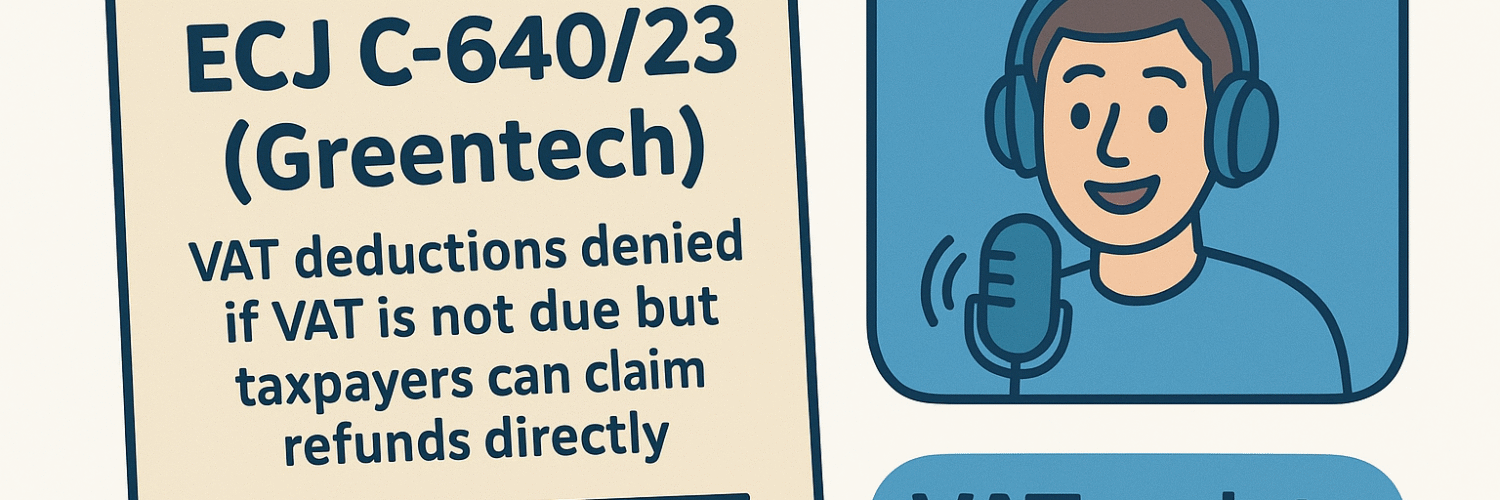
Briefing Document: Case C-640/23 (Greentech SA) – VAT Deduction and Reclassification
I. Executive Summary
Case C-640/23, involving Greentech SA and Romanian tax authorities, centers on the complex interplay between VAT deduction rights, the reclassification of transactions, and national limitation periods. The Court of Justice of the European Union (CJEU) was asked to clarify whether EU VAT principles preclude a refusal to allow VAT deduction in a situation where a transaction, initially treated as a taxable supply of goods, was later reclassified as a non-taxable transfer of an undertaking, and the taxable person (Greentech) could no longer correct the invoice to reclaim the VAT due to the expiry of the limitation period. While the CJEU ruled that national legislation preventing VAT deduction in such circumstances is not necessarily precluded, it emphasized that the principles of VAT neutrality and effectiveness require Member States to allow the taxable person to apply directly to the tax authorities for reimbursement of the unduly paid VAT.
II. Background and Facts
- Transaction: Greenfiber International SA (“Greenfiber”) sold equipment to Greentech SA (“Greentech”). Initially, both companies and the Romanian tax authorities treated this as a supply of goods subject to VAT. Greentech paid VAT to Greenfiber.
- Reclassification: Later, the Romanian tax authorities reclassified the transaction as a transfer of a partial totality of assets between related companies, making it not subject to VAT under Article 128(7) of the Romanian Tax Code.
- VAT Deduction Disallowed: As a result of the reclassification, Greentech was no longer entitled to deduct the VAT it had already paid.
- Limitation Period Expiry: Critically, the limitation period for correcting the VAT invoice had expired under Romanian law. This prevented Greenfiber from correcting the invoice and prevented Greentech from reclaiming the VAT through normal channels.
- Conflicting Assessments: The referring court noted an apparent contradiction in that the tax authorities initially considered the transaction to be subject to VAT for Greenfiber, and not subject to VAT for Greentech, creating the situation where VAT was collected by the State budget from Greenfiber, but not deductible by Greentech.
- Reference for Preliminary Ruling: The Înalta Curte de Casație și Justiție (High Court of Cassation and Justice, Romania) referred the matter to the CJEU for a preliminary ruling under Article 267 TFEU.
III. Legal Issues and Arguments
The core legal questions revolved around the interpretation of the VAT Directive (2006/112/EC) and the principles of:
- Neutrality of VAT: The principle that VAT should be neutral concerning different categories of investors and capital, ensuring equal conditions. As the FAQ source states, it means businesses should be “entirely free from the burden of VAT incurred in their economic activities.”
- Effectiveness: Requires Member States to ensure that EU law rights can be exercised in practice without being impossible or excessively difficult.
- Legal Certainty and Protection of Legitimate Expectations: While raised initially, the CJEU focused on neutrality and effectiveness.
The central articles of the VAT Directive under consideration were:
- Article 2: Defines the scope of VAT.
- Article 19: Addresses transfers of assets.
- Articles 167 and 168: Outline the right to deduct VAT. Article 168 entitles a taxable person to deduct VAT “in so far as the goods and services are used for the purposes of the taxed transactions of a taxable person.”
- Article 203: Concerns the obligation to pay VAT when it is stated on an invoice.
IV. CJEU Reasoning and Decision
The CJEU acknowledged that the situation presented a conflict between the principle of neutrality and the application of national limitation periods.
- Primary Responsibility: The Court reiterated that the issuer of the invoice (Greenfiber) is primarily responsible for rectifying an improperly invoiced VAT amount.
- Member State Obligations: Member States must provide mechanisms to adjust improperly invoiced VAT when the issuer acted in good faith.
- No Right to Deduction: However, the Court emphasized that the right to deduct VAT only arises for taxes actually due on transactions subject to VAT. Since the transaction was reclassified as non-taxable, Greentech did not have a right to deduct the VAT. As stated in the judgment, “in the absence of a transaction subject to VAT, a taxable person cannot claim a right to deduct VAT in relation to that transaction.”
- Right to Reimbursement: Crucially, the CJEU ruled that the principles of neutrality and effectiveness require Member States to allow the taxable person (Greentech) to apply directly to the tax authorities for reimbursement of the unduly paid VAT. This addresses the fundamental unfairness of Greentech having paid VAT on a transaction ultimately deemed non-taxable, and the tax authorities having received that VAT.
V. Key Quotes
- “In the absence of a transaction subject to VAT, a taxable person cannot claim a right to deduct VAT in relation to that transaction.”
- “Articles 168 and 203 of Council Directive 2006/112/EC… as well as the principles of the neutrality of value added tax (VAT) and effectiveness, must be interpreted as not precluding a piece of national legislation or a national administrative practice which does not allow a taxable person to obtain the deduction of the input VAT… However, those principles require that, in such a situation, that taxable person be able to apply directly to the tax authorities for reimbursement.”
- “The principle of neutrality of VAT dictates that all economic activities that are, in principle, subject to VAT should be taxed neutrally, irrespective of their purpose or outcome.”
VI. Implications and Analysis
The CJEU’s decision provides important clarification on the interplay between VAT deduction rights, reclassification, and limitation periods.
- Balancing Act: The ruling reflects a balancing act between upholding the integrity of the VAT system (by linking deduction to taxable transactions) and ensuring fairness to taxable persons who have genuinely paid VAT in good faith.
- Reimbursement as Remedy: The emphasis on the right to reimbursement from the tax authorities provides a critical remedy where the normal deduction mechanism is unavailable.
- Good Faith Requirement: The case indirectly implies a “good faith” requirement. Member States will likely need to establish criteria for determining whether the taxable person acted in good faith when initially treating the transaction as subject to VAT.
- Distinction between Deduction and Reimbursement: The Court clearly differentiates between a deduction (only available for taxable transactions) and reimbursement (available when VAT was unduly paid).
VII. Open Questions
- What specific procedures will Member States need to implement to allow for direct applications for reimbursement in these situations?
- How will “good faith” be defined and assessed by national authorities?
- Will the reimbursement process be efficient and effective in practice?
VIII. Conclusion
Case C-640/23 clarifies that while a taxable person may not be able to deduct VAT on a transaction reclassified as non-taxable, they must be able to seek reimbursement from the tax authorities. This ruling reinforces the principle of VAT neutrality and the need for Member States to provide effective remedies in situations where national rules might otherwise lead to an unfair outcome. The practical implementation of the reimbursement mechanism will be critical to ensuring that the principles outlined in the judgment are fully realized.
See also
- ECJ C-640/23 (Greentech) – Judgment – VAT deductions denied if VAT is not due but taxpayers can claim refunds directly – VATupdate
- Roadtrip through ECJ Cases – Focus on “Liability to pay VAT – VAT shall be payable by any person who enters the VAT on an invoice” (Art. 203) – VATupdate
- Join the Linkedin Group on ECJ/CJEU/General Court VAT Cases, click HERE
- VATupdate.com – Your FREE source of information on ECJ VAT Cases
- Podcasts & briefing documents: VAT concepts explained through ECJ/CJEU cases on Spotify
Latest Posts in "European Union"
- Advocate General’s Opinion Clarifies VAT Treatment of Transfer Pricing Adjustments in Stellantis Portugal Case
- Agenda of the ECJ/General Court VAT cases -1 Judgment, 1 Hearing till Feb 25, 2026
- The «Prefilling» headache
- The Fiscalis Programme 2021–2027: Interim Evaluation and Key Insights
- EU ViDA E-Invoicing: Key Changes and Luxembourg Implications for Cross-Border B2B Transactions