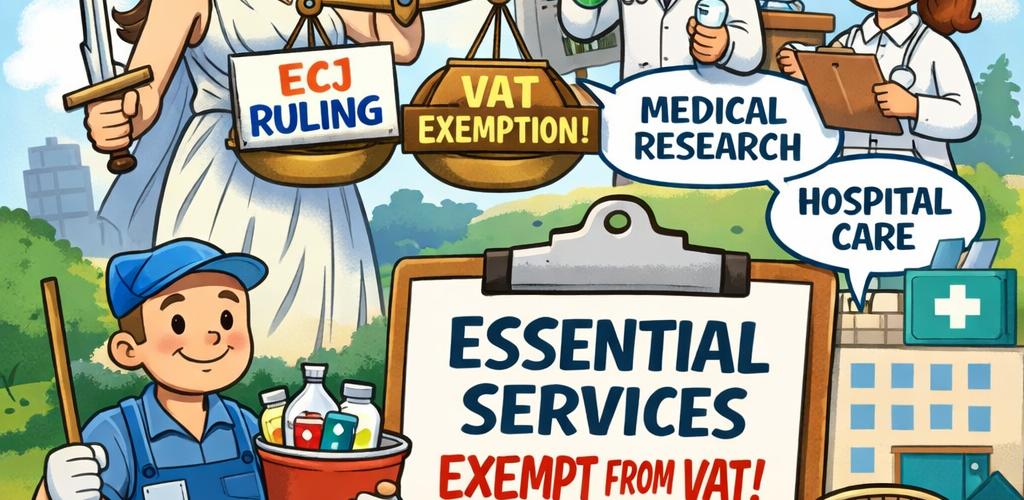
On January 22, 2026, the ECJ issued the Judgment in the case C-379/24 & C-380/24 (Agrupació de Neteja Sanitaria).
Context: References for a preliminary ruling – Tax law – Value added tax – Directive 2006/112/EC – Article 132(1)(f) – Exemption for ‘cost-sharing groups’ – Exemption for services which may not be essential but are useful for the exempt activity of the members – Services for the direct purpose of carrying out tax-exempt activities – Existence of a distortion of competition by the grant of a tax exemption provided for by European Union law
Summary
- Context and Legal Framework: The Court addressed requests for preliminary rulings concerning the interpretation of Article 132(1)(f) of Directive 2006/112/EC regarding VAT exemptions for services provided by autonomous groupings engaged in exempt activities. The cases arose from disputes involving two service providers (Agrupació de Neteja Sanitària and Educat Serveis Auxiliars) that had their VAT exemptions denied by the regional tax authority.
- Key Questions to the Court: The main issues pertained to whether national laws requiring that services be directly and exclusively related to exempt activities contravened EU VAT law. Specifically, the court was asked if the necessity of services for exempt activities could be deemed not exclusive due to their general applicability, and whether such a characterization would inherently create competition distortions.
- Court’s Decision: The Court ruled that national regulations restricting exemptions based on the exclusivity of services were incompatible with EU law. It emphasized that services could still be considered “directly necessary” for exempt activities even if they were not exclusive to those activities, thus affirming the broad interpretation of what constitutes necessary services under the VAT exemption framework.
- Justification for the Decision: The Court highlighted that the purpose of the VAT directive is to harmonize tax treatment and avoid imposing undue burdens on exempt activities. By allowing a broader interpretation of necessary services, the Court aimed to prevent unnecessary restrictions that could hinder access to essential services and create competitive disadvantages for certain sectors.
- Implications for National Law: The judgment clarifies that member states cannot impose overly strict requirements that could limit the scope of VAT exemptions for services that are essential to exempt activities. This ruling aims to ensure that the application of VAT exemptions aligns with the objectives of the directive, fostering fairness and neutrality in VAT treatment across the EU.
Articles in the EU VAT Directive
Article 132(1)(f) of Council Directive 2006/112/EC of 28 November 2006
Exemptions for certain activities in the public interest’:
‘Article 132
1. Member States shall exempt the following transactions:
…
(f) the supply of services by independent groups of persons, who are carrying on an activity which is exempt from VAT or in relation to which they are not taxable persons, for the purpose of rendering their members the services directly necessary for the exercise of that activity, where those groups merely claim from their members exact reimbursement of their share of the joint expenses, provided that such exemption is not likely to cause distortion of competition’
Facts & Background
- Analysing the legality of the administrative decision of the Catalan Regional Tax Tribunal upholding the refusal of an exemption from the VAT assessed by the tax inspectorate, which, on the basis of other earlier decisions of the same authority, also refused the exemption on account of the fact that the cleaning service was not provided in the activity of healthcare – which is an exempt activity – directly ‘by associations, groupings or autonomous entities, including Economic Interest Groupings, made up exclusively of persons carrying on an exempt activity …’. The appellant (ANS AIE) maintains that, for cleaning services in the area of healthcare, the exemption cannot be interpreted in a restrictive manner, as the tax authority does, based on the national provision, since the purpose of the exemption would be neutralised if VAT were required to be paid on such cleaning services, those services being necessary for the exempt activity – healthcare and hospitals – which is in the interests of society as a whole.
- The appellant was established as an ‘Agrupación de Interés Económico’ (Economic Interest Grouping; AIE) on 11 February 2017, with two constituent members, Fundación Benéfica Part Hospital Sant Joan de Deu de Martorell and Mutua de Terrassa Mutualidad de Previsió Social a Prima Fija, which were subsequently joined by Fundació Privada Residencia Sant Joan de Deu de Martorell. The aim was to create shared infrastructure for the members with regard to the provision of comprehensive cleaning service in the hospitals, centres and buildings in general in which the members carry on their healthcare and health and social care activities. On 23 July 2021 it applied for and on 30 August 2012 it obtained the certificate acknowledging its right to the exemption, conditional on fulfilment of the requirements for benefiting from that right.
- On 1 June 2012, the appellant concluded a contract with ISS FACILITY MANAGEMENT SPAIN SAU (‘ISS FACILITY’), under which the latter would take on the administrative management of the staff hired by the appellant, ANS AIE. ISS FACILITY thus assigned the staff to the facilities and also assigned the tasks; it selects the staff, prepares their payslips, handles incidents, ensures that sufficient training is given to meet legislative requirements, supplies materials and, moreover, may be authorised by the appellant to conclude employment contracts and appear before courts and tribunals and public bodies in the event of disputes. The contract justifies the subcontracting of that activity on the basis that ISS FACILITY has the experience, knowledge and resources necessary to conduct the management of the cleaning services which ANS AIE provides to its members.
- On 2 June 2017, inspection proceedings were initiated in relation to the appellant and relating to VAT for the periods from 2013, second quarter, to 2014, fourth quarter, which concluded with the assessment for VAT on the transactions carried out by ANS AIE on account of the provision of the cleaning services to its members. The basis for that assessment was that the exemption provided for in Article 20(1)(6) of the VAT Law cannot be applied, as the appellant did not provide the services directly, but rather it used an external company which actually carries out an essential part of them. Furthermore, the cleaning services are not linked, directly and exclusively, to the exempt activity and, therefore, the application of the exemption could lead to a distortion of competition. In short, the requirements of Article 20(1)(6) of the VAT Law are not met and VAT at the general rate is to be charged to the purchaser of the service. The TEARC confirmed that decision on the basis of a judgment given by the Audiencia Nacional (National High Court, Spain) on 30 June 2017, which held, in essence, that the direct provision of the service was an indispensable requirement for the exemption from VAT under Article 20(1)(6) of the VAT Law to apply, since, otherwise, there would be a real risk of distortion of competition.
- Against that decision confirming the applicability of VAT to the cleaning services provided by ANS AIE to its members, the appellant brought an administrative appeal before this court, emphasising the fact that the TEAC (Central Tax Tribunal, Spain; the upper body of the TEARC) has accepted the interpretation given in the judgment of the Court of Justice of 21 September 2017, in Case C-616/15, regarding the possibility that the support services necessary for the exempt activity may, for reasons of economies of scale, be delegated to entities whose management is shared. That means that the exemption cannot be refused on the ground that the administrative management of the staff has been subcontracted out to a third-party company that works with the AIE, as it contributes to [achieving] the aim of the exemption and is in the spirit of the rule. The discussion, therefore, centres on requirement (a) of Article [20](1)(6) of the VAT Law.
Questions
- Is a national rule – Article 20(1)(6) of the VAT Law – which contains the stipulation that it relates to services provided directly and exclusively to the exempt activity (‘(a) such services are used directly and exclusively in the course of that activity and are necessary in order to carry it out;’) contrary to the meaning and purpose intended by the EU legislature with the exemption contained in Article 132(1)(f) of Council Directive 2006/112/EC of 28 November 2006 on the common system of value added tax, where that stipulation is interpreted such that a service – cleaning in the area of healthcare – [is not considered to be] exclusive to that exempt sector, even though it is singular, technical and complex in its organisation and nature, as well as absolutely necessary?
- Is an interpretation of Article 20(1)(6) of the VAT Law contrary to the meaning and purpose intended by the EU legislature with the exemption contained in Article 132(1)(f) of Directive 2006/112/EC where, in order to refuse the exemption in accordance with EU limits, non-exclusivity in the provision of the service to the activity is equated with causing distortion of competition, thereby combining national and EU limits in order to refuse it? Please clarify whether the limit of ‘not distorting competition’ implies refusing the exemption, if it is not disputed by the parties, whatever the extent of its effect may be ([judgment of 20 November 2003, Taksatorringen, C-8/01, EU:C:2003:621], paragraph 48), on the basis that any exemption is a break with the general principle – acknowledged by the Court of Justice – of liability to tax.
AG Opinion
Article 132(1)(f) of Council Directive 2006/112/EC of 28 November 2006 on the common system of value added tax must be interpreted as meaning that the exemption of services provided by a group to its members in return for the exact reimbursement of their share of the expenses concerns services subject to input VAT used by the members in the context of their tax-exempt activity and which are typically obtained for the provision of the exempt activity because they are necessary for that provision. The exemption of those services does not, in principle, lead to a distortion of competition if the services in question are normally provided as part of the tax-exempt activity, which a large company would usually provide itself. The situation may be different if the exemption is applied inappropriately.
Judgment
(1) Article 132(1)(f) of Council Directive 2006/112/EC of November 28, 2006, on the common system of value-added tax, must be interpreted as meaning that
it opposes national legislation under which the services provided by an autonomous grouping of persons cannot be classified as “directly necessary” services, in the sense of this provision, when such services are necessary for the exempt activity subject to value-added tax carried out by those persons, but are not exclusively linked to this activity due to their general nature.
(2) Article 132(1)(f) of Directive 2006/112 must be interpreted as meaning that
it opposes an interpretation of national legislation under which there is, by principle, a distortion of competition or a risk of distortion of competition when the services provided by an autonomous grouping of persons on behalf of its members can, by their general nature, be used for any taxable activity and not exclusively for the exempt activity they carry out.
Similar ECJ Cases
- Exemption – Supply of services by independent groups of persons (Art. 132(1)(f))
- C-8/01 (Taksatorringen) – Damage estimates to motor vehicles made on behalf of its members by an association of insurance companies are not VAT exempted
- C-412/15 (TMD) – Supplies of plasma obtained from human blood solely for the manufacture of medicinal products are not VAT exempted
- C-274/15 (Commission v Luxembourg) – End of the VAT exemption regime for financial IGPs
- C-616/15 (Commission v Germany) – No umbrella exemption to independent groups of persons whose members only practice certain specific professions
- C-400/18 (Infohos) – Exemptions; Independent groups of persons; Supplies of services to members and non-members
Source
See also
- Join the Linkedin Group on ECJ/CJEU/General Court VAT Cases, click HERE
- VATupdate.com – Your FREE source of information on ECJ VAT Cases
Latest Posts in "European Union"
- Roadtrip through ECJ Cases – Focus on ”Fixed Establishments” (Art. 44 & 45)
- Titanium Case: EU VAT Fixed Establishment Rules
- VAT Margin Scheme Refusal and Good Faith in German Tax Procedure
- EU VAT Consultation Targets Circular Economy and SME-Friendly Reforms
- Comments on T-569/25: EU Court Requires Good Faith to Be Considered in the VAT Margin-Scheme Assessment