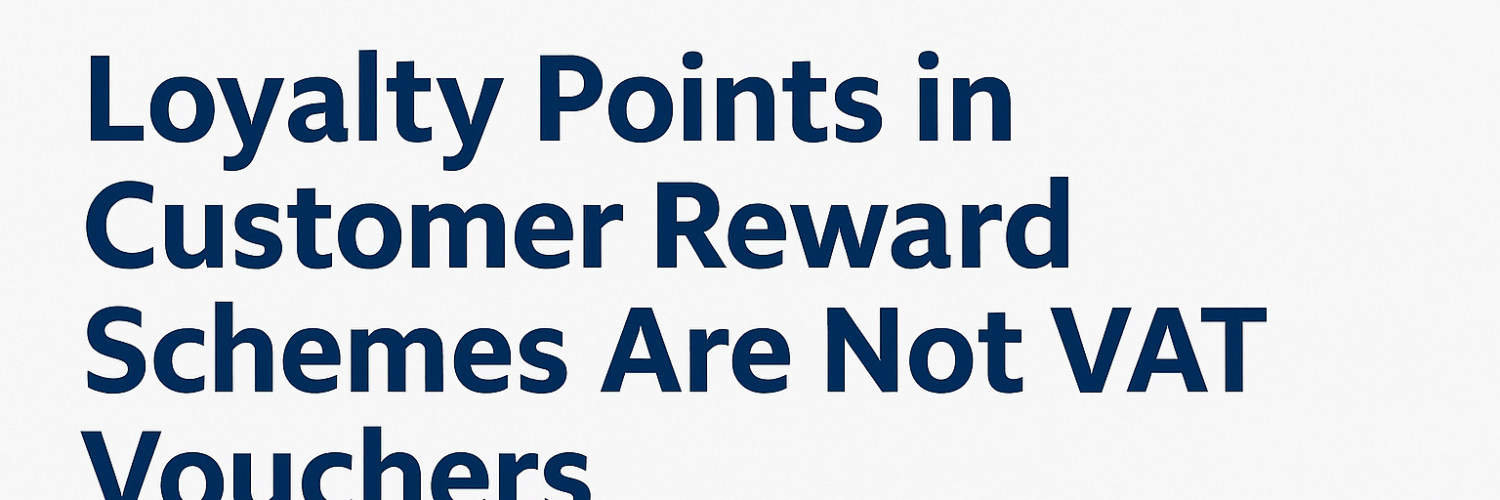
Analysis: “Computer Says No: The Court of Justice Rules on VAT and Loyalty Points in Lyko (C-436/24)”
- Judgment & core issue: In Lyko (C‑436/24), decided on 5 March 2026, the Court of Justice ruled that loyalty points granting customers bonus goods on a subsequent purchase do not qualify as “vouchers” under Article 30a(1) of the VAT Directive, as the supplier is not obliged to accept them as (part) consideration for a supply.
- Reasoning: The Court found that the points merely entitle customers to a more favourable subsequent purchase, since bonus goods are provided only if another transaction takes place; therefore, the points are not accepted as consideration, but function as a mechanism for rewarding customer loyalty.
- Remaining uncertainty & outlook: While excluding voucher treatment, the judgment leaves uncertainty about the VAT treatment of the bonus goods themselves (free supply vs. part of the paid transaction); further clarification may follow in Modelo Continente Hipermercados (T‑914/25), currently pending before the General Court.
Source EUlawlive
No voucher if there is no obligation to accept points in return for the supply of goods
- The Court of Justice ruled that points issued in Lyko’s loyalty program do not qualify as a voucher under Article 30 bis of the VAT Directive, as there is no obligation to accept these points for goods.
- Lyko Operations AB, which sells hair care and beauty products, sought clarification from the Swedish Tax Commission regarding the VAT implications of its loyalty program, where customers earn points with purchases.
- The points earned can only be redeemed for goods in a subsequent purchase from Lyko, further distinguishing them from traditional vouchers.
Source Taxlive
- Loyalty Program Overview: Lyko Operations, a retailer of beauty and hair care products, planned to introduce a loyalty program where customers earn points based on their purchase volume. These points, redeemable for low-value items, can only be used when making a new purchase and represent a value of 2% to 10% of the initial purchase.
- Tax Dispute: A dispute arose between Lyko Operations and the Swedish tax authority regarding the VAT treatment of the loyalty program. Lyko argued that the points should be classified as a “voucher for multiple use” under Article 30 bis of the VAT Directive, which would imply a zero valuation upon redemption, while the tax authority contended they merely offer an additional product selection without qualifying as a voucher.
- Court’s Ruling: The Court ruled that loyalty points do not constitute a “voucher” as defined in the VAT Directive. It determined that for something to be classified as a voucher, the supplier must be obligated to accept it as partial payment for a supply, a condition not met in this case, as the points only grant the right to receive a reward upon making a new purchase.
Source BTW Jurisprudentie
- Join the Linkedin Group on ECJ/CJEU/General Court VAT Cases, click HERE
- VATupdate.com – Your FREE source of information on ECJ VAT Cases
- Podcasts & briefing documents: VAT concepts explained through ECJ/CJEU cases on Spotify
Latest Posts in "European Union"
- EU’s ViDA in Motion: How EU Member States Are Preparing for implementing Digital Reporting Requirements (DRR)
- ECJ/General Court VAT Cases – Pending cases
- ECJ & General Court VAT Cases decided in 2026
- Boost your knowledge of EU’s VAT in the Digital Age (ViDA)
- ViDA – Transfer of Own Goods Scheme and its Intrastat Implications