EU VAT Reforms – Transfer of Own Goods (TOOG) Scheme & Intrastat Implications (Effective July 2028)
Executive Summary
Effective July 1, 2028, the European Union will introduce a new special VAT scheme for the “transfer of own goods” (TOOG) as part of the VAT in the Digital Age (ViDA) reforms. This scheme is designed to significantly simplify cross-border movements of a company’s own inventory within the EU by eliminating the need for multiple VAT registrations in destination Member States. Under TOOG, these transfers will become VAT-neutral at the time of movement and reported via a single monthly One-Stop Shop (OSS) return in a designated Member State of identification.
Crucially, while TOOG streamlines VAT compliance, it does not abolish or replace existing Intrastat reporting requirements. Businesses will still need to report physical movements of goods for statistical purposes, largely following current procedures, including the use of specific Nature of Transaction codes and, where no specific customer is known, dummy VAT identification numbers for the partner country.
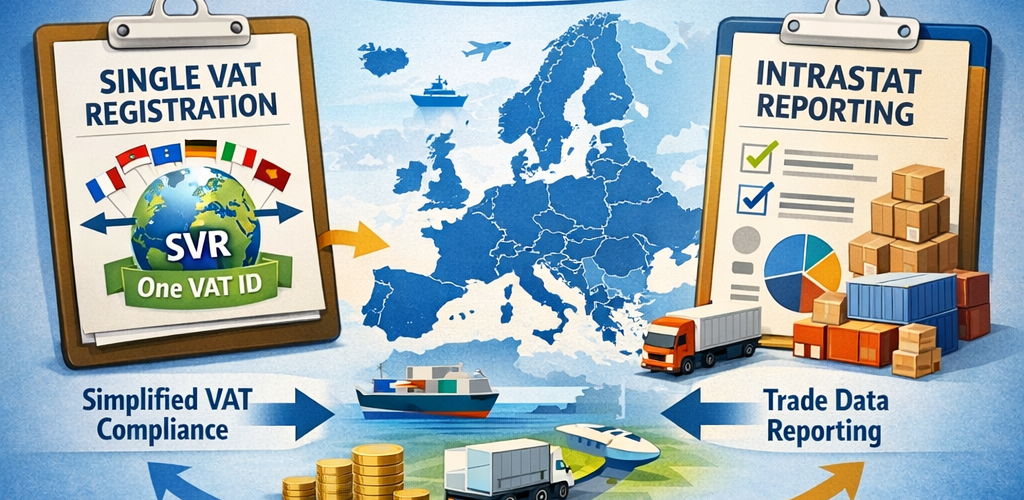
This reform is a major step towards a “Single VAT Registration” environment in the EU, promising reduced administrative burden and costs for businesses engaged in cross-border trade.
- The New Special Scheme for Transfer of Own Goods (TOOG)
1.1. Scope and Objectives The TOOG scheme, introduced by Council Directive (EU) 2025/516, applies when a taxable person moves goods from one EU Member State to another for its own business purposes (e.g., to a warehouse or branch) without an immediate sale. Its primary objective is to “eliminate the need for multiple VAT registrations within the EU when companies move their own goods across borders,” thereby reducing administrative burdens and supporting the EU’s “Single VAT Registration (SVR)” goal.
1.2. Key Features and Provisions
- Voluntary but Open: The scheme is voluntary, but “Any EU or non-EU taxable person making cross-border transfers of own goods can opt to use this scheme, provided they meet the conditions.” Member States are obliged to allow eligible businesses to use it. Once registered, it covers all intra-EU own-goods transfers.
- Single Member State of Identification (MSI): Businesses designate one EU Member State (typically their home country for EU-established entities) through which to administer the scheme. Non-EU businesses without an EU fixed establishment choose a Member State where transport begins. This single VAT ID is used for all TOOG transfers, removing the need for local VAT registration in other Member States solely for stock transfers.
- VAT Neutrality on Transfer: Under TOOG, the “intra-Community acquisition (ICA) of goods in the Member State to which the goods are transferred is exempt from VAT.” This means shipping inventory from one Member State to another no longer triggers a VAT payment or self-assessment in the destination country, making the cross-border transfer “VAT-neutral at the time it occurs.”
- Monthly OSS Reporting: Businesses must submit a “specialized VAT return on a monthly basis via electronic means to their Member State of identification.” This “OSS transfer return” summarizes the total value of goods moved to each destination country, and from each origin country (if multiple), during the month. Nil returns are required.
- No Local Input VAT Deduction via OSS: Input VAT incurred on costs related to these transfers (e.g., import VAT, local warehousing services) cannot be reclaimed via the OSS return. Instead, businesses must use existing EU VAT refund mechanisms (8th/13th Directive processes).
- Record-Keeping Requirements: Detailed records of all TOOG transfers must be kept for at least 10 years, accessible electronically to tax authorities for verification.
- Exclusions: The scheme “explicitly excludes any movement of goods if the business has no full right of VAT deduction on those goods in the destination country.” This prevents misuse for goods tied to exempt or partially deductible activities.
- Notification for Third-Party Transport: A new provision (Article 242b) requires a party transporting goods on behalf of another taxable person to inform the goods’ owner at the latest by the transport’s start, ensuring awareness of potential VAT implications.
1.3. Comparison with Current Rules (Pre-2028)
AspectCurrent VAT Rules (Pre-2028)New TOOG Scheme (From July 1, 2028)Treatment of TransferTreated as a deemed supply (ICS) in origin and deemed acquisition (ICA) in destination under Article 17(1) of the VAT Directive. Creates a “fictitious transaction.”Not treated as a supply for VAT. The movement is a “transfer of own goods,” and the corresponding ICA in the arrival country is exempt from VAT (with full deduction right).VAT RegistrationGenerally requires VAT registration in the destination Member State to report the acquisition and subsequent local supply.No need to register in the destination Member State solely for moving own goods. A single VAT ID in the Member State of identification covers transfers.Call-Off StockAvailable under Article 17a for limited B2B scenarios (goods to known customer, sold within 12 months), avoiding local registration initially.Replaced by TOOG. The new scheme covers all own-stock movements. Call-off stock regime phases out (no new after June 30, 2028; fully ceases June 30, 2029).ReportingInternal invoices/transfer documents. Reporting dispatch in EC Sales List (origin) and acquisition on destination country’s VAT return. Intrastat also applicable.No separate invoices or EC Sales Lists for transfers. Instead, a single monthly OSS return in the home Member State for all transfers. Shared electronically via VIES. Intrastat still applicable.VAT Payment & DeductionICA subject to immediate VAT self-assessment in destination. Zero-rated ICS in origin. Cash-flow impact possible if immediate refund is not possible.No VAT is charged or accounted for at the moment of transfer (acquisition is VAT-exempt), resulting in no immediate VAT cash-flow impact. Input VAT on related expenses (not on the transfer itself) must be reclaimed via 8th/13th Directive, not OSS.This change “abolishes the artificial ‘self-supply’ construct for intra-EU stock movements and marks the end of the EU’s call-off stock simplification.”
- Practical Implications for Businesses
The TOOG scheme is expected to “significantly reduce administrative burdens and costs” by eliminating the need for multiple foreign VAT registrations and localized compliance for stock movements.
2.1. Handling Subsequent Sales from Transferred Stock The TOOG scheme works alongside other ViDA measures to simplify the VAT treatment of goods once they are in the destination Member State:
- B2C Sales (to consumers): The Union OSS is expanded to cover domestic supplies of goods by a non-established supplier. Businesses can charge the destination country’s VAT through their home country’s OSS return, without needing a local VAT number.
- B2B Sales (to VAT-registered businesses): A mandatory domestic reverse-charge rule will apply across all Member States. If the supplier is not established and not VAT-registered in the country of delivery, the VAT-registered customer will be required to self-account for the VAT. This means the foreign supplier does not charge local VAT.
The “combined effect of these measures is that a company can move goods into a Member State under the TOOG scheme… and later sell those goods without a VAT registration in that Member State.”
2.2. Compliance Checklist for Businesses
Businesses should take the following steps to prepare:
- Assess Eligibility: Confirm goods qualify (e.g., used in fully taxable activities in the destination).
- Choose Member State of Identification: For non-EU businesses, decide which EU country of dispatch to nominate.
- Register for the Scheme: Monitor guidance from tax authorities for enrollment procedures.
- Adapt Internal Systems: Update ERP/accounting systems to track “own goods transfers” and compile monthly values per destination country.
- Training and Policy Updates: Educate tax and logistics teams on new procedures, especially regarding the cessation of local VAT accounting for transfers.
- Monitor Input VAT on Local Costs: Establish processes to reclaim local VAT incurred (e.g., on warehousing) via the 8th/13th Directive.
- Cease New Call-Off Stock Deals: Plan to stop new arrangements by June 30, 2028. Ensure existing call-off stock is sold by June 30, 2029.
- Stay Informed: Follow guidance from the European Commission and national tax authorities.
- Intrastat Reporting under the TOOG Scheme
3.1. Continued Obligation for TOOG Transfers “The introduction of the new Special Scheme for the Transfer of Own Goods (TOOG)… does not abolish or replace Intrastat reporting requirements.” Intrastat is a separate system for collecting statistical data on physical goods movements, operating independently of VAT obligations. “The bottom line is that the physical movement under the TOOG scheme needs to be captured in both the sending and receiving country’s trade statistics, just as it is today.”
- Dispatch from Origin: The company moving its goods must report this on its Intrastat dispatch report from the origin country, if thresholds are exceeded.
- Arrival in Destination:If a local entity (branch, subsidiary) exists in the destination, that entity reports the Intrastat arrival.
- If no local VAT-registered party exists (common under TOOG), statistical authorities may either use “mirror data” from the dispatching country’s report (SIMSTAT framework) or require a local agent/consignee to file the Intrastat arrival. Businesses must clarify this requirement in each relevant Member State.
3.2. How to Report TOOG Movements in Intrastat
- Nature of Transaction (NoT) Codes:Code 31: “Movements to/from a warehouse (excluding call-off/consignment stock)” – for transfers to distribution warehouses without an immediate sale or specific buyer.
- Code 32: “Supply for sale on approval or after trial (including call-off and consignment stock)” – for transfers where a limited, identified customer is intended to eventually purchase the goods (even if the VAT call-off stock simplification is phased out).
- Partner Country and Identification: For NoT 32, the customer’s VAT ID is used. For NoT 31 (own storage, no identified buyer), a special dummy code (e.g., “QV999999999999”) is used for the partner VAT ID to signal an unknown counterparty.
- Other Required Data: Intrastat declarations will continue to require commodity codes (CN8), value (cost or market value for transfers), statistical value, net mass, supplementary units, mode of transport, and country of origin. “The TOOG scheme does not introduce any new Intrastat data fields.”
3.3. Member State Differences and Guidance While core Intrastat rules are harmonized, differences persist in thresholds, collection authorities, and reporting practices (e.g., “single-flow” vs. “double-flow” reporting). Businesses “should look out for updated national Intrastat guidelines or notices as 2028 approaches” to understand country-specific requirements, particularly regarding arrival declarations for non-established entities.
3.4. Future of Intrastat There is an expectation that the EU’s Digital Reporting Requirements (DRR) (transaction-level e-invoicing data) from 2028-2030 might eventually simplify or replace some Intrastat reporting. However, the “purely statistical component of Intrastat is slated to continue under the latest regulations.” Therefore, businesses must plan to comply with Intrastat in 2028 and beyond.
- Transitional Measures, Timeline, and Guidance
- Implementation Date: The TOOG scheme will apply from July 1, 2028, with Member States obliged to transpose the necessary national laws by June 30, 2028.
- Call-Off Stock Phase-out: No new call-off stock arrangements should be initiated after June 30, 2028. Any existing call-off stock as of July 1, 2028, must be sold under the old rules by June 30, 2029, after which the regime fully ceases.
- Guidance: The European Commission will update existing OSS guidance and Explanatory Notes before 2028. National tax authorities are also expected to publish their own implementation roadmaps and guidelines.
- Conclusion
The Special Scheme for Transfers of Own Goods represents a significant simplification for EU VAT compliance, moving towards a “single VAT registration” environment for intra-EU stock movements. Businesses will benefit from reduced administrative costs and improved cash flow by eliminating local VAT registrations for inventory transfers. However, businesses must understand that this VAT simplification does not extend to Intrastat reporting, which will continue to be a separate, mandatory obligation.
Preparation is key: businesses should assess eligibility, adapt internal systems to the new monthly OSS reporting for transfers, understand the new rules for subsequent sales, and remain vigilant for updated guidance on both VAT and Intrastat from relevant authorities.
Latest Posts in "European Union"
- Roadtrip through ECJ Cases – Focus on ”Public bodies” (Art. 13)
- Latest Trends in Global VAT Compliance for Online Businesses in 2026
- EU – IOSS Scheme: Customs & Business Benefits for E-Commerce Vendors
- Comments on ECJ C-527/24: Right to VAT Refund Despite Technical Glitch in Cross-Border Application
- Agenda of the ECJ/General Court VAT cases – 2 Judgments and 2 Hearings till April 16, 2026