Hungary is preparing for one of the most far‑reaching transformations in VAT compliance in recent decades. The implementation of the EU’s VAT in the Digital Age (ViDA) package will not merely introduce mandatory electronic invoicing; it will fundamentally redefine the role of invoices, invoicing software, and real‑time data exchange between businesses and the tax authority. In Hungary’s model, invoices will evolve from static documents into continuous data communication tools, reshaping compliance, audit, and accounting processes across the economy.
From Documents to Data: The Core Philosophy of ViDA
At the heart of Hungary’s ViDA concept lies a clear paradigm shift: the invoice is no longer the PDF or paper representation, but the structured XML data itself. Under the new system, the legally authentic invoice will always be the machine‑readable XML file, aligned with the European standard EN 16931. Any human‑readable version, whether PDF or printed, will be merely a visual representation without independent legal status.
This approach ensures full automation, interoperability across Member States, and the elimination of inconsistencies between invoices and reported data. If a discrepancy arises between the XML and the visual version, the XML will prevail, and material differences will require cancellation and reissuance of the invoice. [hun | PDF]
Mandatory Electronic Invoicing for B2B Transactions
Hungary plans to introduce compulsory electronic invoicing for:
- Domestic B2B transactions
- Cross‑border B2B transactions within the EU
Paper invoices will generally be limited to private individuals and non‑EU customers, and even then, only where the parties agree. Importantly, all businesses—regardless of size—must be technically capable of receiving electronic invoices, not just issuing them. [hun | PDF]
For domestic transactions, the full invoice must be transmitted to the tax authority as part of the data supply. For intra‑EU transactions, a reduced data set applies, although businesses may choose to submit the full invoice data for consistency and simplicity. [hun | PDF]
Secure Transmission and the “Five‑Corner” Model
Hungary’s ViDA framework is built around a secure, authenticated, and encrypted transmission model. Invoices may no longer be sent via email or other unsecured channels. Instead, all invoice exchanges must take place through officially identified endpoints, ensuring certainty of receipt and data integrity. [hun | PDF]
The invoicing ecosystem is structured around a five‑corner model, involving:
- The taxable seller
- The seller’s invoicing software or service provider
- The taxable buyer
- The buyer’s accounting or invoicing system
- The tax authority
An optional sixth actor may facilitate transmission, but the use of intermediaries remains voluntary. Businesses may continue using their own software or external service providers, provided all technical and legal requirements are met. [hun | PDF]
Accreditation of Invoicing Software and Taxpayer Processes
A distinctive feature of the Hungarian approach is the accreditation system. While software itself is tested, accreditation ultimately applies to the taxpayer’s operational process, not merely the tool. The process is designed as a self‑service model, without full IT audits, but with rigorous functional testing. [hun | PDF]
There are two accreditation paths:
- Preliminary accreditation, mandatory for invoicing service providers
- Taxpayer accreditation, required when businesses issue invoices using their own systems
Non‑accredited data submissions may remain pending for up to 30 days, after which penalties may apply if accreditation is not completed. Accreditation may also be withdrawn if systems consistently allow incorrect invoices to pass preliminary checks. [hun | PDF]
Buyer‑Side Reporting and Status Reporting
Hungary intends to go beyond the minimum ViDA requirements by introducing mandatory buyer‑side data reporting. Buyers will be required to confirm receipt of invoices within five days, effectively creating real‑time confirmation of transactions across the supply chain. [hun | PDF]
In addition, a status reporting mechanism will require buyers to flag invoices that do not correspond to genuine economic transactions. This significantly strengthens the tax authority’s ability to detect fraud, reconcile data, and assess transaction substance, not merely formal correctness. [hun | PDF]
Implications for Accounting and Internal Controls
The impact of ViDA extends well beyond invoicing. Accounting systems will increasingly rely on automated invoice recognition, validation, and booking, with minimal human intervention. Lost invoices, manual data entry, and reconciliation mismatches are expected to become exceptions rather than the norm. [hun | PDF]
For businesses, this represents both an opportunity and a challenge:
- Opportunity through efficiency gains, faster close processes, and improved VAT accuracy
- Challenge through the need for system upgrades, process redesign, and stronger IT‑tax collaboration
The Role of PEPPOL in Hungary’s ViDA Landscape
While Hungary does not plan to make PEPPOL mandatory, it clearly positions PEPPOL as a key optional transmission channel. To enable this, Hungary will need to establish a national PEPPOL authority to oversee governance and compliance. The tax authority’s own free invoicing solution will remain outside PEPPOL, reflecting the business‑driven nature of the network.
Conclusion: Compliance as Continuous Data Exchange
Hungary’s ViDA implementation represents a structural re‑engineering of VAT compliance. Invoices become real‑time data events, compliance becomes embedded in software, and tax control shifts from ex‑post audits to continuous digital oversight. While the transition will demand significant preparation from businesses and software providers, the end state promises greater transparency, reduced fraud, and a more resilient VAT system aligned with Europe’s digital future.
Sources
Hungary Publishes ViDA Implementation Concept for E-Invoicing
- Mandatory e-invoicing for B2B, B2G, and cross-border EU B2B: Hungary is shifting from real-time reporting to a comprehensive mandatory e-invoicing system based on strict XML standards (EN 16931 + local extensions), eliminating hybrid documents. Paper invoices will be limited to B2C and non-EU transactions, originating from an XML file.
- Five-Corner Model & Secure Transmission: The system will use a five-corner model involving seller, buyer, their software, and the tax authority. All B2B/B2G invoice exchanges must occur via secure, automated API connections, prohibiting email. While an optional Peppol network integration is planned, a national e-invoicing program will operate independently.
- Software Accreditation & Enhanced Buyer Reporting: All invoicing software and service providers must be accredited by the NTCA, verifying compliance before invoice creation. Buyers will also face strict “Acceptance of Receipt” (AOR) requirements, reporting on received invoices within five days and submitting status reports to enable cross-checking and verify economic reality.
Source Comarch
Click on the logo to visit the website

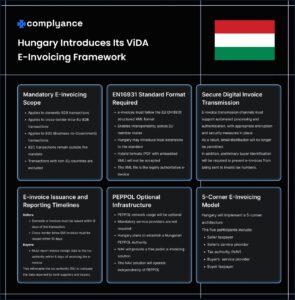
- Hungary is implementing a new e-invoicing framework, aligned with the EU’s ViDA initiative, that will mandate structured digital invoicing for domestic B2B, intra-EU B2B, and B2G transactions using the EN16931 XML format.
- This framework introduces a 5-corner e-invoicing model involving taxpayers, service providers, and the tax authority, utilizing secure digital transmission channels and defining specific timelines for e-invoice issuance and reporting.
- Businesses in Hungary and those trading within the EU must now prioritize evaluating their e-invoicing architecture and integration readiness, as this signifies a broader European shift towards real-time digital exchange infrastructure.
Source Complyance
See also
- Hungary will mandate e-invoicing for all domestic and cross-border transactions, phasing out paper and email-based invoices.
- A dual-reporting mechanism will require both sellers and buyers to report invoice data, with buyers submitting supply data within five days of receipt.
- All invoices must comply with the EN 16931 EU standard, with some local adaptations and enhanced security requirements.
- The PEPPOL network will be optional, and a Hungarian PEPPOL authority will be established alongside a free public invoicing solution.
- Hungary will implement a five-corner transmission model, allowing invoices to be sent through tax authorities or service providers, with service provider use remaining optional.
Source: regfollower.com
Note that this post was (partially) written with the help of AI. It is always useful to review the original source material, and where needed to obtain (local) advice from a specialist.
Latest Posts in "Hungary"
- Hungary Clarifies VAT Reverse Charge Rules for Construction and Installation Services
- Tax Authority to Audit Retail Stores in Bács-Kiskun County, Focusing on Receipts and Employee Reporting
- Hungary Mandates Detailed M-Sheet VAT Deduction Reporting from July 2026; Full Digital Shift Ahead
- Hungary Unveils ViDA Plan: Mandatory E-Invoicing and Major VAT Reform Announced
- Hungary Retires ÁNYK: Preparing for Digital VAT Returns and Enhanced Compliance in 2026