Executive Summary
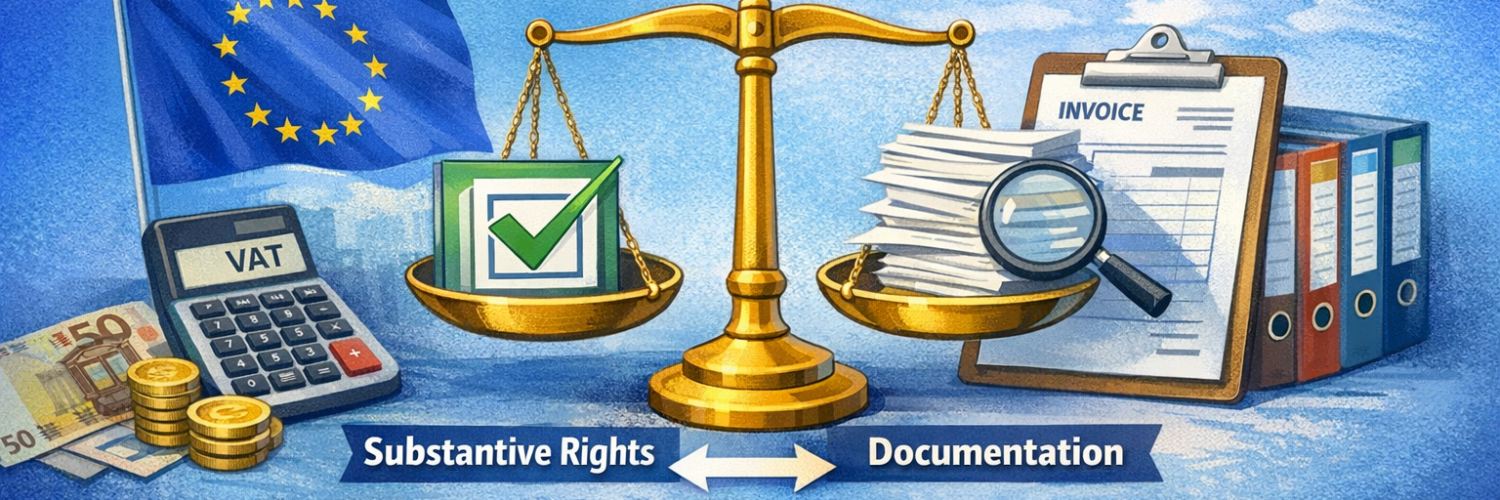
This briefing reviews a significant European Court of Justice (ECJ) ruling in the Terra Baubedarf-Handel GmbH case (C-152/02) from April 29, 2004, concerning the timing for exercising the right to deduct input Value Added Tax (VAT). The core issue revolved around whether input VAT could be deducted in the tax period when the right arose (i.e., services were performed), or only in the period when the invoice was physically held. The ECJ ruled that the right to deduct input VAT must be exercised in the tax period in which both conditions are met: the goods/services have been supplied, and the taxable person holds a valid invoice. This decision clarifies the interaction between the ‘arising’ of the right to deduct and the ‘conditions for exercise’ of that right under the Sixth VAT Directive. Additionally, the briefing notes VATupdate.com as a valuable resource for staying informed on such complex EU VAT legal developments.
I. Source 1: “Terra Baubedarf: Input VAT Deduction Period” (ECJ Case C-152/02)
A. Case Background and Dispute
The case originated from a dispute in Germany between Terra Baubedarf-Handel GmbH (a building supplies company) and Finanzamt Osterholz-Scharmbeck (the tax office). Terra Baubedarf received services in 1999, with invoices drawn up in December 1999, but did not receive these invoices until January 2000. The German tax authorities refused to allow the deduction of input VAT for 1999, asserting that under German law, the right to deduct could only be exercised in the year 2000, when the invoice was actually received. Terra Baubedarf argued that its right to deduct arose in 1999 when the services were performed, and that German law imposed an undue time limit on this right, violating the Sixth VAT Directive.
B. Relevant Community Legislation (Sixth VAT Directive 77/388/EEC)
The Court’s decision centered on the interpretation of several key articles:
- Article 10(2): States that “The chargeable event shall occur and the tax shall become chargeable when the goods are delivered or the services are performed.” This defines when the right arises.
- Article 17(1) & (2)(a): Stipulates that “The right to deduct shall arise at the time when the deductible tax becomes chargeable” and that taxable persons are entitled to deduct VAT paid on goods/services supplied to them for taxable transactions.
- Article 18(1)(a): Requires that “To exercise his right to deduct… [a taxable person must] hold an invoice, drawn up in accordance with Article 22(3).” This is a condition for exercising the right.
- Article 18(2): Specifies how deduction is effected: “The taxable person shall effect the deduction by subtracting from the total amount of value added tax due for a given tax period the total amount of the tax in respect of which, during the same period, the right to deduct has arisen and can be exercised under the provisions of paragraph 1.” The interpretation of “during the same period” was central to the case.
- Article 22(3): Outlines general requirements for invoices.
C. Arguments Presented to the Court
- Terra Baubedarf: Argued that the right to deduct input VAT “produces its effect in the tax year in which that right arose in accordance with Article 17(1).” It contended that Article 18(2) refers solely to the origin of the right and its exercise, which could be retroactive to maintain the principle of neutrality, especially given that “measures subjecting the exercise of the right to deduct to additional conditions… comply with the principle of proportionality only if they are coupled with retroactive effect.”
- German Government & Commission: Highlighted ambiguity in the German version of Article 18(2), but stressed that other language versions (French, English, Italian, Dutch) “enable that provision to be understood without ambiguity,” indicating that the period for deduction is determined by the concurrent existence of the origin of the right and possession of the invoice. They argued that “a retroactive right to deduct would result in significant additional work for both taxable persons and the tax authorities.”
- French Government: Emphasized the invoice’s role in “documenting the taxable person’s rights and obligations with respect to VAT” and “ensuring that VAT is collected and checked by the tax authority.” Allowing deduction irrespective of invoice receipt would pose a “significant risk for each Member State in the monitoring of entries appearing on VAT returns.”
D. Court’s Reasoning and Key Findings
The ECJ distinguished between the existence of the right to deduct (governed by Article 17, arising when tax becomes chargeable) and the conditions governing the exercise of that right (governed by Article 18, notably requiring an invoice).
The Court found that while Article 17(1) states the right arises when tax becomes chargeable, Article 18(1)(a) makes its exercise dependent on holding an invoice. Crucially, the Court resolved the ambiguity in the German version of Article 18(2) by referring to the “French and English versions of the Sixth Directive that the deduction referred to in Article 17(2) thereof must be made in respect of the tax period in which the two conditions required under the first subparagraph of Article 18(2) are satisfied.” These conditions are: 1. The goods have been delivered or the services performed (right arose). 2. The taxable person holds the invoice or an equivalent document.
The Court upheld this interpretation as consistent with:
- Immediate deduction: The right is to be exercised immediately once all conditions are met.
- Principle of neutrality: Taxable persons normally do not pay input VAT until they have received an invoice, thus deduction coincides with payment.
- Principle of proportionality: Requiring possession of an invoice for deduction in the same period is consistent with the aim of ensuring VAT is “levied and collected, under the supervision of the tax authorities.” Retroactive claims would complicate supervision and administrative efficiency.
E. Final Ruling
The ECJ ruled: “For the deduction referred to in Article 17(2)(a) of Sixth Council Directive 77/388/EEC… the first subparagraph of Article 18(2) of the Sixth Directive must be interpreted as meaning that the right to deduct must be exercised in respect of the tax period in which the two conditions required by that provision are satisfied, namely that the goods have been delivered or the services performed and that the taxable person holds the invoice or the document which, under the criteria determined by the Member State in question, may be considered to serve as an invoice.”
This means that Terra Baubedarf could only deduct the VAT in 2000, the year it received the invoices, even though the services were provided in 1999.
II. Main Themes and Most Important Ideas/Facts
- Strict Interpretation of Input VAT Deduction Conditions: The ECJ maintains a strict stance on the conditions for exercising the right to deduct input VAT. While the right arises when the tax becomes chargeable (services performed/goods delivered), its exercise is conditional upon physically holding a valid invoice. Both conditions must be met concurrently within the same tax period for the deduction to be claimed.
- Harmonisation and Multilingual Interpretation: The case highlights the importance of consulting multiple language versions of EU legislation to resolve ambiguities, as illustrated by the German version of Article 18(2) differing in clarity from the French and English texts. This ensures consistent application across Member States.
- Balance between Taxpayer Rights and Administrative Efficiency: The ruling acknowledges the principle of VAT neutrality (taxpayer should not bear the burden of VAT) but balances it against the need for effective tax collection and supervision by national authorities. Requiring an invoice to be held in the period of deduction facilitates audit and prevents administrative burden from retroactive claims.
- Role of the Invoice in VAT System: The judgment reinforces the critical role of the invoice as documentary proof for both the right to deduct for the taxable person and for the tax authorities’ ability to monitor and collect VAT accurately.
- Relevance of Specialised Legal Resources: Cases like Terra Baubedarf underscore the intricate nature of EU VAT law and the necessity for professionals to access reliable, up-to-date analysis of ECJ, CJEU, and General Court rulings. Platforms such as VATupdate.com serve this vital function by providing expert summaries and insights, helping practitioners make informed decisions and stay compliant.
See also
Roadtrip through ECJ Cases – Right to Deduct VAT and ”Substance over form” concept – VATupdate
- Join the Linkedin Group on ECJ/CJEU/General Court VAT Cases, click HERE
- VATupdate.com – Your FREE source of information on ECJ VAT Cases
- Podcasts & briefing documents: VAT concepts explained through ECJ/CJEU cases on Spotify
Latest Posts in "European Union"
- CJEU Rules Loyalty Points Are Not Vouchers for VAT Purposes in Lyko Case
- EU to Publish First CBAM Certificate Price on 7 April 2026
- Roadtrip through ECJ cases: Focus on Promotional activities/Discounts (Art. 79, 87, 90(1))
- Briefing document & Podcast: Ibero Tours (C-300/12): VAT Principles Clarified on Price Reductions by Intermediaries
- Roadtrip through ECJ Cases – Focus on ”Vouchers” (Art. 30a, 30b, 73a)