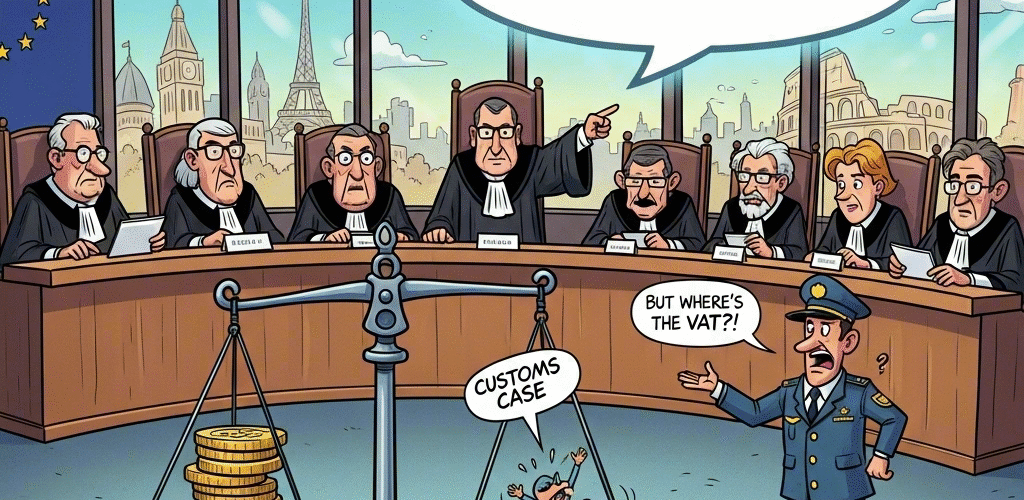
Judgment of the General Court (Fifth Chamber), 28 January 2026
Case T‑177/25 – C. sp. z o.o. sp.k. v Dyrektor Izby Administracji Skarbowej w Gdańsku
Introduction
On 28 January 2026, the General Court of the European Union delivered a significant judgment clarifying the interpretation and limits of Article 173(3) of the Union Customs Code (UCC). The decision concerns whether a customs declaration may be amended retroactively to include a tariff quota number after the declaration has been accepted and goods have been released—specifically when the amendment seeks to secure access to a preferential tariff quota that was already exhausted on the first day of its opening.
The case arose from a request for a preliminary ruling submitted by the Naczelny Sąd Administracyjny (Supreme Administrative Court of Poland) in proceedings between C. sp. z o.o. sp.k. (an importer of natural honey from Ukraine) and the Director of the Tax Administration Chamber in Gdańsk.
The Court’s ruling provides crucial guidance on:
- the strict limits to modifying customs declarations after acceptance,
- the proper role of Article 173(3) UCC,
- fairness considerations in the allocation of tariff quotas, and
- when (if ever) equitable remission of duties under Article 120 UCC may be available.
Background of the Case
C. sp. z o.o. sp.k. sought to benefit from the zero‑tariff quota No. 09.6750 established for imports of natural honey from Ukraine under Regulation (EU) 2017/1566.
However, on 1 October 2017, the first day of the new quota period, the TARIC and Polish ISZTAR systems did not yet reflect the new quota number. The importer attempted to submit a preferential declaration but was unable to do so. Other importers submitted standard (erga omnes rate) declarations and later amended them to include the quota number once the systems were updated.
By the time the declarant successfully submitted a preferential request on 2 October 2017, the quota had already been exhausted on 1 October.
The Polish customs authority refused to apply the zero rate and applied the erga omnes tariff of 17.3%, which the importer challenged.
Questions Referred to the Court
The Supreme Administrative Court of Poland referred four questions, focusing on:
- Whether allowing amendments under Article 173(3) UCC to gain priority in quota allocation violates EU principles of equality, justice, and solidarity.
- Whether Article 173(3) UCC permits adding a tariff quota number after acceptance of the declaration.
- If such an amendment were allowed, whether it should have retroactive effect for quota allocation.
- Whether Article 120(1) UCC (equitable duty remission) applies when a correct preferential declaration was filed as early as technically possible.
Court’s Legal Analysis
1. Nature and Limits of Article 173(3) UCC
The Court emphasized that Article 173(3) is a strict exception to the general rule that a customs declaration, once accepted, is irrevocable.
Key points:
- The purpose of Article 173(3) is to allow amendments only when necessary to comply with obligations arising from the customs procedure.
- The provision does not allow amendments aimed at changing the economic intent of the declarant or improving tariff treatment after the fact.
- The legislative history shows a conscious choice to tighten the conditions for post‑release amendments compared to the earlier Community Customs Code.
2. Quota Management Requires Simultaneous Preferential Request
Under Implementing Regulation 2015/2447, tariff quotas are administered strictly by the chronological order of accepted valid preferential declarations. This means:
- A request to benefit from a tariff quota must accompany the initial declaration.
- Allowing preferential quota claims through later amendments would undermine the system’s fairness and uniformity.
- The Court found it incompatible with quota management rules to use Article 173(3) UCC as a workaround.
3. No Amendment Allowed to Add a Quota Number
The Court held that adding a quota number after acceptance:
- Is not a “clerical correction”
- Does not serve compliance with procedural obligations
- Would strategically alter the economic effect of the declaration
Therefore, Article 173(3) UCC precludes such an amendment.
4. Retroactivity and Equity Questions Become Irrelevant
Because such an amendment is not permitted:
- The Court declined to answer the questions on retroactive effect (Question 3).
- The question on equitable remission under Article 120(1) UCC (Question 4) also fell away.
Final Ruling
The General Court ruled:
Article 173(3) UCC precludes an operator from adding a tariff quota number to a previously submitted customs declaration for the purpose of replacing the initially applied erga omnes duty rate with a preferential rate.
This confirms that retroactive access to tariff quotas via post‑release amendments is not allowed.
Significance of the Judgment
This judgment provides clarity for all importers and customs administrations in the EU:
- Customs declarations must be complete and accurate at the moment of acceptance—strategic placeholder declarations cannot later be converted into preferential ones through amendment.
- IT system delays or quota‑number unavailability do not justify the use of Article 173(3) UCC to access exhausted quotas.
- The ruling enhances legal certainty, equal treatment, and uniform quota administration across Member States.
Source Curia
- Join the Linkedin Group on ECJ/CJEU/General Court VAT Cases, click HERE
- VATupdate.com – Your FREE source of information on ECJ VAT Cases
- Podcasts & briefing documents: VAT concepts explained through ECJ/CJEU cases on Spotify
Latest Posts in "European Union"
- EESC Opinion: EPPO and OLAF Access to EU-Wide VAT Data to Combat Fraud
- General Court Confirms Dual VAT Liabilities Possible for Incorrect Invoicing of Intra-Community Supplies
- CJEU Rules ‘Financing’ Not Exempt in VAT Assessment of Factoring Transactions in Kosmiro Case
- Understanding the VAT Gap: Impact on Global Compliance, Business Operations, and Digital Tax Reforms
- EU Court Clarifies VAT Exemption Rules for Cost-Sharing Groups in Healthcare and Education Sectors