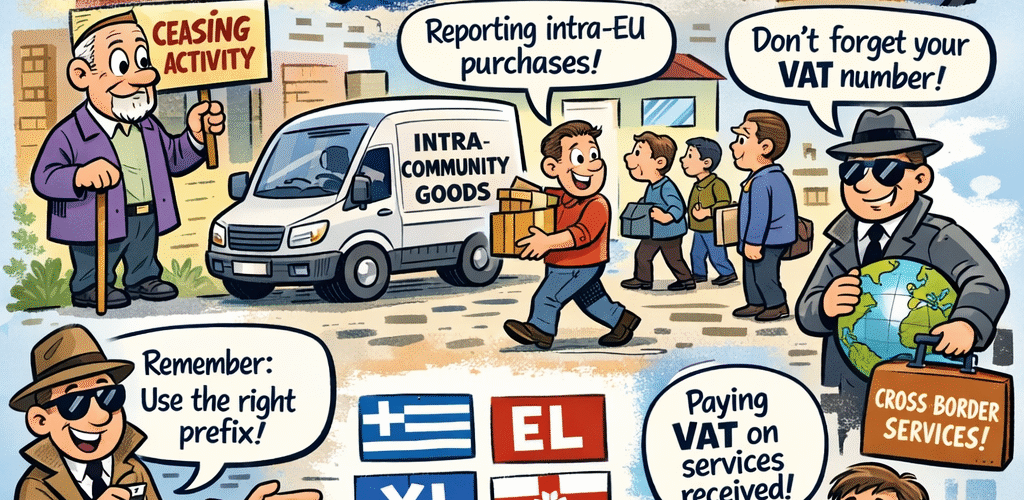
SUMMARY
This briefing document outlines the core requirements and processes surrounding VAT identification as mandated by the reviewed articles. These articles emphasize the importance of registration, provide details on who needs to be identified, and explain the structure and purpose of the VAT identification number. Proper implementation is essential for ensuring accurate application of VAT, particularly in intra-Community transactions.
Key Themes and Important Ideas/Facts:
Obligation to Notify Changes in VAT Status: Taxable persons are obligated to inform Member States of any changes related to their activity as a taxable person, including commencement, changes, and cessation. This ensures that VAT records are kept up-to-date and accurate.
- Quote: “Every taxable person shall state when his activity as a taxable person commences, changes, or ceases.”
- Implication: This places a direct responsibility on taxable entities to proactively manage their VAT registration and reporting requirements. Electronic submission is permitted, and even may be required.
Intra-Community Acquisitions Threshold: The document addresses acquisitions of goods within the Community. Even non-taxable legal persons involved in intra-Community acquisitions above a certain threshold must declare these acquisitions. If they exceed the threshold and VAT becomes applicable, they must register.
- Quote: “Every taxable person or non-taxable legal person who makes intra-Community acquisitions of goods that are not subject to VAT pursuant to Article 3(1) must state that he makes such acquisitions if the conditions laid down in that provision for not making such transactions subject to VAT cease to be fulfilled.”
- Implication: This provision aims to capture and tax intra-Community transactions that might otherwise fall outside the regular VAT regime, ensuring fair taxation across Member States.
Mandatory VAT Identification: Member States are responsible for identifying certain categories of taxable persons with a unique VAT identification number.
- Quote: “Member States shall take the measures necessary to ensure that the following persons are identified by means of an individual number.”
- Implication: This is a cornerstone of VAT administration, enabling Member States to track and control VAT transactions and collections.
Categories of Persons Required to be Identified: Article 214 outlines the specific types of taxable persons required to have a VAT ID, including:
- Those carrying out supplies of goods or services in their territory where VAT is deductible.
- Those making intra-Community acquisitions subject to VAT.
- Those making intra-Community acquisitions for activities carried out outside of their territory.
- Those receiving services for which they are liable to pay VAT.
- Those established in a Member State and supplying services in another Member State where VAT is payable solely by the recipient.
- Implication: This details the breadth of entities required to register for VAT purposes.
Exceptions to Mandatory Identification: Member States have the option not to identify taxable persons who carry out transactions on an occasional basis.
- Quote: “Member States need not identify certain taxable persons who carry out transactions on an occasional basis, as referred to in Article 12.”
- Implication: This introduces a degree of flexibility, recognizing that requiring registration for infrequent transactions may be disproportionate.
- VAT Identification Number Structure: Each VAT identification number must include a prefix based on the ISO 3166—alpha-2 code of the issuing Member State. Northern Ireland uses the prefix ‘XI’.
- Quote: “Each individual VAT identification number shall have a prefix in accordance with ISO code 3166—alpha-2—by which the Member State of issue may be identified. Nevertheless, Greece may use the prefix ‘EL’. The prefix ‘XI’ shall be used for Northern Ireland.”
- Implication: This standardized prefix facilitates the identification of the Member State issuing the VAT number, crucial for cross-border transactions.
Ensuring System Functionality: Member States must ensure their identification systems enable the identification of taxable persons and the correct application of transitional arrangements for intra-Community transactions.
- Quote: “Member States shall take the measures necessary to ensure that their identification systems enable the taxable persons referred to in Article 214 to be identified and to ensure the correct application of the transitional arrangements for the taxation of intra-Community transactions, as referred to in Article 402.”
- Implication: This highlights the ongoing responsibility of Member States to maintain and update their systems to meet the evolving needs of VAT regulations, including provisions for transitional arrangements.
Conclusion:
These articles emphasize the critical role of VAT identification in ensuring the accurate and efficient functioning of the VAT system, particularly within the context of intra-Community trade. Member States are tasked with implementing robust systems to identify and monitor taxable persons, allowing for proper taxation and compliance. The standardized VAT number structure is essential for cross-border transactions and the prevention of VAT fraud.
- Title I: Subject Matter & Scope (Art. 1-4)
- Title II: Territorial Scope (Art. 5-8)
- Tille III: Taxable Person (Art. 9-13)
- Title IV: Taxable Transactions (Art. 14-30)
- Title V: Place of supply (Art.31 – 61)
- Title VI: Chargeable Event & Chargeability of VAT (Art. 62-71)
- Title VII: Taxable Amount (Art. 72-92)
- Title VIII: Rates (Art. 93-129a)
- Title IX: Exemptions (Art. 131-166)
- Title X: Deductions (Art. 167-192)
- Title XI: Obligations of taxable persons and certain non-taxable persons (Art. 192a-280)
- Title XII: Special Schemes (Art. 280a-369cz)
- Title XIII: Derogations (Art. 370-396)
- Title XIV: Miscellaneous (Art. 397-401)
- Title XV: Final provisions (Art. 402-414)
Articles in the EU VAT Directive 2006/112/EC
CHAPTER 2
Identification
Article 213
- Every taxable person shall state when his activity as a taxable person commences, changes, or ceases. Member States shall allow, and may require, the statement to be made by electronic means, in accordance with conditions which they lay down.
- Without prejudice to the first subparagraph of paragraph 1, every taxable person or non-taxable legal person who makes intra-Community acquisitions of goods that are not subject to VAT pursuant to Article 3(1) must state that he makes such acquisitions if the conditions laid down in that provision for not making such transactions subject to VAT cease to be fulfilled.
Article 214
- Member States shall take the measures necessary to ensure that the following persons are identified by means of an individual number:
(a) every taxable person, with the exception of those referred to in Article 9(2), who within their respective territory carries out supplies of goods or services in respect of which VAT is deductible, other than supplies of goods or services in respect of which VAT is payable solely by the customer or the person for whom the goods or services are intended, in accordance with Articles 194 to 197 and Article 199;
(b) every taxable person, or non-taxable legal person, who makes intra-Community acquisitions of goods subject to VAT pursuant to Article 2(1)(b), and every taxable person or non-taxable legal person who exercises the option under Article 3(3) of making their intra-Community acquisitions subject to VAT;
(c) every taxable person who, within their respective territory, makes intra-Community acquisitions of goods for the purposes of transactions that relate to the activities referred to in the second subparagraph of Article 9(1) and which are carried out outside that territory;
(d) every taxable person who, within their respective territory, receives services for which he is liable to pay VAT pursuant to Article 196;
(e) every taxable person established within their respective territory who supplies services within the territory of another Member State for which VAT is payable solely by the recipient pursuant to Article 196. - Member States need not identify certain taxable persons who carry out transactions on an occasional basis, as referred to in Article 12.
Article 215
Each individual VAT identification number shall have a prefix in accordance with ISO code 3166—alpha-2—by which the Member State of issue may be identified. Nevertheless, Greece may use the prefix ‘EL’. The prefix ‘XI’ shall be used for Northern Ireland.
Article 216
Member States shall take the measures necessary to ensure that their identification systems enable the taxable persons referred to in Article 214 to be identified and to ensure the correct application of the transitional arrangements for the taxation of intra-Community transactions, as referred to in Article 402.
Latest Posts in "European Union"
- EU Updates E-Invoicing Standard and Proposes Major Financial Sector Tax Reforms
- EU Approves EN 16931 E-Invoicing Updates, Proposes Financial Sector Tax Harmonization Reforms
- AG: Director Must Be Able to Appeal VAT Assessments Imposed on Company Under EU Law
- Andrés Ritter Appointed as New European Chief Prosecutor, Succeeding Kövesi in November 2026
- Reduced Hotel VAT Rate May Exclude Extras Like Breakfast, Parking, Wellness, Fitness, and WiFi