Summary
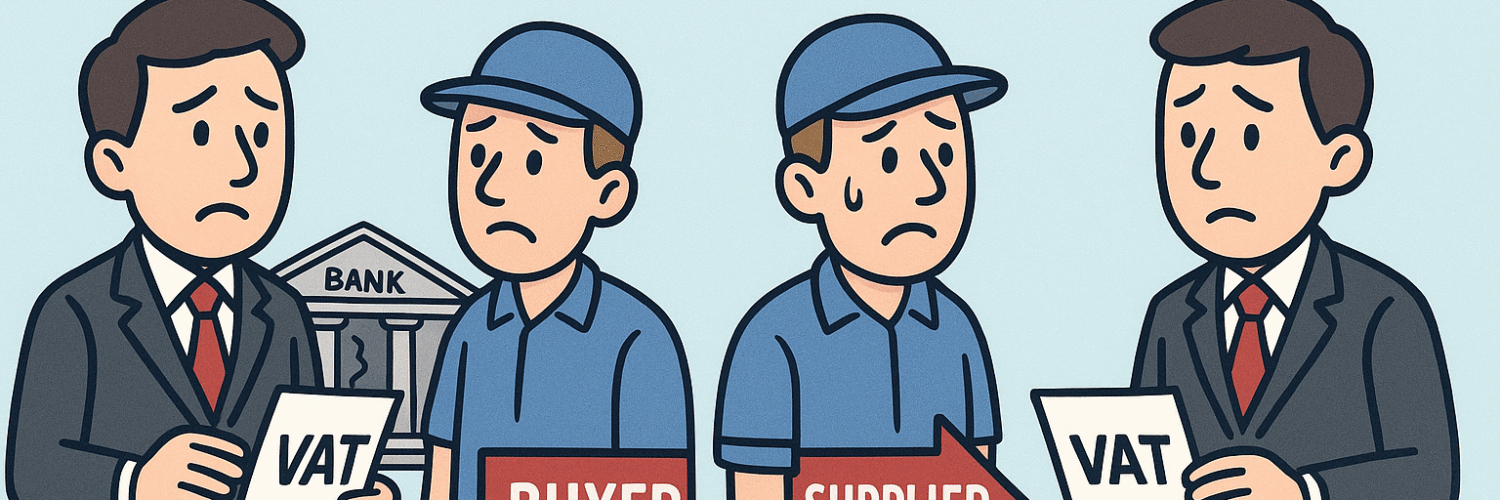
- The key difference between ECJ cases C-227/21 (HA.EN.) and C-121/24 (Vaniz) lies in the buyer’s role and the legal framework applied.
- In HA.EN., the Court upheld the buyer’s right to deduct input VAT despite the supplier’s insolvency and failure to remit VAT, emphasizing that the buyer was not involved in fraud and that denying the deduction would violate the principle of VAT neutrality.
- In contrast, Vaniz concerned the application of joint and several liability under Article 205 of the VAT Directive, where the Court allowed a Member State to hold a buyer liable for unpaid VAT if it was proven that the buyer knew or should have known the supplier would not pay.
- Thus, HA.EN. protects innocent buyers from bearing the supplier’s tax failures, while Vaniz permits liability for buyers who knowingly engage in transactions linked to VAT evasion.
Overview of Outcomes:
The two cases dealt with a similar scenario – a buyer claimed VAT while the seller failed to pay that VAT to the tax authorities – but the ECJ reached opposite outcomes because the legal context and the buyer’s conduct differed. In Case C‑227/21 (HA.EN.), the ECJ ruled that a **purchaser’s input VAT deduction cannot be denied merely because the buyer knew the seller was insolvent and likely to default on the VAT. The buyer did nothing fraudulent, so their right to deduct was upheld, preserving VAT neutrality. In Case C‑121/24 (Vaniz), by contrast, the ECJ held that a Member State may hold a purchaser jointly liable for the supplier’s unpaid VAT if – and only if – the purchaser “knew or should have known” at the time of the transaction that the VAT would go unpaid. In other words, Vaniz clarifies that a buyer who knowingly participates in or benefits from a VAT evasion can be made to pay that VAT, even after the supplier’s insolvency, whereas HA.EN. protects an innocent buyer’s VAT credit when the supplier’s non-payment is not part of any scheme or collusion. The difference in outcomes arises from the distinct legal provisions at play: HA.EN. was about the fundamental right to deduct VAT (which can only be curtailed in cases of fraud or abuse), while Vaniz was about a national anti-fraud measure (joint liability under Article 205 of the VAT Directive), which is permissible only in cases of buyer complicity. Thus, if the buyer is innocent (HA.EN.), they should not bear the tax loss; if the buyer was aware of a tax dodge (Vaniz), the law can make them share the liability.
-
Fundamental Right to Deduct: The Court reiterated that the right to deduct input VAT is a cornerstone of the VAT system. It ensures that VAT is neutral for businesses – they don’t bear the cost of VAT on inputs used for their taxable outputs. Once a business has a valid VAT invoice for a purchase used in its taxable activities, it is generally entitled to deduct that VAT. This right can be denied only in exceptional cases, primarily if the purchaser itself engaged in VAT fraud or abuse. In HA.EN.’s case, all formal requirements for deduction were met (invoice, use of the building for taxed transactions, etc.), so the default position is that the deduction is due.
-
No Fraud or Abuse by the Buyer: The ECJ carefully examined whether HA.EN.’s conduct could be considered fraudulent or an abuse of rights. The Court concluded it could not. Mere knowledge of the seller’s insolvency or likelihood of default is not equivalent to participating in fraud. There was no evidence HA.EN. intended to evade VAT or entered into a sham transaction. On the contrary, the deal had a legitimate economic purpose (HA.EN. was a creditor of the seller and acquired the property through an auction to recover debts). The VAT was properly reported; the only issue was the seller’s failure to actually pay it, which stemmed from financial collapse, not a secret agreement with HA.EN. The Court emphasized that VAT fraud typically involves elements like fake suppliers, carousel schemes, or deliberate concealment, none of which were present here. HA.EN.’s transaction was genuine, and an “abuse of law” requires something more than knowing about another party’s financial weakness. Since HA.EN. neither orchestrated a VAT evasion scheme nor profited from one (aside from the normal deduction), labeling its behavior as abusive was incorrect.
-
Neutrality and Risk Allocation: A critical principle in VAT is that the tax authority’s failure to secure payment from the supplier should not prejudice the customer’s right to deduction. The Court underscored the principle of fiscal neutrality: each taxable transaction’s VAT should be collected only once (from the supplier) and each legitimate business should be able to recover input VAT to avoid double taxation. If HA.EN.’s deduction were denied, HA.EN. would end up effectively paying the VAT out of pocket (since it paid the seller and can’t get credit) – meaning the VAT would have been collected zero times by the state, but paid once by HA.EN., breaking neutrality. The economic burden of the tax would shift from the insolvent seller (who by law was the one obligated to pay it) to the buyer, without any wrongdoing by the buyer. That outcome, the Court found, is not acceptable under EU law except in cases of fraud. Member States assume the risk that some VAT will go uncollected (e.g., due to bankruptcies), and they cannot offset that risk by trampling on the rights of honest traders. The VAT Directive provides other tools to handle such situations (for example, it allows countries to use a reverse-charge mechanism in certain cases of insolvency sales or to pursue the seller in bankruptcy proceedings), but if those aren’t used or aren’t effective, the loss falls on the public purse, not on an innocent customer.
-
“Knew or Should Have Known” Limit in Fraud Context: The tax authority tried to rely on the doctrine from cases like Kittel (ECJ case law on VAT fraud) which says a taxpayer may be denied VAT rights if they knew or should have known they were participating in a transaction connected with fraud. The ECJ clarified that doctrine applies to actual fraud schemes – for instance, buying from a supplier who is issuing fake invoices or missing trader fraud – and it prevents people from claiming VAT advantages from fraudulent transactions. HA.EN.’s scenario was outside that scope. The Court essentially said: yes, denying deductions is justified if the buyer knowingly takes part in a VAT fraud, but here there was no fraud by the seller either – the seller’s failure was openly declared insolvency, not criminal evasion. To extend the “should have known” concept to every case of potential non-payment (including insolvency) would go far beyond its purpose and would infringe legitimate rights. The ECJ refused to label the simple non-payment by a struggling business as “tax fraud” that automatically implicates the buyer who happened to be aware of the situation.
-
Article 205 Allows Joint Liability (Anti-Fraud Tool): The Court observed that Article 205 explicitly allows national laws to make someone else liable for VAT “in addition to” or “instead of” the person legally liable, as long as it’s within the conditions that State sets to ensure tax collection. This is a discretionary tool aimed at combating tax evasion and protecting revenues. The concept isn’t new – many countries have “joint liability” provisions for situations like carousel fraud or construction industry fraud. The ECJ had previously (in cases like ALTI, C‑4/20) upheld the validity of using Article 205 to go after a customer who knew the supplier wouldn’t pay. So, at a high level, the notion of holding Vaniz jointly liable was not incompatible with EU law.
-
Knowledge (“Knew or Should Have Known”) as a Precondition: The Court strongly emphasized the need for the buyer’s knowledge or complicity. It stressed that joint liability cannot be imposed on an unwitting, innocent customer. In Vaniz, the Bulgarian law itself included the “knew or should have known” test – which the ECJ approved as a proper safeguard distinguishing honest from dishonest buyers. Effectively, this imports the same standard used to deny a deduction in fraud cases: a business that knowingly enters into a transaction connected with VAT evasion cannot benefit from that transaction (whether by deduction or by not being pursued for the tax). The ECJ agreed that if Vaniz had indications that the supplier would disappear without paying VAT – for example, if Vaniz obtained an unusually low price because the supplier factored in not paying VAT, or if the supplier was a “missing trader” – then Vaniz was not a completely innocent party and could fairly be made to cover the tax. On the other hand, if Vaniz had no reasonable way to foresee the non-payment, then making it liable would be unjust. So everything hinges on proof of Vaniz’s state of knowledge at the time of purchase.
-
Timing – Post-Dissolution Liability: A novel aspect was whether it matters that the supplier had been dissolved (liquidated) by the time the tax authority went after Vaniz. Vaniz argued that once the supplier ceased to exist, holding Vaniz liable was like resurrecting a debt out of thin air, violating legal certainty. The ECJ rejected the idea that dissolution blocks joint liability. It reasoned that joint and several liability means the tax authority can pursue either debtor to get the money, and if one debtor (the supplier) is gone, the other (the buyer) still can be pursued for the full debt. In practical terms, if the conditions for Vaniz’s liability were met at the time of the transaction, the subsequent removal of the supplier from the register doesn’t erase Vaniz’s liability – it simply means Vaniz becomes the only available debtor to pay. This is consistent with the purpose of Article 205, which is precisely to ensure the VAT can be recovered from a backup party if the main debtor fails to pay. However, the Court did acknowledge that legal certainty requires that taxpayers know this risk from the start. In Bulgaria’s case, the law clearly spelled out that the buyer could be liable if they knew of the non-payment risk. So any business operating in Bulgaria was on notice of this provision. There was no retroactive surprise; the liability is considered to arise from the transaction itself (contingent on knowledge), not from a new event after the supplier’s demise.
-
Proportionality and Fair Process: The ECJ noted that joint liability must be applied proportionately. This means authorities must have evidence of the buyer’s knowledge – they can’t just automatically charge every customer of a bankrupt seller. The burden of proof is on the tax authority to show the buyer’s actual or constructive knowledge of the risk. If Vaniz can show it acted in good faith (e.g., it checked the supplier’s VAT status, market prices were normal, nothing suspicious), it should escape liability. The Court also hinted that joint liability should not become a draconian measure – it’s meant to target fraud prevention, not to make customers insurers of all tax. In this case, so long as the “knowledge” criterion is rigorously applied, the measure is proportional: it will only hit those who chose to engage with dodgy suppliers, which is a reasonable consequence to deter facilitation of VAT evasion. From a fairness standpoint, Vaniz would have the chance in national proceedings to contest the claim by arguing it had no knowledge; thus, its rights of defense are preserved.
-
Different Legal Provisions: HA.EN. turned on Article 168 of the VAT Directive (right to deduct) and the principle of VAT neutrality. The Court’s task was to prevent an unwarranted exception to that right. Vaniz turned on Article 205 (joint liability) and the need to allow effective tax collection in fraud cases. The Court’s task there was to endorse the use of that tool within proper limits. So, the context was not the same: one was examining an attempted derogation from a taxpayer right (which the Court views very restrictively), the other was examining a tool against tax evasion (which the Court views favorably if used proportionately).
-
Presence or Absence of Fraud/Collusion: This is the crux. In HA.EN., the buyer’s conduct was not fraudulent or abusive; the transaction was legitimate, and the buyer at most knew the seller might default. The ECJ therefore treated HA.EN. as deserving full protection of the law. Denying the deduction would have effectively accused the buyer of fraud without any evidence – completely unacceptable. In Vaniz, the assumption (for liability to apply) is that the buyer did have knowledge of something fishy – essentially implying Vaniz would share fault for the tax loss. If that’s proven true, then from the ECJ’s perspective, Vaniz is not an innocent party but rather akin to someone who participated in evasion (even if passively). That changes the outcome: the law can justifiably make such a person pay. In short, innocent buyer => cannot be penalized (HA.EN.); colluding/knowing buyer => can be penalized (Vaniz). The line drawn is consistent: the VAT system protects good faith but comes down hard on bad faith.
-
Policy Balance – Neutrality vs. Anti-Fraud: In HA.EN., neutrality and the integrity of the deduction system carried the day, because enforcing the tax strictly (by denying deduction) would have overshot the mark and harmed a compliant business. In Vaniz, the need to safeguard the revenue and deter tax evasion was given legal effect, because it was framed carefully to only catch those who undermined neutrality by participating in evasion. One can see the two rulings as complementary: together, they ensure that VAT is neutral for the honest but not a free ride for the dishonest. There is no contradiction – just a contextual shift. HA.EN. says: don’t punish the buyer for tax the seller didn’t pay, unless the buyer was involved in fraud. Vaniz says: if the buyer was involved (knew of the non-payment scheme), then the buyer can indeed be made to pay. Thus the outcomes differ only because HA.EN. lacked any fraud element whereas Vaniz explicitly addresses the scenario of fraud or equivalent awareness.
-
Practical Differences (Invoice vs. Aftermath): Another angle: In HA.EN., the dispute arose at the point of the buyer’s deduction claim – essentially questioning the immediate VAT treatment of a transaction. The Court refused to re-characterize a regular transaction as abusive just due to external circumstances (insolvency). In Vaniz, the issue arose after the fact when the state found itself unpaid – questioning the remedial action the state can take. The Court was willing to let the state recover the tax via the customer, but only because that customer, by hypothesis, had engaged in an abnormal transaction (one where they knew tax would go unpaid). So the transactions themselves were of a different nature: HA.EN.’s was normal and above-board, Vaniz’s (if the premise is met) involved an abnormal element (knowledge of evasion). This justifies why one leads to a straightforward application of neutrality (HA.EN.), and the other activates anti-evasion measures (Vaniz).
-
No VAT Credit Denial Without Fraud: Tax authorities in any EU country should not deny a business its input VAT deduction unless they have solid proof that the business engaged in tax fraud or abuse. Financial misfortune of the supplier or administrative failures should not be dumped on the customer. This maintains trust and predictability in the VAT system. Businesses can engage in commerce without fearing that a partner’s bankruptcy will retroactively cost them VAT. It also encourages tax authorities to use preventive measures (like requiring problematic suppliers to give a bank guarantee, or implementing reverse charge in risky sectors) rather than taking shortcuts by disallowing deductions. The HA.EN. case thus reinforces the primacy of the neutrality principle: VAT is a tax on final consumers, not on businesses – and the ECJ will intervene if authorities try to shift the burden inappropriately onto businesses.
-
Empowering Tools Against VAT Evasion: On the flip side, the Vaniz ruling empowers Member States to combat VAT fraud more aggressively, within limits. Article 205 is now confirmed as a viable mechanism to ensure the VAT gets paid in the end by someone involved in the transaction, even if the main taxpayer evades. This is especially relevant in sectors or schemes where fraudsters intentionally use intermediary companies that go bust – a common tactic in carousel fraud, for instance. Member States may feel encouraged to adopt or strengthen joint liability provisions, knowing that as long as they target cases of knowing participation, the ECJ will back them. It closes a loophole: you cannot simply say “I got a valid invoice and deducted VAT” if in reality you colluded with a supplier who was never going to pay that VAT. The judgment does caution that such rules must be clear and proportionate – so Member States must define carefully the scenarios (like Bulgaria did) and ensure taxpayers have a fair opportunity to defend themselves. But within those boundaries, it’s a green light to go after “VAT accomplices.”
-
Diligence and Compliance Culture: For businesses, these decisions together send a message: do your homework on your trading partners. If you unwittingly transact with a fraudulent business, HA.EN. shows that you will be protected (you keep your deduction). But Vaniz shows that if there were red flags you ignored (“should have known”), you might end up paying their VAT. In practice, this likely means companies will want to document their due diligence – checking VAT IDs, avoiding unusually beneficial deals without economic explanation, etc. – to demonstrate they had no knowledge of any potential non-payment. It also means that in industries where joint liability rules exist (like construction or scrap trading in some countries), honest companies might even help tax authorities by reporting suspicious offers or refusing to deal with high-risk suppliers, since otherwise they could get hit with joint liability.
-
Harmonization vs. National Autonomy: These cases illustrate how EU law strikes a balance: certain aspects are fully harmonized (like the right to deduct, which is uniform across the EU), whereas others allow national variation (like how to implement joint liability or other anti-fraud measures). The ECJ ensures the harmonized part (deduction) is uniformly protected (HA.EN. applies union-wide), and it ensures the variable part (joint liability) doesn’t conflict with fundamental EU principles (Vaniz sets conditions that any national law must meet, but otherwise leaves it to national law). The implication is that we’ll continue to see a uniform shield for bona fide taxpayers and a controlled flexibility for anti-fraud enforcement. Member States contemplating stricter VAT enforcement know they must always incorporate the “knew or should have known” standard to pass muster, as a result of Vaniz.
Latest Posts in "European Union"
- EU Updates E-Invoicing Standard and Proposes Major Financial Sector Tax Reforms
- EU Approves EN 16931 E-Invoicing Updates, Proposes Financial Sector Tax Harmonization Reforms
- AG: Director Must Be Able to Appeal VAT Assessments Imposed on Company Under EU Law
- Andrés Ritter Appointed as New European Chief Prosecutor, Succeeding Kövesi in November 2026
- Reduced Hotel VAT Rate May Exclude Extras Like Breakfast, Parking, Wellness, Fitness, and WiFi