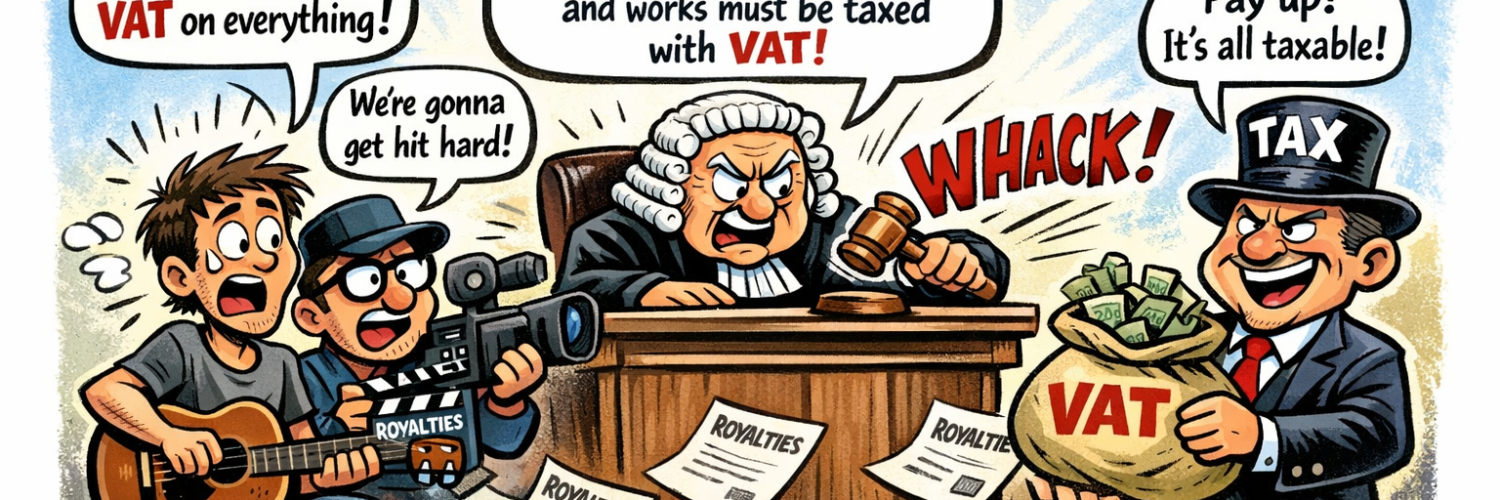
On February 11, 2026, the General Court released the Judgment in the case T-643/24 (Credidam).
Context: Reference for a preliminary ruling – Taxation – Value added tax (VAT) – Article 2(1)(c), Article 24(1) and Article 25 of Directive 2006/112/EC – Concept of ‘supply of services for consideration’ – Collective management of copyright – Fee for the communication to the public of protected musical works – Surcharge applied in the absence of a licence – Article 73 of Directive 2006/112 – Taxable amount – Concept of ‘consideration’
Summary
- Factual Background
The case concerns Credidam’s claim that Cristian General Serv communicated phonograms and audiovisual works to the public without a licence. Under Romanian law and the related methodology, remuneration for unlicensed use is calculated as three times the standard licence fee. - Questions Referred
The Court of Appeal Bucharest asked whether right‑holders provide a taxable supply of services when works are used without a licence. It also asked whether VAT applies only to the normal remuneration or also to the tripled amount imposed for unlicensed use. - Court’s Legal Assessment
The General Court examined whether a “supply of services for consideration” exists under Articles 2(1)(c), 24(1), 25(a),(c), 73 and 78(a) of Directive 2006/112. It found that the legal framework creates a direct link between the user’s act of communication and the remuneration owed, even without prior contractual agreement. - Decision
The Court held that holders of related rights do supply services for consideration when their protected works are communicated to the public without a licence. It further ruled that VAT applies to the entire remuneration, including the surcharge resulting from unlicensed use. - The Court reasoned that EU VAT rules apply regardless of whether the underlying transaction was lawful or unlawful, to ensure fiscal neutrality. It also held that the tripled remuneration forms part of the taxable consideration because it directly reflects the legal framework governing the supply of the protected works.
Articles in the EU VAT Directive
Article 2
1. The following transactions shall be subject to VAT:
(c) the supply of services for consideration within the territory of a Member State by a taxable person acting as such;
Article 24
1. ‘Supply of services’ shall mean any transaction which does not constitute a supply of goods.
Article 25
A supply of services may consist, inter alia, in one of the following transactions:
(a) the assignment of intangible property, whether or not the subject of a document establishing title;
Article 28
Where a taxable person acting in his own name but on behalf of another person takes part in a supply of services, he shall be deemed to have received and
supplied those services himself.
Article 73
In respect of the supply of goods or services, other than as referred to in Articles 74 to 77, the taxable amount shall include everything which constitutes consideration obtained or to be obtained by the supplier, in return for the supply, from the customer or a third party, including subsidies directly linked to the price
of the supply.
Article 79
The taxable amount shall not include the following factors:
(a) price reductions by way of discount for early payment;
(b) price discounts and rebates granted to the customer and obtained by him at the time of the supply;
(c) amounts received by a taxable person from the customer, as repayment of expenditure incurred in the name and on behalf of the customer, and entered in his
books in a suspense account.
Facts & Background
- Parties Involved: The case involves the Romanian Centre for the Administration of Performing Artists’ Rights (CREDIDAM), a collective management organization responsible for collecting and distributing remuneration for performing artists’ rights, and Cristian General Serv SRL, a Romanian company that owns a three-star rated tourist guesthouse.
- Claim Initiation: CREDIDAM initiated proceedings on November 25, 2022, against Cristian General Serv SRL, seeking compensation for the unauthorized communication of phonograms and artistic performances that occurred in the guesthouse from October 1, 2019, to December 31, 2022. The claim included a demand for three times the remuneration due to performing artists, along with VAT.
- Initial Judgment: On April 19, 2023, the Tribunalul București dismissed CREDIDAM’s claim as unfounded. The court found that Cristian General Serv SRL did not conduct any commercial activity during the relevant period, and thus, did not communicate the protected works to the public. The court also noted that a space owned by the defendant had been removed in February 2023.
- Appeal Process: CREDIDAM appealed the decision, arguing it had demonstrated that the defendant had indeed communicated to the public. The appeal was registered with the Curtea de Apel București, which raised the issue of whether VAT should apply to the compensation claimed under tortious civil liability.
- Referral to CJEU: The Curtea de Apel considered the need for a preliminary ruling from the Court of Justice of the European Union (CJEU) regarding the classification of the compensation as a taxable supply of services under EU VAT law, particularly in light of the defendant’s claims that the amounts were not subject to VAT as per the Romanian Tax Code.
Questions
(1) On a proper construction of Article 2(1)(c), Article 24(1), and Article 25(a) of Directive 2006/112/EC, do holders of related rights carry out a supply of
services for consideration where the user carries out a communication to the public of protected works in the absence of a licence to that effect?
(2) Does the answer to the first question depend on whether, under national law, the holder of such a related right is not able to object to the uses, being entitled
only to the single equitable remuneration, or does it depend on the method of calculation used in determining the amounts due?
AG Opinion
(1) Article 2(1)(c), Article 24(1) and Article 25(b) and (c) of Council Directive 2006/112/EC of 28 November 2006 on the common system of value added tax
must be interpreted as meaning that the regulatory obligation to tolerate, in return for a fee, the communication of protected works to the public by a user, who has not previously obtained the licence required for that purpose, must be classified as a ‘supply of services for consideration’.
(2) Article 2(1)(c) of Directive 2006/112, read in conjunction with Article 73 of that directive,
must be interpreted as meaning that the remuneration, which is payable for the communication of protected works to the public, which consists of a basic fee and a surcharge applied where a licence has not been obtained prior to that communication, may be classified as ‘consideration’, which it is for the referring court to ascertain, in particular in the light of the legal basis and the purpose of that remuneration.
Decision
Article 2(1)(c), Article 24(1), Article 25(a) and (c), Article 73 and point (a) of the first paragraph of Article 78 of Council Directive 2006/112/EC of 28 November 2006 on the common system of value added tax
must be interpreted as meaning that:
- holders of related rights supply services for consideration when their protected works are communicated to the public by a user who does not have a licence for that purpose, notwithstanding the fact that, first, they cannot oppose such communication and, secondly, their remuneration results from national law as well as the regulatory provisions to which that law refers;
- value added tax applies to the total remuneration due to holders of related rights for that supply of services, including the portion of that remuneration that exceeds the remuneration that that user would have been liable for if they had held a licence.
Source
Reference to other ECJ Cases
Cases on whether there is a taxable supply of services for consideration
- Suzlon Wind Energy Portugal, C‑605/20 (24 Feb 2022) – Defines when a service is “for consideration”: there must be a legal relationship with reciprocal performance and a direct link between the service and the payment (para 62).
Used to frame the Article 2(1)(c)/24/25 test. - Apcoa Parking Danmark, C‑90/20 (20 Jan 2022) – Even regulated usage (paid parking) creates the legal relationship; surcharges called “penalties” under national law can still be consideration and be subject to VAT (paras 28–34, 39–46).
Supports that “unlicensed” use doesn’t prevent a direct link/consideration and that surcharges can be part of the taxable amount. - Fluvius Antwerpen, C‑677/21 (27 Apr 2023) – Illegal electricity consumption: compensation for the undue advantage is consideration and subject to VAT (paras 30–32).
Parallels unlicensed communication of works: payment owed due to the use is still VAT‑able consideration. - UCMR – ADA, C‑501/19 (21 Jan 2021) – Collective management and statutory frameworks do not break the direct link; a CMO collecting on behalf of rightholders fits Article 25(c) (“performance of services … in pursuance of the law”) (para 37).
Directly supports treating statutory remuneration as consideration for a service. - Credidam, C‑179/23 (4 Jul 2024) – The legislative framework itself can establish the direct link between the service and the obligation to pay; Article 25(c) covers services performed under the law (para 40).
Applies to the Romanian statutory “single equitable remuneration” and its regulated calculation. - SAWP, C‑37/16 (18 Jan 2017) – Earlier related‑rights context; cited by the referring court as distinguishable.
The GC notes the factual differences but keeps the focus on the direct‑link and consideration analysis in current case.
Cases on admissibility / presumption of relevance of references
- Global Ink Trade, C‑537/22 (11 Jan 2024) – Reaffirms that referred questions are presumed relevant; the Court only refuses when manifestly unrelated or hypothetical (para 20).
Used to accept the reference despite factual disputes in the national case. - NARE‑BG, C‑429/23 (12 Sep 2024) – Cited (para 42) by analogy on the presumption of relevance and scope for answering where national facts are for the referring court to establish.
Supports proceeding to answer notwithstanding open factual points.
Cases on the taxable amount (Article 73 and Article 78(a) VAT Directive)
- Efir, C‑19/12 (7 Mar 2013) – The taxable amount is the subjective consideration actually received, expressed in money; not an objective estimate (para 41).
Grounds that what counts is the price fixed by law for the actual unlicensed use. - Dyrektor Izby Administracji Skarbowej w Bydgoszczy (Incorrect rate), C‑606/22 (21 Mar 2024) – VAT is not part of the taxable amount (Art. 78(a)); the agreed price is VAT‑inclusive for the payer (para 27).
Reinforces how the legal “price” interacts with VAT calculus. - Apcoa Parking Danmark, C‑90/20 (20 Jan 2022) – (also listed above) expressly treats surcharges/penalties as consideration where they arise from using the service under the legal framework (paras 30–34, 46).
Analogous to the Romanian methodology’s triple remuneration for unlicensed use. - Fluvius Antwerpen, C‑677/21 (27 Apr 2023) – (also listed above) compensation equal to the undue advantage is VAT‑able (para 32).
Backs VAT on the tripled remuneration as part of consideration.
What the Court did with these authorities (in a nutshell)
- Supply for consideration exists even for unlicensed communication of protected works when the national legal framework (collective management, statutory remuneration) creates the reciprocal relationship and direct link (Art. 25(c)). The fact no licence was granted and that rightholders cannot oppose certain uses doesn’t negate VAT taxation.
- The taxable amount is the price fixed by law for unlicensed use—here, three times the licensed remuneration per the Romanian methodology—because that surcharge flows directly from the service relationship and thus forms part of the consideration. VAT is charged on that total (exclusive of VAT itself).
- Join the Linkedin Group on ECJ/CJEU/General Court VAT Cases, click HERE
- VATupdate.com – Your FREE source of information on ECJ VAT Cases
- Podcasts & briefing documents: VAT concepts explained through ECJ/CJEU cases on Spotify
Latest Posts in "European Union"
- ECG T-96/26 (TellusTax Advisory) – Questions – VAT deductions in the event of different VAT treatment between Member States
- VIDA Measures applicable from 1 January 2027
- Agenda of the ECJ/General Court VAT cases – 7 Judgments and 2 Hearings till March 25, 2026
- Comments on T-638/24: Double dip alert – an incorrect invoice can create multiple VAT liabilities
- VAT IOSS Scheme: Intermediary Registration Available from April 2026 for Non-EU Businesses